Topic 8.7 Notes – pH and pKa
1. What pKa Means and How It Connects to pH
p-notation refresher
In AP Chem, “p” just means negative log.
Lower pKa → larger → stronger acid.
Because this is a log scale:
- A difference of 1 pKa unit = 10× difference in .
- If Acid 1 has pKa 3 and Acid 2 has pKa 5, Acid 1 is 100× stronger.
Ka expression for a weak acid
For a weak acid:
This ratio tells you how much acid dissociates.
Henderson-Hasselbalch equation
If you rearrange the Ka expression and take the negative log, you get:
This equation connects:
- pH of the solution
- pKa of the acid
- Ratio of base to acid
Even if you forget the equation, you can derive it from the Ka expression. That skill shows up in FRQs.
The key idea hiding inside this equation is simple:
the ratio determines which form dominates.
That leads to the rule you absolutely need to know.
2. The pH vs pKa Rule for Predominant Form
This is the core concept.
What happens at different pH values?
| Condition | Math Result | Predominant Form |
|---|---|---|
| pH < pKa | HA (protonated acid form) | |
| pH = pKa | 50% HA, 50% A⁻ | |
| pH > pKa | A⁻ (deprotonated base form) |
Here’s why:
- If pH < pKa → the log term must be negative → numerator smaller than denominator → more HA.
- If pH > pKa → log term positive → more A⁻.
This shows up constantly in multiple choice questions where they give you a pH and a pKa and ask which form dominates. You rarely need heavy math. Just compare the numbers.
3. Applying the Rule to Weak Acids and Weak Bases
Weak acids (HA)
Usually you’re given pKa directly.
Example idea:
If an acid has pKa = 6.2 and the solution pH is 8.0:
- 8.0 > 6.2
- Deprotonated form predominates.
That’s it. No ICE table needed unless they specifically ask for concentrations.
Weak bases (B)
Weak bases are usually given with Kb, not pKa.
You have to work with the conjugate acid.
Step-by-step:
- Write conjugate acid:
- Convert:
- Compare solution pH to that pKa.
Example setup:
If :
- pKb = 6
- pKa = 14 − 6 = 8
If solution pH = 6:
- 6 < 8
- Protonated form predominates.
Remember at 25°C:
Students often forget to convert to pKa before applying the rule. That’s a common trap.
4. Buffers and Why pH = pKa Matters
A buffer contains a weak acid and its conjugate base.
From Henderson-Hasselbalch:
Strongest buffering condition
When:
Then log(1) = 0, so:
On a titration curve, this occurs at the half-equivalence point. For a weak acid titrated with a strong base, it is halfway to the equivalence volume in the buffer region of the curve.
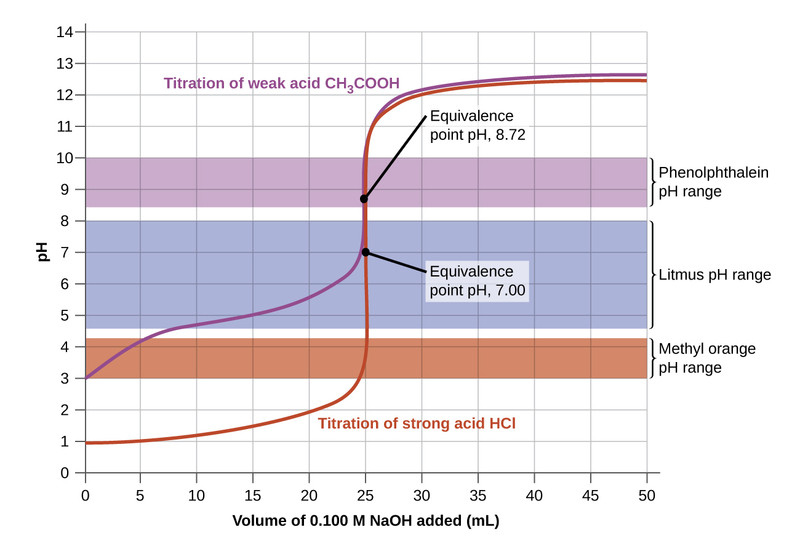
On the weak acid curve shown, the half-equivalence point lies in the middle of the gently sloping buffer region, before the steep vertical rise.
At half-equivalence:
- Equal acid and base
- Maximum buffering capacity
Effective buffer range
Buffers work best when:
- pH is within ±1 of pKa
Outside that range, one form dominates too much and buffering weakens.
5. Acid-Base Indicators
An indicator is usually a weak acid:
- and have different colors.
- The color depends on which form predominates.
When pH ≈ pKa of the indicator:
- Both forms present in noticeable amounts
- Color change occurs
Choosing an indicator
For a titration:
- Find the equivalence point pH.
- Choose an indicator whose pKa is close to that pH.
- Effective transition range ≈ pKa ± 1.
You don’t memorize specific indicators for AP. You justify the choice using pH vs pKa logic.
Key Takeaways
p Notation
A quantity written as the negative base-10 logarithm of a value, such as pH or pKa.
pKa and Acid Strength
Lower values mean larger Ka and a stronger acid on a logarithmic scale.
pKa and pKb Relationship
For a conjugate acid-base pair in water at 25°C, their values add to 14.
Henderson-Hasselbalch Equation
pH = pKa + log([A−]/[HA]), relating solution pH to conjugate base-to-acid ratio.
pH vs. pKa Rule
If pH < pKa, HA predominates; if pH > pKa, A− predominates; if equal, concentrations match.
Predominant Form of a Weak Base
Compare solution pH to the pKa of its conjugate acid to predict protonated versus unprotonated form.
Effective Buffer Range
A buffer works best when solution pH is within about 1 unit of the pKa.
Acid-Base Indicators
Weak acids or bases whose protonated and deprotonated forms have different colors or properties.
Indicator Transition Range
Color change occurs mainly over about pKa ± 1, where both indicator forms are present.
Choosing an Indicator for a Titration
Select one whose pKa or transition range is close to the equivalence-point pH.
pH = pKa Condition
When conjugate acid and base concentrations are equal, neither form predominates and buffering is strongest.
Notes
p Notation
A quantity written as the negative base-10 logarithm of a value, such as pH or pKa.
pKa and Acid Strength
Lower values mean larger Ka and a stronger acid on a logarithmic scale.
pKa and pKb Relationship
For a conjugate acid-base pair in water at 25°C, their values add to 14.
Henderson-Hasselbalch Equation
pH = pKa + log([A−]/[HA]), relating solution pH to conjugate base-to-acid ratio.
pH vs. pKa Rule
If pH < pKa, HA predominates; if pH > pKa, A− predominates; if equal, concentrations match.
Predominant Form of a Weak Base
Compare solution pH to the pKa of its conjugate acid to predict protonated versus unprotonated form.
Effective Buffer Range
A buffer works best when solution pH is within about 1 unit of the pKa.
Acid-Base Indicators
Weak acids or bases whose protonated and deprotonated forms have different colors or properties.
Indicator Transition Range
Color change occurs mainly over about pKa ± 1, where both indicator forms are present.
Choosing an Indicator for a Titration
Select one whose pKa or transition range is close to the equivalence-point pH.
pH = pKa Condition
When conjugate acid and base concentrations are equal, neither form predominates and buffering is strongest.
