Topic 3.11 Notes – Spectroscopy and the Electromagnetic Spectrum
1. What Electromagnetic Radiation Is
Electromagnetic (EM) radiation behaves as both a wave and a particle. You need both ideas to understand spectroscopy.
Wave behavior
Two properties describe a wave:
Wavelength (λ)
Distance between repeating points like peak-to-peak.Frequency (ν)
Number of waves passing a point per second (units = Hz or s⁻¹).
This diagram shows how wavelength is measured along a wave (and also labels amplitude for reference):
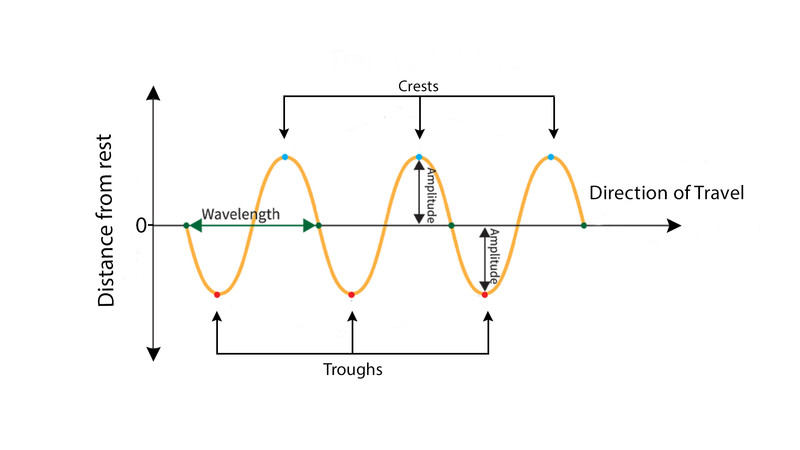
Basic wave properties: wavelength and amplitude
These two are linked by:
- (speed of light)
- If increases, decreases.
- Short wavelength → high frequency.
Particle behavior
Light also comes in packets called photons.
Each photon has energy:
- Higher frequency → higher energy photon.
Combine the equations and you see:
- Shorter → higher → higher
That energy is what drives molecular and electronic changes.
The key idea
Atoms and molecules have quantized energy levels. They can only absorb or emit energy in specific amounts.
A photon will only be absorbed if:
No exact match, no transition. That’s a favorite conceptual test question.
2. The Regions of the Electromagnetic Spectrum
Ordered from highest energy / shortest wavelength to lowest energy / longest wavelength:
- Gamma rays
- X‑rays
- Ultraviolet (UV)
- Visible
- Infrared (IR)
- Microwaves
- Radio waves
Trends to lock in
- Moving from gamma rays toward radio waves (high energy to low):
- Wavelength increases
- Frequency decreases
- Energy decreases
Visible light is only a tiny slice of the spectrum, about 400-700 nm:
- Violet ≈ shortest λ (highest energy in visible)
- Red ≈ longest λ (lowest energy in visible)
For AP Chem, the three most important regions are:
- Microwaves
- Infrared
- UV/Visible
Each corresponds to a different type of transition.
3. Types of Energy Transitions and Their Spectral Regions
Energy spacings in molecules are not all the same size. Smaller gaps require lower-energy radiation.
a. Rotational Transitions - Microwaves
- Involve whole molecules rotating
- Very small energy differences
- Observed mostly in gas phase
Microwave photons provide just enough energy to move between rotational levels.
Small gap → low energy → long wavelength.
b. Vibrational Transitions - Infrared
- Involve bond vibrations
- Stretching
- Bending
- Bonds behave like tiny springs.
Infrared radiation excites molecules to higher vibrational levels.
Important connection for class:
- Different bonds absorb characteristic IR frequencies.
- That’s how IR spectroscopy identifies functional groups.
Vibrational energy gaps are larger than rotational ones, so IR has more energy than microwaves.
c. Electronic Transitions - Ultraviolet and Visible
- Involve electrons moving between energy levels
- Much larger energy gaps
- Usually valence electrons
UV/visible photons promote electrons to higher electronic states.
Why substances have color:
- They absorb certain visible wavelengths.
- The remaining transmitted or reflected light is what you see.
Electronic transitions require the most energy of the three.
4. Absorption and Emission of Photons
Two processes matter:
Absorption
- Photon is absorbed.
- System moves to a higher energy level.
- Photon energy equals the energy gap.
Emission
- Excited state relaxes.
- Photon is released.
- Emitted photon energy equals the energy difference.
Here’s the energy picture. Focus on the upward arrow for absorption and the downward arrow for emission, with in both cases.
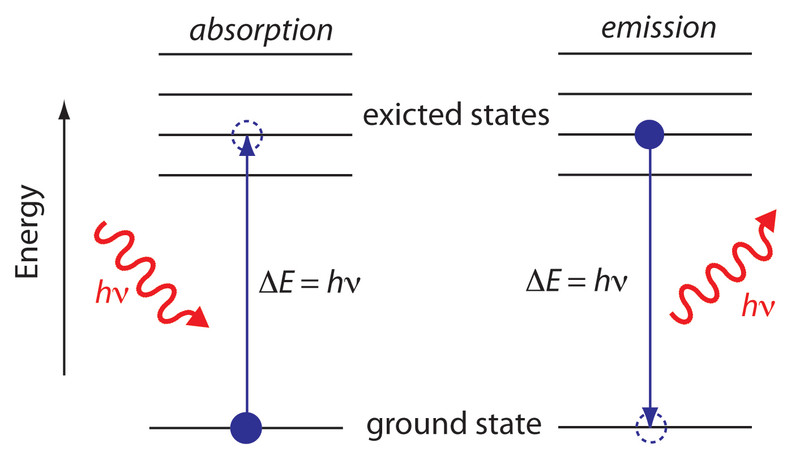
Energy-level diagram for absorption and emission
On exams, they love asking which region matches a given transition type. Think in terms of energy gap size, not memorized trivia.
Small gap → microwave → rotation
Medium gap → IR → vibration
Large gap → UV/visible → electronic
5. Big Picture Relationship
Memorize this order of increasing energy:
Rotation < Vibration < Electronic
Which matches:
Microwave < Infrared < UV/Visible
If you understand that the spectrum maps directly onto the size of the energy gap, everything in this topic falls into place.
Key Takeaways
Electromagnetic Radiation / Radiant Energy
Energy that travels through space as oscillating electric and magnetic waves.
Photon
A discrete packet of electromagnetic energy absorbed or emitted by matter.
Wave-Particle Duality
The idea that light behaves as both a wave and a particle.
Electromagnetic Spectrum
The full range of electromagnetic radiation, ordered by wavelength or frequency.
Spectroscopy
The study of how matter absorbs, emits, or interacts with electromagnetic radiation.
Absorption and Emission Spectra
Patterns formed when matter absorbs specific wavelengths or emits photons at specific wavelengths.
Wavelength, Frequency, and c = λν
Wavelength and frequency are inversely related and connected by c = λν.
Spectral Regions and Energy Transitions
Microwaves cause rotational changes, infrared causes vibrational changes, and UV-visible causes electronic changes.
Notes
Electromagnetic Radiation / Radiant Energy
Energy that travels through space as oscillating electric and magnetic waves.
Photon
A discrete packet of electromagnetic energy absorbed or emitted by matter.
Wave-Particle Duality
The idea that light behaves as both a wave and a particle.
Electromagnetic Spectrum
The full range of electromagnetic radiation, ordered by wavelength or frequency.
Spectroscopy
The study of how matter absorbs, emits, or interacts with electromagnetic radiation.
Absorption and Emission Spectra
Patterns formed when matter absorbs specific wavelengths or emits photons at specific wavelengths.
Wavelength, Frequency, and c = λν
Wavelength and frequency are inversely related and connected by c = λν.
Spectral Regions and Energy Transitions
Microwaves cause rotational changes, infrared causes vibrational changes, and UV-visible causes electronic changes.
