Topic 2.4 Notes – Structure of Metals and Alloys
1. Metallic Bonding and the Sea of Electrons
A metallic solid is best pictured as a lattice of positive metal ions (cations) surrounded by a cloud of delocalized valence electrons.
Here’s the classic model you need to recognize and draw:
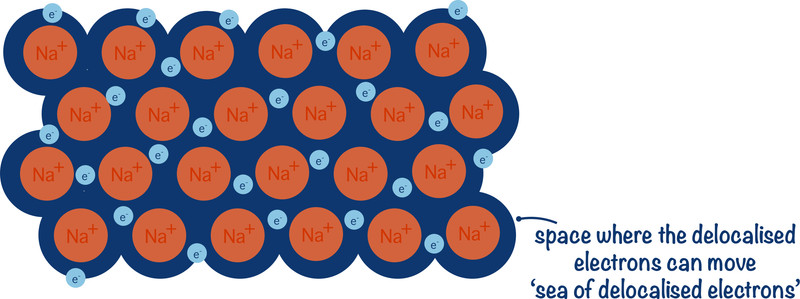
Metallic bonding model with delocalized “sea” of electrons
What That Means Structurally
- The nucleus + core electrons of each metal atom stay fixed in position.
- The valence electrons are delocalized, meaning they are not attached to one specific atom.
- These mobile electrons move throughout the entire solid.
- The attraction between the positively charged ions and the negatively charged electron “sea” holds the metal together. That attraction is the metallic bond.
If you ever need to represent this on an FRQ, you must show:
- An ordered array of positive ions
- A surrounding cloud or dots showing mobile electrons
- Some indication that electrons are shared across the whole solid, not between two atoms
Why Metals Have Their Characteristic Properties
The structure directly explains the properties. Always connect structure → particle motion → property.
Electrical conductivity
- The delocalized electrons can move when a voltage is applied.
- These mobile electrons carry charge through the solid.
- Metals conduct electricity as solids.
Thermal conductivity
- Mobile electrons transfer kinetic energy quickly from one region to another.
Malleability and ductility
- Cation layers can slide past each other.
- Because the electrons are delocalized, shifting the ions does not break specific directional bonds.
- The electron sea simply redistributes.
Variable melting points
- Stronger metallic bonding occurs when there are more valence electrons available or higher positive ion charge.
- More attraction → more energy required to separate particles.
Students often confuse this with ionic bonding. In ionic solids, positive and negative ions are locked in place and shifting layers causes like charges to line up and repel. Metals do not have that problem because of the flexible electron sea.
2. Types of Alloys
An alloy is a mixture of two or more elements, at least one of which is a metal, that still has metallic bonding and metallic properties.
The key factor that determines the type of alloy is relative atomic size.
Interstitial Alloys
These form when small atoms fill the holes (interstitial spaces) between larger metal atoms. In the rightmost diagram below, the small green atoms sit in the gaps between the larger red metal atoms.
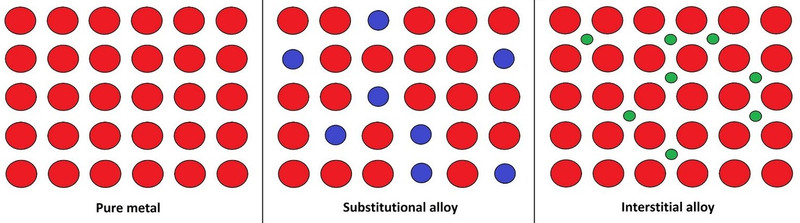
Pure metal vs substitutional alloy vs interstitial alloy
- Requires a large size difference between atoms.
- The original metal lattice remains mostly intact.
- Classic example: carbon in iron (steel).
Effect on properties
- Increased hardness and strength
- Decreased malleability
- Small atoms distort the lattice and make it harder for metal ions to slide
Think “added into gaps.”
Substitutional Alloys
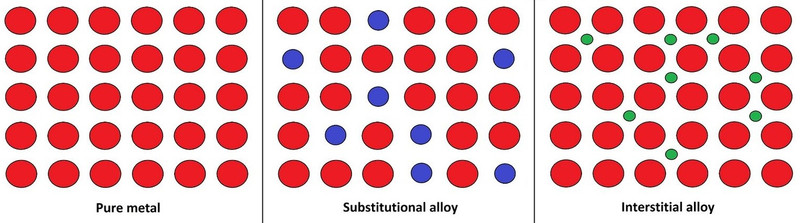
These form when atoms of similar atomic radius replace metal atoms in the lattice. In the middle diagram above, some atoms of similar size take the place of the original metal atoms.
- Requires comparable atomic size.
- One atom substitutes for another.
- Example: zinc replacing copper in brass.
Effect on properties
- Retain good conductivity (still have delocalized electrons)
- Often harder than pure metal
- Properties depend on composition ratio
Think “replaced, not inserted.”
Interstitial vs Substitutional Alloys
| Feature | Interstitial | Substitutional |
|---|---|---|
| Atomic size | Very different | Similar |
| What happens in lattice | Small atoms fill gaps | Atoms replace host atoms |
| Example | C in Fe (steel) | Zn in Cu (brass) |
| Effect on hardness | Large increase | Moderate increase |
3. How Metallic Structure Explains Conductivity
This is a common quiz question.
Metallic solids
- Conduct electricity in the solid state.
- Charge carriers are mobile electrons.
Ionic solids
- Do not conduct as solids because ions are fixed in place.
- Conduct when molten or dissolved in water, when ions become mobile.
If you’re asked why iron conducts but does not, your answer must mention mobile charge carriers and identify them correctly.
4. What You Must Be Able to Represent
You should be able to:
- Draw a metallic solid with:
- Array of positive ions
- Delocalized electron sea
- Draw an interstitial alloy with small atoms in gaps
- Draw a substitutional alloy with atoms replaced
Use precise terms like delocalized valence electrons, array of cations, interstitial spaces, and substitution. The scoring often depends on those exact ideas.
Key Takeaways
Alloy
A mixture of elements, at least one a metal, that forms a metallic solid with altered properties.
Steel
An interstitial alloy of iron and carbon in which carbon occupies spaces in the iron lattice.
Brass
A substitutional alloy, usually copper and zinc, in which zinc replaces some copper atoms.
Metallic Bonding
Electrostatic attraction between metal cations and mobile, delocalized valence electrons.
Interstitial Vs. Substitutional Alloys
Small atoms fill gaps in one type, while similar-sized atoms replace lattice atoms in the other.
Notes
Alloy
A mixture of elements, at least one a metal, that forms a metallic solid with altered properties.
Steel
An interstitial alloy of iron and carbon in which carbon occupies spaces in the iron lattice.
Brass
A substitutional alloy, usually copper and zinc, in which zinc replaces some copper atoms.
Metallic Bonding
Electrostatic attraction between metal cations and mobile, delocalized valence electrons.
Interstitial Vs. Substitutional Alloys
Small atoms fill gaps in one type, while similar-sized atoms replace lattice atoms in the other.
