Topic 1.8 Notes – Valence Electrons and Ionic Compounds
1. Valence Electrons and Why They Control Reactivity
Valence electrons are the outermost electrons of an atom. For main‑group elements, these are the electrons in the highest energy level (usually the s and p orbitals).
These electrons determine:
- How an atom reacts
- What bonds it forms
- What charge it takes as an ion
Atoms bond because of attractions between nuclei and valence electrons. If two atoms can lower their potential energy by interacting, a bond forms.
Most atoms tend to achieve a full valence shell. For main‑group elements, that usually means 8 valence electrons (the octet rule). Noble gases already have this, which explains why they are so unreactive.
Finding Valence Electrons from the Periodic Table
For main‑group elements:
- Group 1 → 1 valence electron
- Group 2 → 2
- Group 13 → 3
- Group 14 → 4
- Group 15 → 5
- Group 16 → 6
- Group 17 → 7
- Group 18 → 8 (full shell)
A graph of ionization energy also reveals valence electrons. When you see a huge jump between removing one electron and the next, that jump means you started removing a core electron. The number removed before the jump equals the number of valence electrons. That pattern shows up in FRQs.
Because elements in the same group have the same number of valence electrons, they form analogous compounds. For example:
- , ,
- ,
Same group → same valence electrons → similar bonding behavior.
2. Periodic Trends and Reactivity
Reactivity depends on how strongly a nucleus attracts electrons and how easily valence electrons are removed.
Metals
- Low electronegativity
- Lose electrons → form cations
- Reactivity increases down a group
Down a group, valence electrons are farther from the nucleus and shielded by inner electrons. Easier to remove → more reactive metal.
That’s why cesium is more reactive than lithium.
Nonmetals
- High electronegativity
- Gain electrons → form anions
- Reactivity increases up a group
Up a group, atoms are smaller and attract electrons more strongly. Fluorine is extremely reactive because it strongly pulls in electrons.
Electronegativity and Bond Formation
Electronegativity measures how strongly an atom attracts electrons in a bond.
Trend:
- Increases left → right
- Increases bottom → top
- Fluorine is highest.
Bond type depends on electronegativity difference:
- Large difference → ionic
- Small difference → covalent
It’s about how strongly one nucleus pulls on another atom’s valence electrons.
3. Typical Ionic Charges and How to Predict Them
Atoms form ions to achieve a full valence shell.
Here’s the pattern for main‑group elements:
| Group | Valence Electrons | Typical Charge | Why |
|---|---|---|---|
| 1 | 1 | +1 | Loses 1 to reach full shell |
| 2 | 2 | +2 | Loses 2 |
| 13 | 3 | +3 | Loses 3 |
| 15 | 5 | −3 | Gains 3 |
| 16 | 6 | −2 | Gains 2 |
| 17 | 7 | −1 | Gains 1 |
| 18 | 8 | 0 | Already stable |
Transition metals are less predictable and can have multiple charges. On the AP exam, you’ll usually be given the charge if needed.
Forming Neutral Ionic Compounds
Compounds must be electrically neutral.
Example: aluminum and oxygen.
- Al → +3
- O → −2
- Balance total charge:
Formula:
If you ever see +2 and −1, think 1:2 ratio. +1 and −2, think 2:1. This logic shows up constantly in MCQs.
4. Ionic vs Covalent Bonding and Charge Distribution
Ionic Bonding
- Electron transfer
- Metal + nonmetal
- Full positive and negative charges
- Strong electrostatic attraction
Properties:
- High melting points
- Conduct electricity when molten or dissolved
- Often water soluble
Classic example:
Magnesium loses two electrons. Chlorine gains them.
Covalent Bonding
- Electron sharing
- Usually nonmetal + nonmetal
Two types:
Nonpolar Covalent
- Similar electronegativities
- Equal sharing
- No partial charges
Polar Covalent
- Moderate electronegativity difference
- Unequal sharing
- Partial charges (δ+ and δ−)
Compare the three situations below. Focus on how the electrons are distributed and whether the atoms carry partial or full charges.
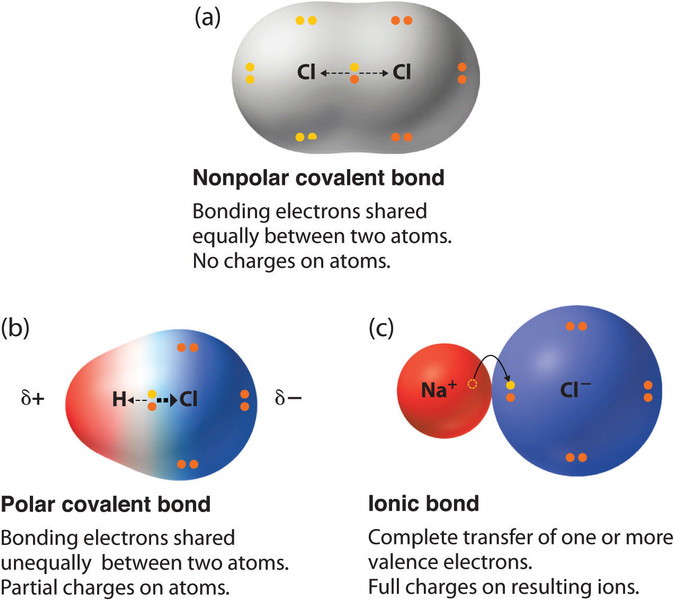
Electron distribution in nonpolar, polar, and ionic bonds
In the nonpolar case, electrons are shared evenly. In the polar covalent example, electron density is pulled toward the more electronegative atom, giving δ+ and δ−. In the ionic example, an electron is fully transferred, producing separate ions with full charges.
The more electronegative atom pulls electron density toward itself, creating partial charges, not full ions. That distinction is something AP questions love to test.
5. Big Picture Connections to Lock In
Everything connects back to valence electrons.
- Same group → same valence electrons → similar reactivity.
- Metals react by losing valence electrons.
- Nonmetals react by gaining them.
- Charge prediction comes straight from group number.
- Bond type depends on how strongly nuclei attract valence electrons.
When you see an unfamiliar element on a quiz, look at its position first. The periodic table is doing most of the work for you.
Key Takeaways
Valence Electrons
The outermost s and p electrons that are involved in bonding.
Valence Electrons From Periodic Table Position
For main-group elements, the group number gives the number of outermost electrons.
Ionization Energy Gap and Valence Electrons
A large jump after removing several electrons shows how many outer electrons were present.
Analogous Compounds
Elements in the same group form similar compounds because they have the same valence electron pattern.
Typical Ionic Charges by Group
Group 1: +1, Group 2: +2, Group 13: +3, Group 15: -3, Group 16: -2, Group 17: -1.
Ionic Bond
Electrostatic attraction between oppositely charged ions formed after electron transfer.
Ionic Compound Formula Prediction
Combine ions in the smallest whole-number ratio that makes the total charge zero.
Ions, Cations, and Anions
Charged atoms or molecules are positive after electron loss and negative after electron gain.
Electronegativity
An atom’s attraction for bonding electrons helps predict whether it gains, loses, or shares electrons.
Octet Rule and Noble Gas Configuration
Main-group atoms often gain or lose electrons to achieve a stable noble-gas-like valence shell.
Notes
Valence Electrons
The outermost s and p electrons that are involved in bonding.
Valence Electrons From Periodic Table Position
For main-group elements, the group number gives the number of outermost electrons.
Ionization Energy Gap and Valence Electrons
A large jump after removing several electrons shows how many outer electrons were present.
Analogous Compounds
Elements in the same group form similar compounds because they have the same valence electron pattern.
Typical Ionic Charges by Group
Group 1: +1, Group 2: +2, Group 13: +3, Group 15: -3, Group 16: -2, Group 17: -1.
Ionic Bond
Electrostatic attraction between oppositely charged ions formed after electron transfer.
Ionic Compound Formula Prediction
Combine ions in the smallest whole-number ratio that makes the total charge zero.
Ions, Cations, and Anions
Charged atoms or molecules are positive after electron loss and negative after electron gain.
Electronegativity
An atom’s attraction for bonding electrons helps predict whether it gains, loses, or shares electrons.
Octet Rule and Noble Gas Configuration
Main-group atoms often gain or lose electrons to achieve a stable noble-gas-like valence shell.
