Topic 4.2 Notes – Net Ionic Equations
1. What a Net Ionic Equation Is
A chemical equation represents a rearrangement of atoms. Nothing disappears. Nothing appears from nowhere. Atoms are just reorganized.
Two rules always apply:
- Conservation of mass → same number of each atom on both sides
- Conservation of charge → total charge must be equal on both sides
A net ionic equation shows only the species that actually undergo chemical change. It removes ions that don’t participate.
The same reaction can be written three ways:
- Molecular equation → compounds written intact
- Complete ionic equation → all strong electrolytes split into ions
- Net ionic equation → spectator ions removed
The form depends on what you’re trying to show. Net ionic equations answer the question: What actually reacted?
2. The Three Forms of a Reaction
Let’s see how the forms connect.
Molecular Equation
This shows substances as neutral formulas with phases.
Example:
This tells you what was mixed and what formed, including the solid precipitate .
Complete Ionic Equation
Now separate all strong electrolytes (soluble ionic compounds, strong acids/bases).
Important:
Do NOT dissociate:
- Solids (s)
- Liquids (l)
- Gases (g)
- Weak acids/bases (they stay mostly intact)
This form shows everything in solution.
Net Ionic Equation
Cancel ions that appear unchanged on both sides.
Here, and are spectators.
Now you clearly see what changed: the barium and sulfate formed a solid.
Always check:
- Atoms balanced?
- Charge balanced?
Left side charge:
Right side charge: 0
Balanced ✔️
3. Reactions in Aqueous Solution
Most reactions in this unit happen in water.
Why Ionic Compounds Dissociate
Water is polar. Oxygen has partial negative charge. Hydrogens have partial positive charge.
That polarity stabilizes separated ions through ion-dipole attractions, so soluble ionic compounds break apart.
Here’s what that looks like at the particle level:
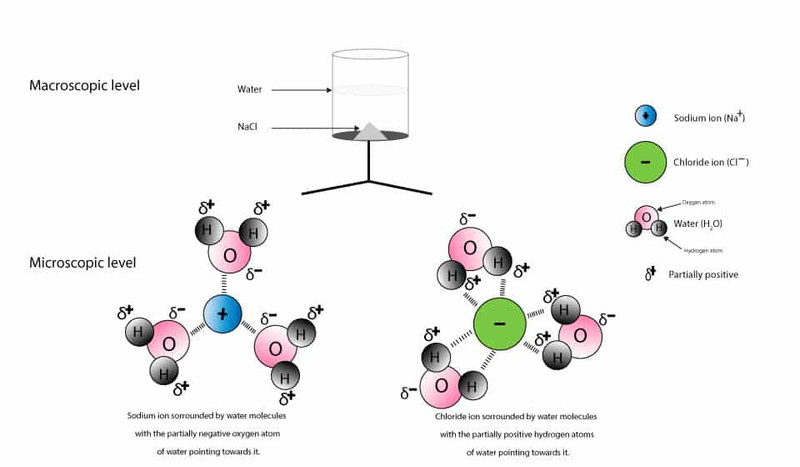
NaCl dissolving in water at the macroscopic and microscopic levels
Notice how the oxygen ends of water point toward , and the hydrogen ends point toward . That orientation is what stabilizes the ions in solution.
So when something is labeled (aq), think free-moving ions, not intact formula units.
Solubility Rules You Must Know
The College Board guarantees:
- All Na⁺, K⁺, NH₄⁺, and NO₃⁻ salts are soluble.
If a product is insoluble, it forms a precipitate (s) and stays intact in ionic equations.
Precipitation Reactions
Two aqueous ionic solutions mix. Ions swap partners. If one combination is insoluble, a solid forms.
General pattern:
The net ionic form usually looks like:
cation (aq) + anion (aq) → solid (s)
On tests, you’re often given reactants and must predict the solid using solubility rules before writing anything else.
4. How to Write a Net Ionic Equation
Here’s the clean process.
- Write and balance the molecular equation.
Never skip balancing first. - Determine solubility.
Identify aqueous vs solid. - Write the complete ionic equation.
Dissociate only soluble aqueous compounds. - Cancel spectator ions.
- Write the final net ionic equation.
Reduce coefficients if possible.
Re-check atom and charge balance.
If your final equation isn’t balanced for charge, something went wrong.
5. Physical vs Chemical Changes
Every process can be written symbolically.
Physical Changes
No rearrangement of atoms.
Examples:
The second looks dramatic, but it’s dissolution. No new substance formed.
Chemical Changes
Atoms rearrange into new substances.
Precipitation example:
Bonds are forming and breaking. That’s chemical change.
On FRQs, you may be asked to write either a full molecular equation or just the net ionic form depending on context. Read carefully.
6. Common AP Mistakes
- Dissociating a solid precipitate
- Forgetting phases (aq vs s matters)
- Not balancing before splitting into ions
- Leaving spectators in the final equation
- Ignoring charge balance
If you’re unsure, imagine the beaker. Which particles actually combine into something new?
Key Takeaways
Aqueous Solution
A mixture in which a substance is dissolved in water and written with the phase symbol (aq).
Dissociation of Soluble Ionic Compounds
When dissolved in water, soluble ionic compounds separate into their individual aqueous ions.
Solubility Rule Assessed on AP Chemistry
All sodium, potassium, ammonium, and nitrate salts are soluble in water.
Molecular Equation
A reaction written with compounds shown as intact formulas rather than separated aqueous ions.
Complete Ionic Equation / Total Ionic Equation
A reaction written with all strong electrolytes in solution separated into their aqueous ions.
Net Ionic Equation
A reaction showing only the species that actually change, with spectator ions omitted.
Spectator Ions
Ions present in solution that appear unchanged on both sides of the ionic equation.
What to Dissociate in Ionic Equations
Dissociate soluble aqueous ionic compounds; do not split solids, liquids, gases, or weak electrolytes.
Writing a Net Ionic Equation
Balance the reaction, dissociate soluble aqueous species, cancel spectator ions, and keep phases shown.
Physical Change Equation
A symbolic representation of a phase change or dissolution without forming new substances.
Precipitation Reaction and Precipitate
An aqueous reaction that forms an insoluble solid product that separates from solution.
Balanced Chemical Equation
A symbolic reaction showing equal atoms and total charge on both sides.
Notes
Aqueous Solution
A mixture in which a substance is dissolved in water and written with the phase symbol (aq).
Dissociation of Soluble Ionic Compounds
When dissolved in water, soluble ionic compounds separate into their individual aqueous ions.
Solubility Rule Assessed on AP Chemistry
All sodium, potassium, ammonium, and nitrate salts are soluble in water.
Molecular Equation
A reaction written with compounds shown as intact formulas rather than separated aqueous ions.
Complete Ionic Equation / Total Ionic Equation
A reaction written with all strong electrolytes in solution separated into their aqueous ions.
Net Ionic Equation
A reaction showing only the species that actually change, with spectator ions omitted.
Spectator Ions
Ions present in solution that appear unchanged on both sides of the ionic equation.
What to Dissociate in Ionic Equations
Dissociate soluble aqueous ionic compounds; do not split solids, liquids, gases, or weak electrolytes.
Writing a Net Ionic Equation
Balance the reaction, dissociate soluble aqueous species, cancel spectator ions, and keep phases shown.
Physical Change Equation
A symbolic representation of a phase change or dissolution without forming new substances.
Precipitation Reaction and Precipitate
An aqueous reaction that forms an insoluble solid product that separates from solution.
Balanced Chemical Equation
A symbolic reaction showing equal atoms and total charge on both sides.
