Topic 9.2 Notes – Absolute Entropy and Entropy Change
1. What Absolute Entropy Is
Entropy (S) measures the number of possible microscopic arrangements, or microstates, of particles in a system. More possible arrangements means more disorder and a higher entropy.
Absolute entropy (S°) is the actual entropy value of a substance at standard conditions (usually 1 bar and 298 K).
- Units: J/mol}\\cdot\\text{K
- Each substance has its own tabulated S° value.
- Unlike enthalpy (H), entropy can be measured on an absolute scale.
So when you see a thermodynamic table, those S° values are real, usable numbers.
Standard Entropy Change (ΔS°)
For a process at standard conditions, the standard entropy change tells you how disorder changes overall.
- Positive ΔS° → system becomes more disordered.
- Negative ΔS° → system becomes more ordered.
Like enthalpy, entropy is a state function. It depends only on the initial and final states, not the path taken. That’s why we can calculate reaction entropy using tabulated data.
2. The ΔS° Reaction Formula
For any balanced reaction:
Where:
- = stoichiometric coefficient
- S° values come from a data table
- Units: J/mol}\\cdot\\text{K (per mole of reaction as written)
This is structurally identical to how you calculated ΔH° from ΔHf° values.
How the Calculation Works
Take this reaction:
Suppose the table gives:
- S°() = 248 J/mol}\\cdot\\text{K
- S°() = 205 J/mol}\\cdot\\text{K
- S°() = 257 J/mol}\\cdot\\text{K
Step 1: Multiply by coefficients
Products:
Reactants:
Step 2: Subtract
The reaction has negative ΔS°, meaning disorder decreases.
Notice something physical here: 3 moles of gas become 2 moles of gas. That matches the negative result. If your math contradicts the particle trend, recheck your subtraction.
Common mistakes I see on quizzes:
- Forgetting to multiply by coefficients.
- Mixing up product − reactant order.
- Using the wrong physical state from the table.
3. What Determines the Size of S° for a Substance
When scanning a table of S° values, patterns jump out.
Phase of Matter
Entropy increases as particles gain freedom of motion:
solid < liquid < gas
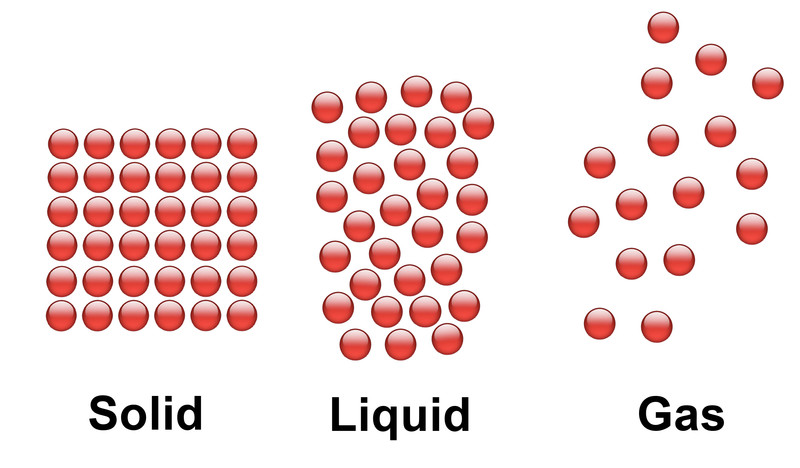
Particle model comparison of solid, liquid, and gas
In the diagram, notice how tightly packed and ordered the solid is, how the liquid particles are still close but less organized, and how the gas particles are spread far apart. Gas-phase substances almost always have much larger S° values than solids or liquids.
Number of Particles (Especially Gas Particles)
More moles of gas means more possible arrangements.
- 1 mol gas → 2 mol gas = increase in entropy.
- Reactions producing more gas often have positive ΔS°.
This is one of the fastest ways to predict the sign during multiple-choice.
Molecular Complexity
Within the same phase:
- Larger, more complex molecules → higher S°
- More atoms = more vibrational modes = more possible arrangements.
For example, a larger hydrocarbon has a higher S° than a smaller one in the same phase.
4. Predicting the Sign of ΔS° Without Numbers
You won’t always be given data tables. Sometimes you just need the sign.
Phase Changes
- Solid → liquid → gas → ΔS° positive
- Gas → liquid → solid → ΔS° negative
Vaporization strongly increases entropy. Condensation strongly decreases it.
Changes in Moles of Gas
Compare total gaseous moles on each side.
- More gas on product side → ΔS° positive
- Fewer gas moles → ΔS° negative
- Same gas moles → look at phase or complexity changes
Forming a Solid from Gases
Example pattern:
Gas disappears and a solid forms. Entropy decreases significantly. Expect negative ΔS°.
5. Connecting Calculation and Meaning
After you compute ΔS°:
- Positive → products are more disordered overall.
- Negative → products are more ordered.
Later, this plugs directly into
So getting the sign right matters for spontaneity analysis.
On FRQs, they often expect both:
- The numerical calculation.
- A physical explanation based on particle freedom or gas moles.
If those two don’t match, something went wrong in your setup.
Key Takeaways
Absolute Entropy / Standard Molar Entropy (S°)
The entropy of 1 mole of a substance at standard conditions, measured absolutely.
State Function
A property whose change depends only on initial and final states, not pathway.
Sign of ΔS°
Positive means greater disorder; negative means greater order or fewer accessible microstates.
Predicting Entropy Change from Physical or Chemical Change
Entropy usually increases with more gas particles, phase changes toward gas, or more dispersed matter.
Standard Entropy Change of Reaction (ΔS°rxn)
Calculate by summing coefficient-weighted product entropies and subtracting coefficient-weighted reactant entropies.
Notes
Absolute Entropy / Standard Molar Entropy (S°)
The entropy of 1 mole of a substance at standard conditions, measured absolutely.
State Function
A property whose change depends only on initial and final states, not pathway.
Sign of ΔS°
Positive means greater disorder; negative means greater order or fewer accessible microstates.
Predicting Entropy Change from Physical or Chemical Change
Entropy usually increases with more gas particles, phase changes toward gas, or more dispersed matter.
Standard Entropy Change of Reaction (ΔS°rxn)
Calculate by summing coefficient-weighted product entropies and subtracting coefficient-weighted reactant entropies.
