Topic 2.1 Notes – Types of Chemical Bonds
1. Why Atoms Bond and What Controls Bond Type
Atoms bond because the attractions between positive nuclei and negative electrons lower potential energy. When those attractions outweigh repulsions, a stable bond forms.
The electrons involved are the valence electrons:
- Outer-shell s and p electrons
- The only electrons that participate in bonding
- The ones that determine chemical behavior
Whether electrons are transferred, shared equally, or shared unequally depends mostly on electronegativity (EN).
Electronegativity and Periodic Trends
Electronegativity is an atom’s ability to attract electrons in a bond.
Here’s the trend you need locked in.
- Increases left → right
- Decreases down a group
Highest values are found near the top right corner, which is why fluorine is the most electronegative element.
Why this happens comes straight from Coulomb’s Law:
- More protons (larger nuclear charge) → stronger attraction
- Greater distance between nucleus and valence electrons → weaker attraction
Across a period:
- Proton count increases
- Valence shell stays the same
- Attraction gets stronger → EN increases
Down a group:
- Valence electrons are farther from nucleus
- Shielding increases
- Attraction weakens → EN decreases
This explains why fluorine is extremely electronegative and cesium is not.
Bond strength and bond type both depend on this same charge-and-distance idea.
2. The Three Types of Chemical Bonds
Ionic Bonding
Forms when electrons are transferred, usually from a metal to a nonmetal.
- Metal loses electron → cation (+)
- Nonmetal gains electron → anion (−)
- Attraction is purely electrostatic
Structure matters here.
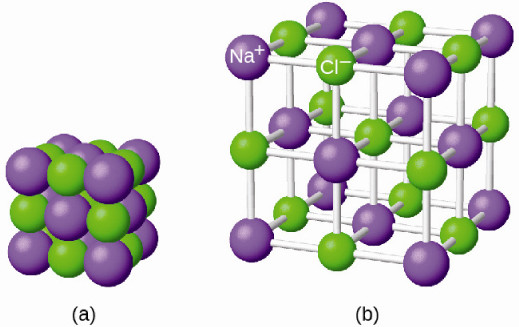
Sodium chloride crystal lattice
Instead of existing as separate and pairs, ionic compounds form extended 3D networks of alternating positive and negative ions.
That repeating 3D structure is a crystal lattice.
Properties
- High melting and boiling points (strong electrostatic attractions)
- Brittle
- Conduct electricity when molten or dissolved
- Do not conduct as solids (ions can’t move)
What makes one ionic compound stronger than another?
- Charge magnitude
- (2+ and 2−) > (1+ and 1−)
- Ion size
- Smaller ions → shorter distance → stronger attraction
On exams, compare charge first, then size. Charge has the bigger effect.
Covalent Bonding
Forms between nonmetals that share valence electrons.
Nonpolar Covalent
- Similar EN
- Electrons shared equally
- No partial charges
- Example: C-H is effectively nonpolar
Polar Covalent
- Different EN
- Unequal sharing
- More electronegative atom becomes δ−
- Less electronegative atom becomes δ+
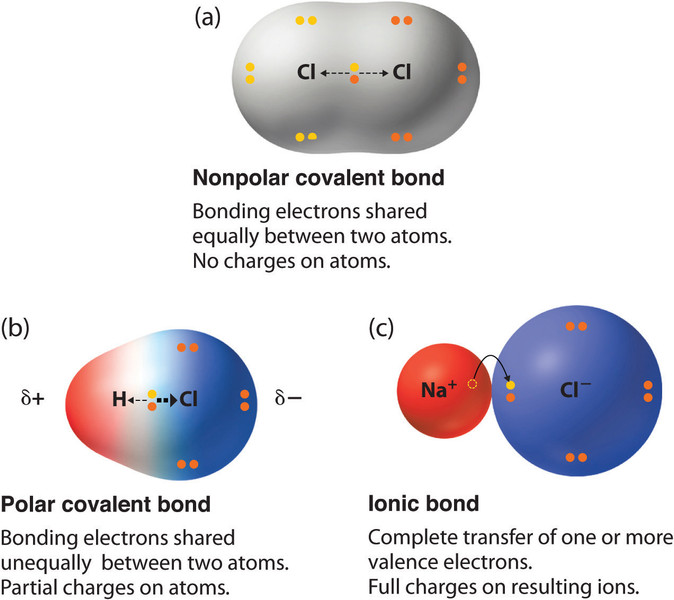
Nonpolar, polar, and ionic bonding comparison
The three panels show the progression from equal sharing (Cl-Cl), to unequal sharing with partial charges (H-Cl), to full electron transfer (Na+ and Cl−).
Greater EN difference → larger bond dipole.
Important idea: Bonding is a continuum.
- All polar bonds have some ionic character.
- There is no sharp cutoff between ionic and covalent.
General guideline (not a rule):
- 0-0.4 → nonpolar covalent
- 0.4-1.7 → polar covalent
- >1.7 → mostly ionic
But AP questions often expect you to confirm using properties, not just EN difference.
Molecular (covalent) substances
- Lower melting points
- Poor electrical conductivity in all states
Metallic Bonding
Occurs between metal atoms.
Valence electrons are delocalized. They form a mobile “sea” around positive metal cations.
This explains metallic properties:
- Conduct electricity as solids (mobile electrons)
- Malleable and ductile (layers slide without breaking bonds)
- Shiny (electrons absorb and re-emit light)
- Good thermal conductors
Stronger metallic bonding occurs when:
- More valence electrons are contributed
- Metal atoms are smaller
3. How to Determine Bond Type from Elements and Properties
When you’re given a compound, think in layers.
1. Element types
- Metal + nonmetal → usually ionic
- Nonmetal + nonmetal → covalent
- Metal + metal → metallic
2. Electronegativity difference
- Larger difference → more ionic character
3. Observed properties (most reliable)
| Observation | Likely Bond Type |
|---|---|
| High melting point, conducts when molten | Ionic |
| Low melting point, never conducts | Molecular covalent |
| Conducts as solid, shiny, malleable | Metallic |
| High melting point, does not conduct | Network covalent (covered later) |
AP questions love giving you melting point and conductivity data instead of saying the bond type directly. You’re expected to connect structure to properties.
4. The Big Relationship to Lock In
Everything connects like this:
Periodic trend → electronegativity → electron distribution → bond type → structure → properties
If you can explain that chain clearly, you’re thinking the way AP graders want.
Key Takeaways
Electronegativity
An atom's ability to attract shared electrons in a chemical bond.
Electronegativity Trends
Increases across a period and decreases down a group because of charge and distance effects.
Coulomb's Law
Attraction increases with larger charges and shorter distances between oppositely charged particles.
Valence Electrons
Outermost electrons that participate in bonding and determine many chemical properties.
Nonpolar Covalent Bond
Electrons are shared nearly equally between atoms with similar electronegativities.
Polar Covalent Bond
Electrons are shared unequally between atoms with different electronegativities.
Partial Charges
Delta positive and delta negative charges caused by unequal electron distribution in a bond.
Bond Dipole
A separation of charge in a bond caused by unequal electron sharing.
Ionic Character and Bonding Continuum
Polar bonds have some ionic character, so bonding ranges continuously from covalent to ionic.
Ionic Bonding
Electrostatic attraction between cations and anions, usually formed after electron transfer.
Cation and Anion
Cations are positively charged ions; anions are negatively charged ions.
Crystal Lattice
A repeating three-dimensional arrangement of ions in an ionic solid.
Properties of Ionic Compounds
Usually brittle, high-melting solids that conduct electricity when molten or dissolved.
Properties of Metals
Conductive, malleable, ductile, and lustrous because mobile electrons move through the solid.
Bond Type Identification
Metal plus nonmetal is usually ionic; two nonmetals are usually covalent; metals are metallic.
Electronegativity Difference Guidelines
About 0 to 0.4 is nonpolar covalent, 0.4 to 1.7 polar covalent, above 1.7 often ionic.
Compound Properties vs Electronegativity
Observed properties classify bonding more reliably than electronegativity difference alone.
Carbon-Hydrogen Bond
A bond treated as effectively nonpolar because the electronegativity difference is very small.
Metallic Bonding
Attraction between metal cations and mobile valence electrons spread throughout the solid.
Notes
Electronegativity
An atom's ability to attract shared electrons in a chemical bond.
Electronegativity Trends
Increases across a period and decreases down a group because of charge and distance effects.
Coulomb's Law
Attraction increases with larger charges and shorter distances between oppositely charged particles.
Valence Electrons
Outermost electrons that participate in bonding and determine many chemical properties.
Nonpolar Covalent Bond
Electrons are shared nearly equally between atoms with similar electronegativities.
Polar Covalent Bond
Electrons are shared unequally between atoms with different electronegativities.
Partial Charges
Delta positive and delta negative charges caused by unequal electron distribution in a bond.
Bond Dipole
A separation of charge in a bond caused by unequal electron sharing.
Ionic Character and Bonding Continuum
Polar bonds have some ionic character, so bonding ranges continuously from covalent to ionic.
Ionic Bonding
Electrostatic attraction between cations and anions, usually formed after electron transfer.
Cation and Anion
Cations are positively charged ions; anions are negatively charged ions.
Crystal Lattice
A repeating three-dimensional arrangement of ions in an ionic solid.
Properties of Ionic Compounds
Usually brittle, high-melting solids that conduct electricity when molten or dissolved.
Properties of Metals
Conductive, malleable, ductile, and lustrous because mobile electrons move through the solid.
Bond Type Identification
Metal plus nonmetal is usually ionic; two nonmetals are usually covalent; metals are metallic.
Electronegativity Difference Guidelines
About 0 to 0.4 is nonpolar covalent, 0.4 to 1.7 polar covalent, above 1.7 often ionic.
Compound Properties vs Electronegativity
Observed properties classify bonding more reliably than electronegativity difference alone.
Carbon-Hydrogen Bond
A bond treated as effectively nonpolar because the electronegativity difference is very small.
Metallic Bonding
Attraction between metal cations and mobile valence electrons spread throughout the solid.
