Topic 6.1 Notes – Endothermic and Exothermic Processes
Energy in Chemical and Physical Changes
Energy is the capacity to do work or transfer heat. In AP Chem, we mostly track how energy moves during reactions or physical changes.
Two types matter most:
- Kinetic energy (KE) = energy of motion
- Temperature is proportional to the average KE of particles.
- Higher temperature → particles moving faster.
- Potential energy (PE) = stored energy due to position/interactions
- In chemistry, this is mainly energy in chemical bonds and electrostatic attractions.
- Lower PE → more stable arrangement of particles.
So when something “releases energy,” what’s usually happening is that particles move to a lower potential energy state.
Law of Conservation of Energy
Energy cannot be created or destroyed. It only transfers or changes form.
In any process:
- Energy lost by the system = energy gained by the surroundings
- Total energy of the universe stays constant
This idea drives everything in this unit.
System and Surroundings
- System = what you are studying (usually the reacting chemicals)
- Surroundings = everything else (solution, container, air, etc.)
If you mix and , the reacting ions are the system. The water and beaker are surroundings.
On tests, mistakes almost always happen because students forget to answer from the system’s perspective.
Enthalpy and Energy Changes
To track heat flow at constant pressure (typical lab conditions), we use enthalpy (H).
- depends only on initial and final states.
- That makes enthalpy a state function.
- Heat and work depend on how you get there, so they are not state functions.
At constant pressure:
- (heat transferred)
If is negative, the system’s energy decreased. If positive, it increased.
Endothermic and Exothermic Processes
Here’s the core comparison you need to know:
| Exothermic | Endothermic | |
|---|---|---|
| Heat flow | System → Surroundings | Surroundings → System |
| Sign of ΔH | ΔH < 0 | ΔH > 0 |
| Energy of system | Decreases | Increases |
| Temp of surroundings | Increases | Decreases |
Exothermic
- Heat released by system
- Products have lower potential energy than reactants
- Surroundings warm up
Common examples:
- Combustion
- Many acid-base neutralizations
- Freezing or condensation
Endothermic
- Heat absorbed by system
- Products have higher potential energy than reactants
- Surroundings cool down
Common examples:
- Melting, vaporization
- Some dissolutions
- Thermal decomposition
Now connect that to a reaction coordinate diagram. The left panel shows an exothermic reaction and the right panel shows an endothermic reaction.
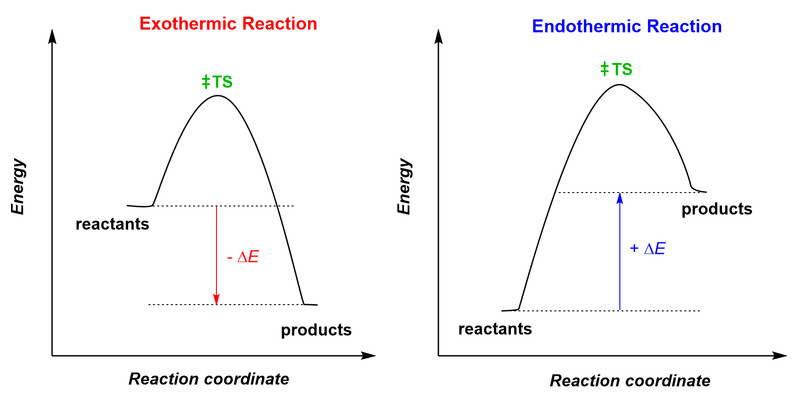
Exothermic and endothermic energy diagrams
Focus on the vertical difference between reactants and products in each case. That vertical gap is ΔH. Downward means ΔH is negative. Upward means ΔH is positive.
What Temperature Changes Tell You
In lab problems, you’re often given a temperature change and asked what type of process occurred.
- If solution temperature increases
- surroundings gained heat
- system released heat
- exothermic
- If solution temperature decreases
- surroundings lost heat
- system absorbed heat
- endothermic
If a metal reacts in solution and the beaker gets warm, that reaction is exothermic. The AP loves giving short experimental descriptions and asking you to classify the energy change.
Types of Processes That Can Be Endo or Exo
All energy changes fall into these categories:
Heating or Cooling a Substance
- Temperature change only
- KE changes
- No change in identity
Phase Changes
Energy changes involve intermolecular forces, not covalent bonds.
- Melting, vaporization, sublimation → endothermic
- Freezing, condensation, deposition → exothermic
Energy is required to separate particles and released when attractions form.
Chemical Reactions
- Breaking bonds absorbs energy
- Forming bonds releases energy
- Net ΔH depends on which effect is larger
Dissolution
When something dissolves, three energy steps occur:
- Separate solute particles
- Separate solvent particles
- Form solute-solvent attractions
If new attractions are stronger overall → exothermic.
If weaker → endothermic.
Cold packs use endothermic dissolution. Some hot packs rely on exothermic dissolution or crystallization.
Key Takeaways
Energy
The capacity to do work or transfer heat.
Kinetic Energy
Energy due to motion; in particles, it increases as temperature increases.
Potential Energy
Stored energy due to position or interactions, especially in chemical bonds and attractions.
Law of Conservation of Energy / First Law of Thermodynamics
Energy cannot be created or destroyed, only transferred or converted between forms.
System and Surroundings
The part studied is the system; everything else is the surroundings.
Enthalpy and Enthalpy Change
Total heat content of a system and the difference between final and initial values.
Physical and Chemical Transformations as Endothermic or Exothermic
Heating, cooling, phase changes, and reactions can absorb or release energy.
Dissolution as Endothermic or Exothermic
Solution formation absorbs or releases energy depending on relative interaction strengths before and after dissolving.
Endothermic vs. Exothermic Processes
Processes absorb heat from surroundings with positive ΔH or release heat with negative ΔH.
Temperature Change and Energy Transfer
Temperature changes show energy transfer between system and surroundings during physical or chemical changes.
Notes
Energy
The capacity to do work or transfer heat.
Kinetic Energy
Energy due to motion; in particles, it increases as temperature increases.
Potential Energy
Stored energy due to position or interactions, especially in chemical bonds and attractions.
Law of Conservation of Energy / First Law of Thermodynamics
Energy cannot be created or destroyed, only transferred or converted between forms.
System and Surroundings
The part studied is the system; everything else is the surroundings.
Enthalpy and Enthalpy Change
Total heat content of a system and the difference between final and initial values.
Physical and Chemical Transformations as Endothermic or Exothermic
Heating, cooling, phase changes, and reactions can absorb or release energy.
Dissolution as Endothermic or Exothermic
Solution formation absorbs or releases energy depending on relative interaction strengths before and after dissolving.
Endothermic vs. Exothermic Processes
Processes absorb heat from surroundings with positive ΔH or release heat with negative ΔH.
Temperature Change and Energy Transfer
Temperature changes show energy transfer between system and surroundings during physical or chemical changes.
