Topic 3.3 Notes – Solids, Liquids, and Gases
1. How the Three Phases Differ at the Particulate Level
Everything here comes back to three ideas: spacing between particles, strength of intermolecular forces (IMFs), and particle motion.
Solids
In a solid, particles are:
- In close contact
- Held by strong IMFs
- Limited to vibrational motion only (they jiggle in place, no overall translation)
Because of that:
- Definite shape and definite volume
- Nearly incompressible (no empty space to squeeze out)
- Extremely slow diffusion
Crystalline vs Amorphous Solids
Crystalline solids
- Particles arranged in a regular, repeating 3D pattern
- Structure depends on packing and interparticle forces
Think of a crystalline solid as a tiny building block repeated over and over in three dimensions.
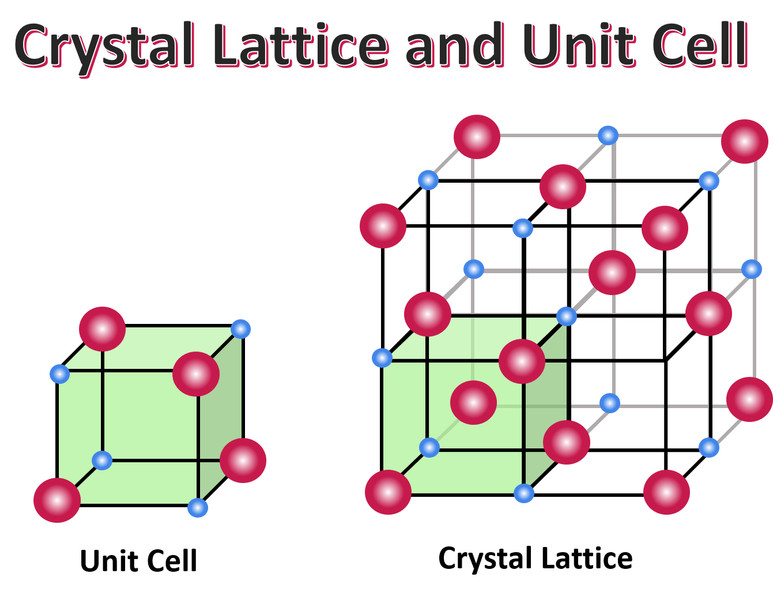
Unit cell and repeating crystal lattice
The small cube represents a unit cell, the smallest repeating portion of the structure. When that unit cell repeats in all directions, it forms the full crystal lattice.
Amorphous solids
- No long-range repeating pattern
- Still rigid overall, but particles are arranged more randomly
On a test, if they show a neat repeating array of spheres, that’s crystalline. A jumbled but tightly packed diagram is amorphous.
Liquids
Liquids look similar to solids at the particle level in one key way: particles are still in close contact.
But now:
- IMFs are weaker than in solids
- Particles are in constant motion and collisions
- They can slide past one another
Macroscopic results:
- Definite volume
- No definite shape (takes shape of container)
- Nearly incompressible
- Slow diffusion, but faster than solids
Important connection: since solids and liquids both have particles in close contact, they usually have similar molar volumes for the same substance.
Gases
Gases are the big contrast.
- Particles are far apart
- IMFs are minimal or negligible
- Motion is constant, random, straight-line motion
Because of this:
- No definite shape
- No definite volume
- Highly compressible
- Rapid diffusion
Collision frequency and spacing depend on temperature, pressure, and volume. Higher temperature means faster particles and more forceful collisions.
On the AP exam, when they ask why gases are compressible but liquids are not, the answer is almost always about empty space between particles.
2. Comparing the Three Phases
Here’s how to line them up side by side:
| Property | Solid | Liquid | Gas |
|---|---|---|---|
| Particle Spacing | Very close | Very close | Very far apart |
| Motion | Vibrational only | Translational + collisions | Random, straight-line motion |
| IMF Strength | Strongest | Intermediate | Minimal |
| Shape | Definite | Takes container shape | Takes container shape |
| Volume | Definite | Definite | Equals container volume |
| Compressibility | Very low | Very low | High |
| Diffusion | Extremely slow | Slow | Fast |
Energy trend:
Solid → Liquid → Gas = increasing kinetic energy and particle motion
Density trend (generally):
Solid ≥ Liquid ≫ Gas
3. How Intermolecular Forces and Temperature Control Phases
Phase depends on the competition between:
- IMFs pulling particles together
- Thermal energy pushing particles apart
Stronger IMFs:
- Favor solid or liquid
- Increase surface tension and viscosity
Higher temperature:
- Increases kinetic energy
- Helps particles overcome IMFs
- Favors liquid or gas
If they describe a substance with strong hydrogen bonding, expect higher surface tension, higher viscosity, and a greater tendency to be liquid or solid at a given temperature.
4. Special Properties of Liquids
These are all IMF stories.
Surface Tension
Surface molecules experience a net inward force because they aren’t surrounded on all sides.
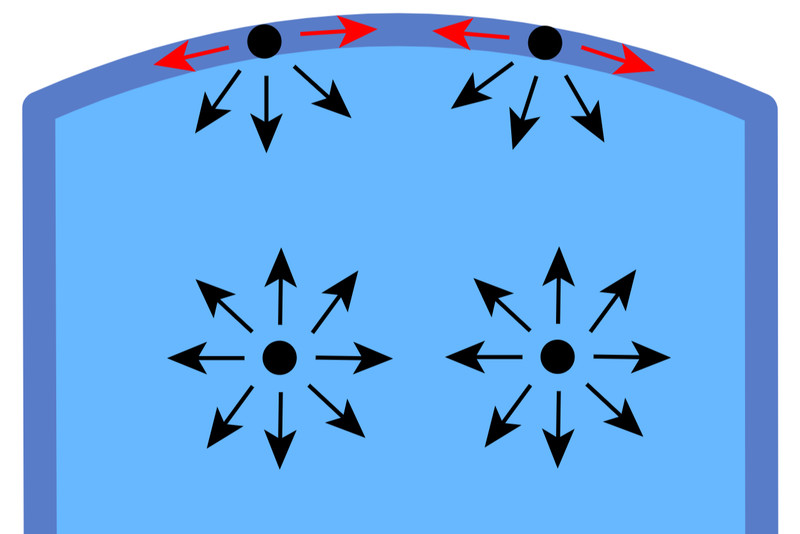
Surface molecules experience a net inward force
Interior molecules are pulled equally in all directions. Molecules at the surface are pulled inward, which creates surface tension along the top layer.
Trends:
- Stronger IMFs → higher surface tension
- Higher temperature → lower surface tension
Cohesive vs Adhesive Forces
- Cohesive = liquid-liquid attraction
- Adhesive = liquid-container attraction
These determine the meniscus.
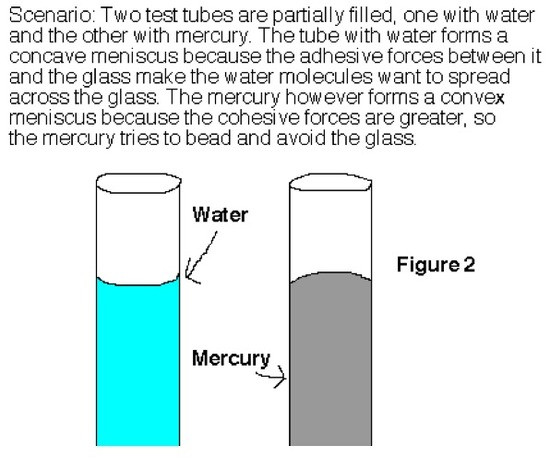
Concave vs. convex meniscus
- Adhesive > Cohesive → Concave
- Cohesive > Adhesive → Convex
Capillary action happens when adhesion pulls liquid up a surface and cohesion drags more molecules along.
Viscosity
Viscosity = resistance to flow.
- Stronger IMFs → higher viscosity
- Higher temperature → lower viscosity
If they compare glycerol and hexane, think IMF strength.
5. What You Must Be Able to Do
You should be able to:
- Draw and interpret particulate diagrams of each phase
- Explain macroscopic properties using spacing + motion + IMFs
- Justify why solids and liquids have similar molar volume
- Explain why gases expand and are compressible
- Predict how temperature or IMF strength affects surface tension and viscosity
Everything in this topic reduces to particle-level reasoning.
Key Takeaways
States of Matter: Solid, Liquid, and Gas
Solid: fixed shape and volume; liquid: fixed volume only; gas: neither fixed shape nor volume.
Crystalline vs. Amorphous Solids
Crystalline solids have ordered 3-D particle arrangements; amorphous solids lack long-range regular order.
Particle Motion in Solids
Particles stay in fixed positions and only vibrate, with no overall translational motion.
Packing and Interparticle Forces in Solids
Solid structure depends on how strongly particles attract and how efficiently they can pack together.
Liquid Particle Model
Particles remain close together but move continuously, collide often, and slide past one another.
Fluidity
The ability of particles in a substance, especially a liquid or gas, to flow past one another.
Molar Volume of Solids vs. Liquids
For one substance, solid and liquid phases usually have similar molar volumes because particles stay closely packed.
Gas Particle Model
Particles are far apart, move constantly in straight lines, and experience minimal intermolecular attractions.
Temperature, Pressure, and Volume Effects on Gases
These variables change particle spacing and collision frequency in a gas.
Compressibility
The extent to which a substance's volume decreases when pressure is applied.
Diffusion in Solids, Liquids, and Gases
Mixing is extremely slow in solids, slow in liquids, and rapid in gases.
Surface Tension
A liquid minimizes surface area; stronger intermolecular forces increase it, while higher temperature decreases it.
Viscosity
A liquid's resistance to flow increases with stronger intermolecular forces and decreases with higher temperature.
Cohesive and Adhesive Forces
Attractions within a liquid and to surfaces determine capillary action and meniscus shape.
Notes
States of Matter: Solid, Liquid, and Gas
Solid: fixed shape and volume; liquid: fixed volume only; gas: neither fixed shape nor volume.
Crystalline vs. Amorphous Solids
Crystalline solids have ordered 3-D particle arrangements; amorphous solids lack long-range regular order.
Particle Motion in Solids
Particles stay in fixed positions and only vibrate, with no overall translational motion.
Packing and Interparticle Forces in Solids
Solid structure depends on how strongly particles attract and how efficiently they can pack together.
Liquid Particle Model
Particles remain close together but move continuously, collide often, and slide past one another.
Fluidity
The ability of particles in a substance, especially a liquid or gas, to flow past one another.
Molar Volume of Solids vs. Liquids
For one substance, solid and liquid phases usually have similar molar volumes because particles stay closely packed.
Gas Particle Model
Particles are far apart, move constantly in straight lines, and experience minimal intermolecular attractions.
Temperature, Pressure, and Volume Effects on Gases
These variables change particle spacing and collision frequency in a gas.
Compressibility
The extent to which a substance's volume decreases when pressure is applied.
Diffusion in Solids, Liquids, and Gases
Mixing is extremely slow in solids, slow in liquids, and rapid in gases.
Surface Tension
A liquid minimizes surface area; stronger intermolecular forces increase it, while higher temperature decreases it.
Viscosity
A liquid's resistance to flow increases with stronger intermolecular forces and decreases with higher temperature.
Cohesive and Adhesive Forces
Attractions within a liquid and to surfaces determine capillary action and meniscus shape.
