Topic 5.5 Notes – Collision Model
1. The Collision Model
At the particle level, a reaction happens when reactant particles collide and rearrange bonds. No collision, no reaction.
In the collision model, particles:
- Move in constant, random motion.
- Collide with one another.
- Only react if the collision is successful.
For an elementary reaction (a single-step reaction), the rate directly reflects that one molecular event. If the step is
,
then the rate depends on how often A and B collide successfully.
Reaction rate is proportional to:
- Collision frequency (how often particles hit each other)
- Fraction with enough energy
- Fraction with correct orientation
Put simply:
Rate = total collisions × fraction that are successful
Most collisions are not successful. That idea shows up again and again on tests.
2. What Makes a Collision Successful
A collision must meet two conditions at the same time.
a. Sufficient Energy and Activation Energy
Activation energy () is the minimum energy required to begin breaking bonds.
During a collision:
- Some kinetic energy is used to stretch and distort bonds.
- If kinetic energy < , particles bounce apart.
- If kinetic energy ≥ , bonds can rearrange.
Think of as an energy barrier between reactants and products. Most particles at a given moment do not have enough energy to cross it.
On FRQs, you may need to explain why a reaction is slow at low temperature. The correct reasoning is that few particles have energy ≥ , so few effective collisions occur.
b. Correct Orientation
Even with enough energy, molecules must collide in the proper geometry.
- Reactive sites must line up.
- Bonds must be positioned so new bonds can form.
- Complex molecules have stricter orientation requirements.
If orientation is wrong, particles separate unchanged.
This is why the fraction of successful collisions is small. You need:
- Enough energy
- Correct alignment
Both at once.
3. Collision Frequency and Reaction Rate
Now think about how often collisions happen.
Collision frequency increases when:
- Concentration increases
More particles per volume → more collisions per second. - Pressure increases (for gases)
Particles are closer together → collide more often. - Temperature increases
Particles move faster → collide more frequently.
For an elementary reaction, if you double the frequency of A-B collisions, you directly increase the rate because that step is the reaction.
But remember: more collisions alone does not guarantee reaction. They must be effective.
4. Maxwell-Boltzmann Distribution
The Maxwell-Boltzmann distribution shows how particle energies are spread out in a sample. The graph below compares two temperatures and highlights the activation energy, .
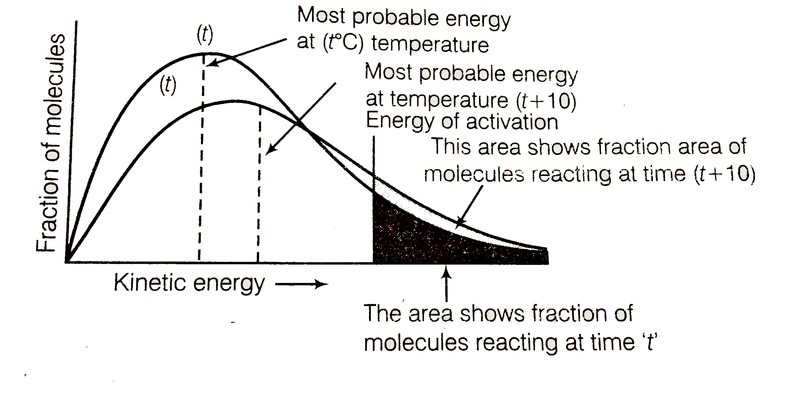
Maxwell-Boltzmann distributions at two temperatures
What this graph tells you:
- The peak represents the most probable energy.
- The total area under each curve is the same (same number of particles).
- Only particles to the right of can react.
When temperature increases:
- The curve shifts right.
- It becomes flatter and broader.
- The area to the right of increases significantly.
Two effects happen at higher temperature:
- Particles collide more often.
- A much larger fraction have energy ≥ .
That second effect is why temperature has such a dramatic impact on rate. A small temperature increase causes a disproportionately large increase in particles above .
On the AP exam, you may be asked to compare shaded areas or explain why rate increases. The correct explanation references the increase in the fraction of particles with energy ≥ .
5. Effective vs Ineffective Collisions
Ineffective collisions
- Energy < , or
- Incorrect orientation
- No reaction occurs
Effective collisions
- Energy ≥
- Proper alignment
- Bonds break and form → products result
In most reactions, only a small fraction of total collisions are effective. Reaction rate increases when:
- Collision frequency increases
- The fraction exceeding increases
- The fraction with proper orientation increases
Everything in this topic ties back to that single idea.
Key Takeaways
Collision Model
Particles react only when they collide with enough energy and the correct orientation.
Activation Energy
The minimum energy particles need during a collision to begin bond breaking and forming.
Orientation Requirement
Reacting particles must collide in an arrangement that allows the necessary bonds to rearrange.
Temperature and Collision Model
Higher temperature increases average kinetic energy, causing more frequent and more energetic collisions.
Fraction of Collisions Leading to Reaction
Only a small fraction of collisions form products because few have both enough energy and correct orientation.
Elementary Reaction
A reaction step that occurs in a single molecular event with one set of colliding particles.
Effective vs. Ineffective Collision
Product formation occurs only when collisions have enough energy and the correct orientation.
Maxwell-Boltzmann Distribution
A curve showing particle energies; higher temperature increases the fraction exceeding activation energy.
Notes
Collision Model
Particles react only when they collide with enough energy and the correct orientation.
Activation Energy
The minimum energy particles need during a collision to begin bond breaking and forming.
Orientation Requirement
Reacting particles must collide in an arrangement that allows the necessary bonds to rearrange.
Temperature and Collision Model
Higher temperature increases average kinetic energy, causing more frequent and more energetic collisions.
Fraction of Collisions Leading to Reaction
Only a small fraction of collisions form products because few have both enough energy and correct orientation.
Elementary Reaction
A reaction step that occurs in a single molecular event with one set of colliding particles.
Effective vs. Ineffective Collision
Product formation occurs only when collisions have enough energy and the correct orientation.
Maxwell-Boltzmann Distribution
A curve showing particle energies; higher temperature increases the fraction exceeding activation energy.
