Topic 3.6 Notes – Deviation from Ideal Gas Law
1. Why the Ideal Gas Law Sometimes Fails
The Ideal Gas Law comes from the Kinetic Molecular Theory (KMT). Two assumptions matter most here:
- Gas particles have no attractive or repulsive forces between them.
- Gas particles have negligible volume compared to the container.
Those assumptions work pretty well at:
- High temperature (fast particles)
- Low pressure (particles far apart)
They fail at:
- Low temperature
- High pressure
When that happens, we say the gas shows non‑ideal behavior.
The key is always this question:
Which KMT assumption is breaking?
2. The Two Causes of Non‑Ideal Behavior
a. Interparticle Attractions (IMFs)
When particles attract each other, the “no forces” assumption is violated.
This matters most when:
- Temperature is low → particles move slower.
- Pressure is high → particles are closer together.
- Molecules are polar or large → stronger intermolecular forces.
What happens to pressure?
Attractive forces pull particles slightly inward. That means:
- Fewer strong collisions with the walls.
- Measured pressure is lower than predicted by .
So if you see:
The explanation is almost always attractive forces reducing wall collisions.
This comes up a lot in free-response questions. If they say “the measured pressure is lower than predicted,” they want you to mention:
- Intermolecular attractions
- Reduced frequency/force of collisions
That’s the scoring language.
b. Finite Particle Volume
Now the other assumption breaks: particles do have volume.
At very high pressure:
- The container volume shrinks.
- Particles take up a measurable fraction of that space.
- The “empty space” available for motion is smaller than assumed.
Because the ideal gas law treats particles as point masses, it overestimates how much free space exists.
At extremely high pressures:
- The gas resists compression more than expected.
- Measured pressure becomes higher than predicted.
So:
That’s the particle volume effect dominating.
A helpful way to think about it:
- Moderate pressure → attractions dominate.
- Extremely high pressure → particle size dominates.
3. Conditions That Increase Deviation
Three main factors control how ideal a gas behaves.
Temperature
Lower temperature:
- Lower kinetic energy
- Attractions matter more
- Gas may approach condensation
→ Greater deviation
Pressure
Higher pressure:
- Particles closer together
- IMFs increase
- Volume becomes significant
→ Greater deviation
Molecular Identity
| Type of Gas | Behavior Compared to Ideal |
|---|---|
| Small, nonpolar (He, Ne) | Most ideal |
| Large, nonpolar | Less ideal |
| Polar molecules | Less ideal |
| Easily liquefied gases | Strong deviation |
Small, nonpolar gases at high temperature and low pressure behave most ideally.
4. Interpreting Graphs of Deviation
You’ll often see a graph of the compressibility factor, , versus pressure. Take a second to read it from left to right and notice how the real gas curve compares to the ideal line at .
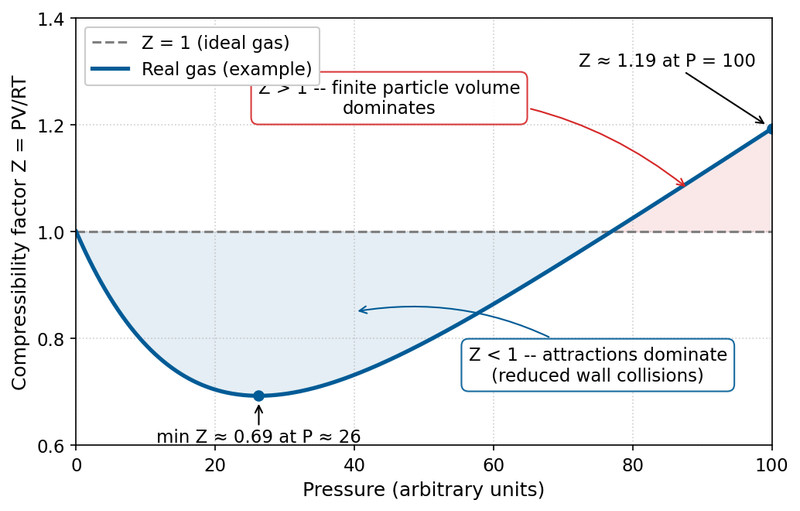
Compressibility factor (Z) vs. pressure for an ideal and real gas
For an ideal gas:
For real gases:
- Z < 1 → attractions dominate.
- Z > 1 → particle volume dominates.
Students often mix up which side is which. Just remember: attractions pull particles inward, which lowers the measured pressure and gives a lower Z.
5. Correcting the Ideal Gas Law Conceptually
The Van der Waals equation adjusts the ideal gas law to account for both problems.
Conceptually:
- Add a correction to pressure (because attractions lower measured pressure).
- Subtract a correction from volume (because particles take up space).
You do not need to memorize or calculate with this equation for AP. Just understand:
- “a” term corrects for attractions.
- “b” term corrects for particle volume.
Key Takeaways
Effect of Attractions on Measured Pressure
Real-gas pressure is lower than ideal pressure because attractions reduce wall-collision frequency and force.
Effect of Particle Volume at High Pressure
At very high pressure, real gases occupy more volume than ideal gases predict.
Causes of Real Gas Deviation
Real gases deviate because particles attract each other and occupy finite volume.
Factors That Increase Non-Ideal Behavior
Low temperature, high pressure, polarity, and larger size make gases less ideal.
Van Der Waals Equation and Constants
This real-gas model corrects pressure for attractions and volume for particle size.
Notes
Effect of Attractions on Measured Pressure
Real-gas pressure is lower than ideal pressure because attractions reduce wall-collision frequency and force.
Effect of Particle Volume at High Pressure
At very high pressure, real gases occupy more volume than ideal gases predict.
Causes of Real Gas Deviation
Real gases deviate because particles attract each other and occupy finite volume.
Factors That Increase Non-Ideal Behavior
Low temperature, high pressure, polarity, and larger size make gases less ideal.
Van Der Waals Equation and Constants
This real-gas model corrects pressure for attractions and volume for particle size.
