Topic 2.6 Notes – Resonance and Formal Charge
1. What Resonance Is
Sometimes you can draw more than one valid Lewis structure for the same arrangement of atoms, where only the electrons move. That situation is called resonance.
Key rules:
- Atom positions stay the same.
- Total number of valence electrons stays the same.
- Only π bonds and lone pairs shift.
- Structures are connected with a double-headed arrow (↔), not an equilibrium arrow.
The real molecule is a resonance hybrid. Electrons are delocalized over multiple atoms.
A classic example is carbonate, . In the diagram below, the double bond moves between the three oxygens, giving three equivalent Lewis structures.
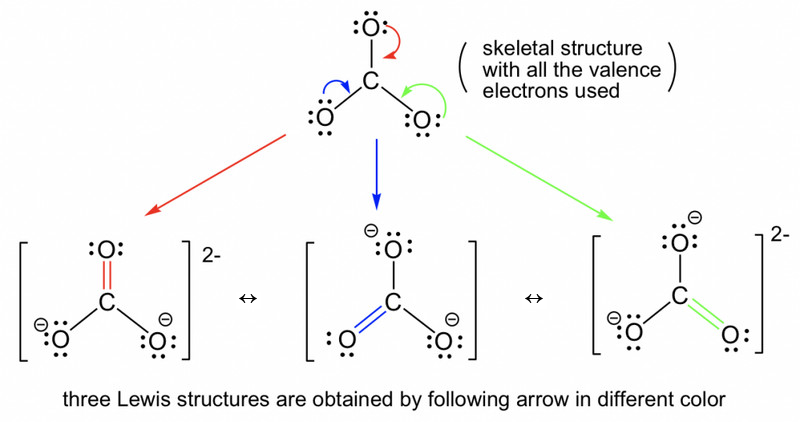
Resonance structures of the carbonate ion,
All three structures are equivalent. In reality:
- All C-O bonds are the same length.
- None is purely single or double.
Bond Order in Resonance Hybrids
When bonds are shared across positions, the bond order becomes fractional:
For carbonate:
- In any one structure: one double bond and two single bonds, so 4 shared electron pairs spread over 3 C-O positions
- Bond order
That means each bond is stronger than a single bond but weaker than a double bond.
Equivalent resonance structures contribute equally. Nonequivalent ones do not.
2. When and How to Draw Resonance Structures
When Resonance Is Required
You should look for resonance when:
- A double bond can be placed in multiple equivalent positions
- A lone pair is adjacent to a π bond
- A negative charge can spread over multiple atoms
- A positive charge can shift between atoms
- You are drawing common polyatomic ions like , ,
If equivalent structures exist, you must draw all of them on exams.
How to Draw Resonance Structures
The process is mechanical:
- Draw a correct Lewis structure.
- Find a π bond or lone pair next to a π bond.
- Move electrons only:
- Lone pair → form double bond
- Double bond → becomes lone pair
- Keep the same atoms and total electrons.
- Use brackets and charge for ions.
- Connect with ↔.
Never move atoms. Only electrons move.
On FRQs, missing a valid resonance structure can cost a point even if everything else is correct.
3. Formal Charge and Choosing the Best Structure
Sometimes multiple Lewis structures are possible but not equivalent. That’s when formal charge helps.
What Formal Charge Is
Formal charge estimates how electrons are distributed compared to a neutral atom.
Quick check:
If it doesn’t match, something is wrong.
Choosing the Best Structure
Use these criteria:
| Good Features | Unfavorable Features |
|---|---|
| Full octets (C, N, O, F) | Incomplete octets (unless unavoidable) |
| Small formal charges | Large magnitude charges |
| Negative charge on more electronegative atom | Negative charge on less electronegative atom |
| Minimal charge separation | Wide separation of + and − charges |
Example pattern: If one structure places a −1 on oxygen and another places −1 on carbon, the oxygen structure is better because oxygen is more electronegative.
On exams, when they say “justify,” explicitly mention formal charge and electronegativity.
4. Expanded Octets and Exceptions to the Octet Rule
Atoms in Period 3 or below (P, S, Cl, etc.) can exceed 8 electrons.
Example situation:
- All single bonds give the central atom a +1 formal charge.
- Forming one double bond reduces that charge to 0.
Often, the best structure:
- Minimizes formal charge
- Places negative charge on oxygen if present
Expanded octets are allowed for these larger atoms, but carbon, nitrogen, oxygen, and fluorine do not expand.
5. Limitations of Lewis Structures
Lewis structures are models. They have limits.
Odd-Electron Species
If a molecule has an odd number of valence electrons, one atom will not have a full octet.
Example type:
You cannot satisfy every octet. That’s expected. These are called radicals.
What Lewis Structures Don’t Show
- Actual 3D shape (that’s VSEPR)
- Real electron motion
- Exact bond energy
- True electron density distribution
Resonance structures are not flipping back and forth. The hybrid is the real structure.
Key Takeaways
Resonance Hybrid
The actual structure is the average of all resonance structures, not any one drawing.
Delocalized Electrons
Electrons spread over multiple atoms rather than confined to one bond or atom.
Fractional Bond Order in Resonance
Average bond order equals total bond lines divided by equivalent bond positions.
Formal Charge
Assigned charge on an atom assuming bonding electrons are shared equally.
Formal Charge Formula
Valence electrons minus lone electrons minus number of bonds around the atom.
Choosing the Best Lewis Structure
Prefer full octets, minimal formal charges, and negative charge on more electronegative atoms.
Sum of Formal Charges Rule
The total of all assigned charges must equal the molecule's or ion's overall charge.
Equivalent vs. Nonequivalent Lewis Structures
Equivalent forms contribute equally; nonequivalent forms are judged by octets and formal charges.
Resonance Arrow
A double-headed arrow between resonance structures shows alternative representations of one species.
Limitations of Lewis Structures
They can fail for odd-electron species and cannot fully show delocalization or fractional bonds.
Odd-Electron Species
Molecules or ions with an odd number of valence electrons cannot give every atom an octet.
Resonance
Two or more equivalent Lewis diagrams represent one delocalized electron arrangement.
Major Resonance Contributor
The most stable valid structure has full octets and the most favorable formal charges.
Notes
Resonance Hybrid
The actual structure is the average of all resonance structures, not any one drawing.
Delocalized Electrons
Electrons spread over multiple atoms rather than confined to one bond or atom.
Fractional Bond Order in Resonance
Average bond order equals total bond lines divided by equivalent bond positions.
Formal Charge
Assigned charge on an atom assuming bonding electrons are shared equally.
Formal Charge Formula
Valence electrons minus lone electrons minus number of bonds around the atom.
Choosing the Best Lewis Structure
Prefer full octets, minimal formal charges, and negative charge on more electronegative atoms.
Sum of Formal Charges Rule
The total of all assigned charges must equal the molecule's or ion's overall charge.
Equivalent vs. Nonequivalent Lewis Structures
Equivalent forms contribute equally; nonequivalent forms are judged by octets and formal charges.
Resonance Arrow
A double-headed arrow between resonance structures shows alternative representations of one species.
Limitations of Lewis Structures
They can fail for odd-electron species and cannot fully show delocalization or fractional bonds.
Odd-Electron Species
Molecules or ions with an odd number of valence electrons cannot give every atom an octet.
Resonance
Two or more equivalent Lewis diagrams represent one delocalized electron arrangement.
Major Resonance Contributor
The most stable valid structure has full octets and the most favorable formal charges.
