Topic 8.8 Notes – Properties of Buffers
1. What a Buffer Is and Why It Works
A buffer is a solution that resists large changes in pH when small amounts of strong acid or strong base are added.
That resistance only happens when the solution contains both members of a conjugate acid-base pair in significant amounts:
- A weak acid (HA) and its conjugate base (A⁻)
- Or a weak base (B) and its conjugate acid (BH⁺)
A conjugate pair differs by one . For example:
Here, and are a conjugate pair.
The crucial idea is large amounts of both species. If almost all of the solution is HA and there’s barely any A⁻, it won’t effectively neutralize added acid. Buffers only work when both players are present and ready to react.
Here’s the general picture. The example below shows what happens when a small amount of strong base is added to a weak acid buffer:
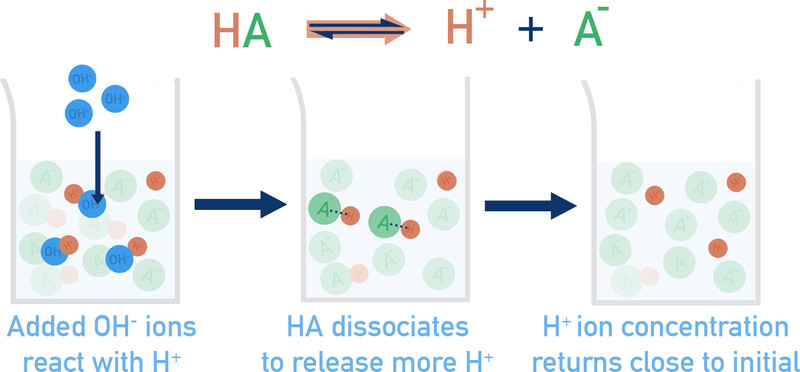
Buffer response to added OH⁻
Added reacts with , lowering the free concentration. That shift causes more HA to dissociate, producing additional and . The equilibrium adjusts so the concentration ends up close to where it started.
2. What Makes a True Buffer and What Does Not
For a solution to act as a buffer, two things must be true.
It contains a weak species and its conjugate
Examples:
- and (weak acid + conjugate base)
- and (weak base + conjugate acid)
Usually, one component comes from a salt. For example, sodium formate provides , while formic acid provides .
It does NOT involve strong acids or strong bases
These do not make buffers:
- and
- and
Strong acids and bases fully dissociate. Their conjugates are so weak they do not meaningfully react. No equilibrium system means no buffering action.
Also not a buffer:
- Just a weak acid alone
- Just a weak base alone
- Two substances that are not conjugates
On multiple-choice questions, they often hide the conjugate relationship inside a salt. Always separate ionic compounds into their ions and check whether a conjugate pair is present.
3. The Two Reactions That Make Buffers Work
Everything about buffers comes down to two neutralization reactions.
Assume a buffer made from and .
When strong acid is added
Added reacts with the conjugate base:
Instead of free building up, it gets converted into HA.
So:
- increases only slightly
- pH decreases only slightly
Without A⁻ present, that added acid would dramatically lower pH.
When strong base is added
Added reacts with the weak acid:
The is removed by forming water.
So:
- doesn’t spike
- pH increases only slightly
These are simple stoichiometric reactions. The reason the pH barely changes is that the ratio of HA to A⁻ changes only a little when both are present in large amounts.
That ratio controls pH. Small ratio change → small pH change.
4. Buffer Capacity and Maximum Effectiveness
Buffers are not unlimited.
Buffer Capacity
Buffer capacity is how much acid or base the buffer can neutralize before the pH changes dramatically.
It depends on total concentration:
- 1.0 M HA and 1.0 M A⁻ → high capacity
- 0.05 M HA and 0.05 M A⁻ → low capacity
Once one component is mostly used up, the solution stops resisting pH change.
On FRQs, they sometimes have you explain why two buffers with the same pH behave differently when acid is added. The one with higher concentration has greater capacity.
Maximum Effectiveness
A buffer works best when:
At this point:
- It can neutralize acid and base equally well
- The ratio changes the least upon addition
Even though Henderson-Hasselbalch is from an earlier topic, this is where the concept becomes meaningful.
Key Takeaways
Buffer Components
A weak acid with its conjugate base, or a weak base with its conjugate acid.
Why Strong Acid-Base Pairs Do Not Form Buffers
Their conjugates are negligible bases or acids, so they cannot neutralize added H+ or OH-.
Comparable Concentrations in a Buffer
Both conjugate pair members must be present in significant, similar amounts for effective pH resistance.
Maximum Buffering When [Acid] = [Base]
A buffer resists pH change most effectively when conjugate acid and base concentrations are equal.
Buffer Capacity
The amount of added acid or base a solution can neutralize before pH changes significantly.
Buffer Reactions
Added H+ is consumed by the conjugate base, and added OH− by the conjugate acid.
Buffer
A solution of a weak acid-base conjugate pair that resists large pH changes.
Notes
Buffer Components
A weak acid with its conjugate base, or a weak base with its conjugate acid.
Why Strong Acid-Base Pairs Do Not Form Buffers
Their conjugates are negligible bases or acids, so they cannot neutralize added H+ or OH-.
Comparable Concentrations in a Buffer
Both conjugate pair members must be present in significant, similar amounts for effective pH resistance.
Maximum Buffering When [Acid] = [Base]
A buffer resists pH change most effectively when conjugate acid and base concentrations are equal.
Buffer Capacity
The amount of added acid or base a solution can neutralize before pH changes significantly.
Buffer Reactions
Added H+ is consumed by the conjugate base, and added OH− by the conjugate acid.
Buffer
A solution of a weak acid-base conjugate pair that resists large pH changes.
