Topic 9.10 Notes – Cell Potential Under Nonstandard Conditions
1. What Cell Potential Under Nonstandard Conditions Means
is the voltage under standard conditions:
- 1 M solutions
- 1 atm gases
- 298 K
is the actual voltage at whatever concentrations you have right now.
Here’s the big idea you need to internalize:
- A working galvanic cell is not at equilibrium.
- The cell potential is a driving force toward equilibrium.
- As the reaction proceeds, the system moves closer to equilibrium and the magnitude of decreases.
- At equilibrium:
- The battery is “dead.”
That “dead battery” idea shows up in conceptual questions a lot. If voltage is zero, the reaction has reached equilibrium.
Now we need the tool that connects concentration to voltage. That tool is .
2. The Reaction Quotient Q in Electrochemical Cells
For a redox reaction,
Each raised to their stoichiometric coefficients.
Solids and pure liquids are omitted.
At standard conditions:
- All aqueous concentrations are 1 M
- So
- Therefore
Now compare to 1:
When
- Fewer products relative to reactants
- Reaction is far from equilibrium
- The system has a strong “push” forward
When
- More products than at standard conditions
- Closer to equilibrium
- Smaller driving force
As
- The system approaches equilibrium
This pattern is one of the most tested conceptual relationships in Unit 9.
Important warning
Do not use Le Châtelier’s principle language here. A running electrochemical cell is not at equilibrium. On FRQs, using Le Châtelier reasoning instead of reasoning can cost you points.
3. The Nernst Equation and What It Tells You
The Nernst equation makes the relationship precise:
You are not expected to grind through heavy calculations on the AP exam. You are expected to reason from it.
Look at the structure:
- If increases → increases → more is subtracted → decreases
- If decreases → decreases → less is subtracted → increases
At equilibrium:
This links everything together:
- (products favored)
And don’t forget the energy relationship:
- Positive → negative → spontaneous
Voltage is just another measure of thermodynamic driving force.
4. How Concentration Changes Affect Cell Potential
When a question changes concentration, do this mentally:
- Write the expression for .
- Decide if the change makes bigger or smaller.
- Compare to 1 or to .
- Predict how changes.
Example reasoning
If the reaction is:
- Increase → increases → decreases.
- Increase → decreases → increases.
- Change the mass of Zn(s) → no effect on → no change in .
Students often miss that changing the size of a solid electrode does not change voltage. Only concentrations in matter.
5. Concentration Cells and Direction of Electron Flow
A concentration cell uses the same half-reaction in both half-cells but at different ion concentrations.
Since the substances are the same:
- Voltage comes entirely from concentration differences
Here is a typical metal/metal-ion concentration cell using zinc:
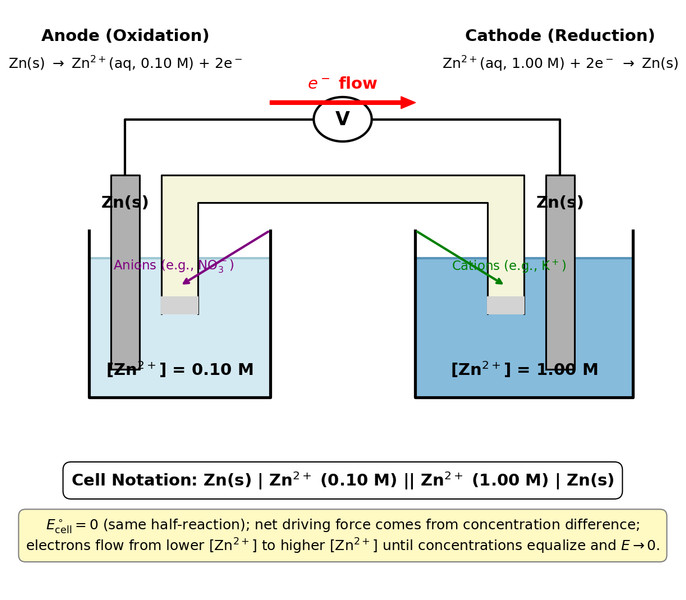
Zinc concentration cell
Electrons flow in the direction that makes concentrations equal.
- From the lower ion concentration half-cell
- Toward the higher ion concentration half-cell
The reaction proceeds until:
- Concentrations equalize
The system always runs toward equilibrium.
Key Takeaways
Standard Conditions for Electrochemical Cells
298 K, 1 atm, 1 M dissolved species, and reaction quotient Q = 1.
Nonstandard Conditions
Any cell conditions where concentrations, pressures, temperature, or Q differ from standard values.
Standard Cell Potential and Cell Potential
E°cell is the voltage at standard conditions; Ecell is the actual voltage under current conditions.
Reaction Quotient in Electrochemical Cells
Q is products over reactants using activities or concentrations, omitting pure solids and liquids.
Q = 1, Q < 1, and Q > 1
Q = 1 at standard conditions; Q < 1 means reactant-favored; Q > 1 means product-favored.
Cell Potential as a Driving Force Toward Equilibrium
Voltage measures the tendency for a redox reaction to proceed until equilibrium is reached.
Distance From Equilibrium and Magnitude of Ecell
The farther a system is from equilibrium, the larger the absolute value of its voltage.
Comparing Ecell to E°cell Using Q
If Q < 1, Ecell > E°cell; if Q > 1, Ecell < E°cell; if Q = 1, Ecell = E°cell.
Closer To Equilibrium vs Farther From Equilibrium
Changes moving Q toward K lower |Ecell|, while changes moving Q away from K raise |Ecell|.
Concentration Effects on Cell Potential
Changing ion concentrations changes Q, which changes the cell voltage under nonstandard conditions.
Pure Solids and Liquids in Q Expressions
Their activities are treated as 1, so they are omitted from the reaction quotient.
Electrode Size and Cell Potential
Changing the amount or surface area of a pure solid electrode does not change Q or voltage.
Concentration Cell Direction of Electron Flow
Electrons flow from the lower-ion-concentration half-cell toward the higher-ion-concentration half-cell to equalize concentrations.
Q = K in the Nernst Equation
Substituting equilibrium conditions gives Ecell = 0 and connects standard voltage to the equilibrium constant.
Running Electrochemical Cells and Equilibrium
A functioning electrochemical cell is not at equilibrium, so Le Châtelier’s principle does not apply.
Electrochemical Cell Equilibrium
At equilibrium, Q equals K and the cell potential is zero.
Nernst Equation
It relates cell potential to Q, letting you predict voltage changes qualitatively under nonstandard conditions.
Notes
Standard Conditions for Electrochemical Cells
298 K, 1 atm, 1 M dissolved species, and reaction quotient Q = 1.
Nonstandard Conditions
Any cell conditions where concentrations, pressures, temperature, or Q differ from standard values.
Standard Cell Potential and Cell Potential
E°cell is the voltage at standard conditions; Ecell is the actual voltage under current conditions.
Reaction Quotient in Electrochemical Cells
Q is products over reactants using activities or concentrations, omitting pure solids and liquids.
Q = 1, Q < 1, and Q > 1
Q = 1 at standard conditions; Q < 1 means reactant-favored; Q > 1 means product-favored.
Cell Potential as a Driving Force Toward Equilibrium
Voltage measures the tendency for a redox reaction to proceed until equilibrium is reached.
Distance From Equilibrium and Magnitude of Ecell
The farther a system is from equilibrium, the larger the absolute value of its voltage.
Comparing Ecell to E°cell Using Q
If Q < 1, Ecell > E°cell; if Q > 1, Ecell < E°cell; if Q = 1, Ecell = E°cell.
Closer To Equilibrium vs Farther From Equilibrium
Changes moving Q toward K lower |Ecell|, while changes moving Q away from K raise |Ecell|.
Concentration Effects on Cell Potential
Changing ion concentrations changes Q, which changes the cell voltage under nonstandard conditions.
Pure Solids and Liquids in Q Expressions
Their activities are treated as 1, so they are omitted from the reaction quotient.
Electrode Size and Cell Potential
Changing the amount or surface area of a pure solid electrode does not change Q or voltage.
Concentration Cell Direction of Electron Flow
Electrons flow from the lower-ion-concentration half-cell toward the higher-ion-concentration half-cell to equalize concentrations.
Q = K in the Nernst Equation
Substituting equilibrium conditions gives Ecell = 0 and connects standard voltage to the equilibrium constant.
Running Electrochemical Cells and Equilibrium
A functioning electrochemical cell is not at equilibrium, so Le Châtelier’s principle does not apply.
Electrochemical Cell Equilibrium
At equilibrium, Q equals K and the cell potential is zero.
Nernst Equation
It relates cell potential to Q, letting you predict voltage changes qualitatively under nonstandard conditions.
