Topic 8.10 Notes – Buffer Capacity
1. What Buffer Capacity Is
A buffer contains a weak acid and its conjugate base . Its pH is described by the Henderson-Hasselbalch equation:
That equation tells you something important:
- pH depends on the ratio
Buffer capacity is different. It asks:
How many moles of or can this buffer neutralize before the pH changes a lot?
Key distinction:
- pH → ratio
- Capacity → total amount (moles or concentrations) of and
Two buffers can have the same pH but very different capacities.
Example idea:
- Buffer 1: 0.20 M and 0.20 M
- Buffer 2: 0.020 M and 0.020 M
Both have the same ratio (1:1), so same pH.
But Buffer 1 has 10× more moles per liter, so it can absorb much more acid or base before the ratio changes significantly.
Buffers are resistant, not invincible. Once one component gets mostly used up, the pH shifts quickly.
2. What Determines Buffer Capacity
a. Total Concentration of Buffer Components
If you increase both and by the same factor:
- The ratio stays the same
- The pH stays the same
- The buffer capacity increases
Why? Because of the neutralization reactions:
More means more can be absorbed.
More means more can be absorbed.
If both are diluted equally:
- Ratio unchanged → pH unchanged
- Fewer total moles → capacity decreases
That dilution idea shows up a lot in tricky multiple choice questions.
b. Relative Amounts of Acid vs Base (Directional Capacity)
Buffers do not always resist added acid and base equally.
It depends on which component is present in greater amount.
This table summarizes how the ratio affects directional capacity.
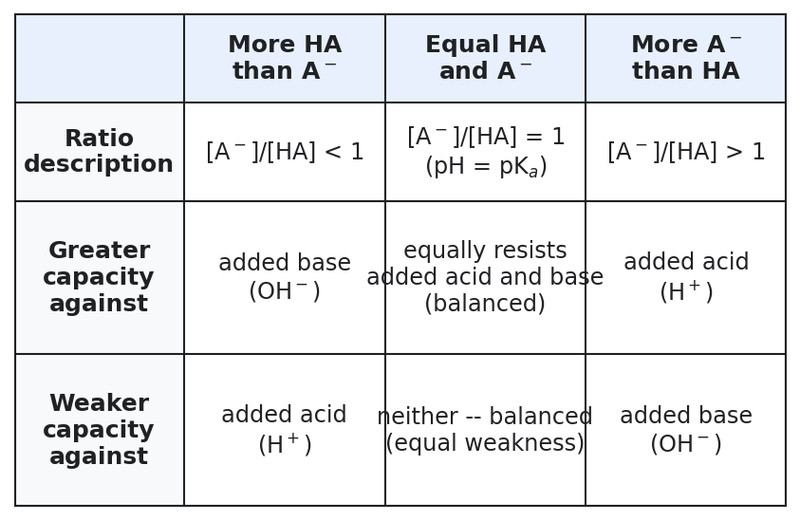
Why this makes sense:
- Added acid reacts with
- Added base reacts with
If you have more , you’re better prepared to neutralize .
If you have more , you’re better prepared to neutralize .
When :
- pH = pKa
- Capacity is balanced in both directions
That balanced case is often treated as “maximum overall buffering.”
3. How Capacity Changes as Acid or Base Is Added
When strong acid is added:
- reacts with
- decreases
- increases
- Ratio decreases → pH drops slightly
When strong base is added:
- reacts with
- decreases
- increases
- Ratio increases → pH rises slightly
Capacity weakens when:
- One component becomes very small
- The ratio shifts far from 1
- The solution is diluted
Once most of one species is consumed, the buffer “breaks,” and the pH changes sharply. On a titration curve, this is where the flat buffer region ends and the curve becomes steep.
4. How This Gets Tested
Most buffer capacity questions are qualitative.
You’ll see things like:
- Two buffers with the same ratio but different concentrations → higher concentration = greater capacity
- A dilution where both components are reduced proportionally → same pH, lower capacity
- A buffer with more conjugate base than acid → better at neutralizing added acid
- Experimental error where moles of both components are cut in half → ratio unchanged, capacity decreased
They love giving you lots of numbers and expecting you to notice what didn’t change. If the ratio stays constant, the pH stays constant. Then ask yourself how the total moles changed.
Key Takeaways
Buffer Capacity
The amount of acid or base a buffer can neutralize before pH changes significantly.
Concentration Magnitude and Buffer Capacity
Higher concentrations of both buffer components increase resistance to pH change without changing pH if their ratio stays constant.
Constant Ratio, Same pH
If conjugate acid and base concentrations change proportionally, the pH stays the same.
Directional Buffer Capacity
A buffer neutralizes added acid or base better depending on which conjugate component is present in greater amount.
Directional Buffer Capacity Comparison
Whichever buffer component is more abundant determines whether added acid or base is better neutralized.
Buffer Neutralization Reactions
Conjugate base removes added H+ and weak acid removes added OH− in a buffer.
Notes
Buffer Capacity
The amount of acid or base a buffer can neutralize before pH changes significantly.
Concentration Magnitude and Buffer Capacity
Higher concentrations of both buffer components increase resistance to pH change without changing pH if their ratio stays constant.
Constant Ratio, Same pH
If conjugate acid and base concentrations change proportionally, the pH stays the same.
Directional Buffer Capacity
A buffer neutralizes added acid or base better depending on which conjugate component is present in greater amount.
Directional Buffer Capacity Comparison
Whichever buffer component is more abundant determines whether added acid or base is better neutralized.
Buffer Neutralization Reactions
Conjugate base removes added H+ and weak acid removes added OH− in a buffer.
