Topic 9.9 Notes – Cell Potential and Free Energy
1. Cell Potential and What It Means
Cell potential (E°cell) is the voltage produced by a redox reaction in an electrochemical cell under standard conditions (1 M, 1 atm, 298 K).
- Units: volts (V), which equal J/C
- It measures the driving force for electron flow
- Positive voltage means electrons flow spontaneously through the wire
Quick galvanic refresher:
- Anode = oxidation
- Cathode = reduction
- Electrons flow anode → cathode
- “An Ox, Red Cat”
Here’s the standard Zn-Cu galvanic cell you’ve seen before:
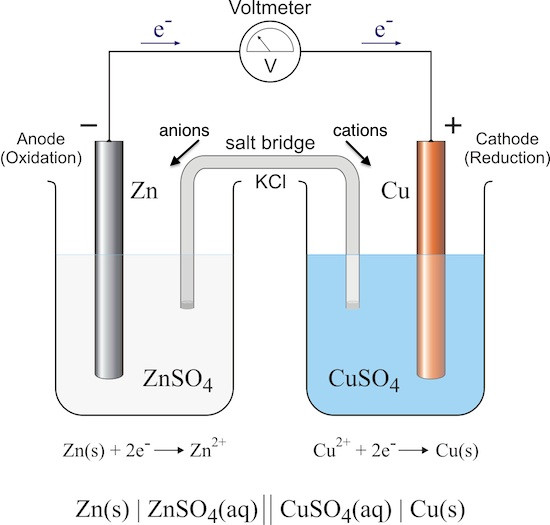
Zn-Cu galvanic cell (voltaic cell)
What the sign tells you
- E°cell > 0 → reaction is thermodynamically favored (spontaneous)
- E°cell < 0 → reaction is unfavored (needs external energy, electrolytic)
- E°cell = 0 → system at equilibrium
In the Zn-Cu cell above, electrons flow from the zinc anode to the copper cathode because the overall E°cell is positive.
A positive voltage means the reaction can do electrical work on the surroundings.
2. Standard Reduction Potentials and Calculating E°cell
All tabulated values are standard reduction potentials (E°red).
The Standard Reduction Potential Table
Every half-reaction is written as a reduction and measured relative to the:
That’s the Standard Hydrogen Electrode (SHE).
Here’s how to interpret the numbers:
| More Positive E°red | More Negative E°red |
|---|---|
| Greater tendency to be reduced | Less tendency to be reduced |
| Stronger oxidizing agent | Stronger reducing agent (when reversed) |
| More likely to be the cathode | More likely to be the anode |
The species with the higher (more positive) reduction potential gets reduced.
Identifying Anode and Cathode
When given two half-reactions:
- Pick the one with the more positive E°red → that’s the cathode (reduction).
- The other must run in reverse → that’s the anode (oxidation).
The reaction that “wants” electrons more strongly wins the reduction spot.
Calculating Standard Cell Potential
Important rules students mess up:
- Use values exactly as written in the table.
- Do not multiply E° values when balancing electrons.
- If you reverse a half-reaction, change the sign of E°.
- Coefficients affect n, not E°.
Quick Example
Suppose:
Fe³⁺ has the higher reduction potential → cathode.
Positive. The reaction is thermodynamically favored.
3. From Cell Potential to Spontaneity and ΔG°
Voltage is directly tied to free energy:
Where:
- n = moles of electrons transferred
- F = 96,485 C/mol e⁻
- E°cell in volts
- ΔG° in joules
This equation explains the sign relationship:
| E°cell | ΔG° | Reaction |
|---|---|---|
| Positive | Negative | Thermodynamically favored |
| Negative | Positive | Unfavored |
| Zero | Zero | Equilibrium |
If voltage is positive, free energy decreases. That’s why the reaction runs.
Determining n (Common AP Trap)
- n comes from the balanced overall reaction
- It is the total electrons transferred
- You must balance electrons before finding n
If one half-reaction transfers 1 e⁻ and the other 2 e⁻, you scale them to match. That changes n, but never the E° values.
On FRQs, students often multiply E° after scaling. That always loses points.
4. Big-Picture Connections
Electrochemistry is thermodynamics in action.
- Galvanic cell → chemical energy → electrical energy
- Electrolytic cell → electrical energy forces a nonspontaneous reaction
If you can:
- Identify oxidation and reduction
- Calculate E°cell correctly
- Determine its sign
- Connect that sign to ΔG°
then you can explain whether a cell is thermodynamically favored in any AP-style question.
Key Takeaways
Cell Potential / Electromotive Force
The voltage that drives electrons from anode to cathode in an electrochemical cell.
Standard Cell Potential
The cell voltage under standard conditions: 1 M, 1 atm, and 298 K.
Standard Conditions
Conditions of 1 M solutes, 1 atm gases, and a temperature of 298 K.
Anode and Cathode
Anode: oxidation; cathode: reduction; electrons flow from anode to cathode.
Calculating Standard Cell Potential from Reduction Potentials
Use E degrees cell = E degrees cathode minus E degrees anode, with both values as reductions.
Reversing a Half-Reaction and Potential Sign
If a reduction half-reaction is reversed to oxidation, its listed potential changes sign.
Standard Reduction Potential
The voltage for a half-reaction written as a reduction under standard conditions.
Standard Hydrogen Electrode
The reference half-cell assigned 0.00 V, used to define all reduction potentials.
n and Faraday's Constant in ΔG° = -nFE°
n is moles of electrons transferred; F is 96,485 coulombs per mole of electrons.
Reducing Agent and Oxidizing Agent in a Cell
The reducing agent is oxidized at the anode, and the oxidizing agent is reduced at the cathode.
Cell Potential and Thermodynamic Favorability
A positive standard cell potential means a spontaneous reaction, while a negative one requires external energy.
Cell Potential and Gibbs Free Energy
Standard free energy change equals −nFE°, so positive cell potential gives negative ΔG°.
Notes
Cell Potential / Electromotive Force
The voltage that drives electrons from anode to cathode in an electrochemical cell.
Standard Cell Potential
The cell voltage under standard conditions: 1 M, 1 atm, and 298 K.
Standard Conditions
Conditions of 1 M solutes, 1 atm gases, and a temperature of 298 K.
Anode and Cathode
Anode: oxidation; cathode: reduction; electrons flow from anode to cathode.
Calculating Standard Cell Potential from Reduction Potentials
Use E degrees cell = E degrees cathode minus E degrees anode, with both values as reductions.
Reversing a Half-Reaction and Potential Sign
If a reduction half-reaction is reversed to oxidation, its listed potential changes sign.
Standard Reduction Potential
The voltage for a half-reaction written as a reduction under standard conditions.
Standard Hydrogen Electrode
The reference half-cell assigned 0.00 V, used to define all reduction potentials.
n and Faraday's Constant in ΔG° = -nFE°
n is moles of electrons transferred; F is 96,485 coulombs per mole of electrons.
Reducing Agent and Oxidizing Agent in a Cell
The reducing agent is oxidized at the anode, and the oxidizing agent is reduced at the cathode.
Cell Potential and Thermodynamic Favorability
A positive standard cell potential means a spontaneous reaction, while a negative one requires external energy.
Cell Potential and Gibbs Free Energy
Standard free energy change equals −nFE°, so positive cell potential gives negative ΔG°.
