Topic 9.4 Notes – Thermodynamic and Kinetic Control
Thermodynamic Favorability vs Reaction Rate
Two separate ideas control what you observe in a reaction.
Thermodynamics
Thermodynamics is about energy differences between reactants and products.
The key quantity is Gibbs free energy:
- → reaction is thermodynamically favored (spontaneous).
- → reaction is not favored.
- → system is at equilibrium.
What ΔG tells you:
- Whether products are favored at equilibrium.
- The relative stability of products vs reactants.
What ΔG does not tell you:
- How fast the reaction occurs.
- Whether you’ll see it happen during class.
Students mix this up all the time. “Spontaneous” means energetically favorable, not fast.
Kinetics
Kinetics is about rate, meaning how quickly concentrations change.
A rate law looks like:
- = rate constant (depends on temperature and activation energy)
- Exponents , come from experiment
- Larger rate → reaction happens faster
Rate depends on:
- Activation energy
- Temperature
- Concentration
- Presence of a catalyst
- Reaction mechanism
So thermodynamics tells you where the reaction wants to go.
Kinetics tells you whether it gets there in your lifetime.
Activation Energy and the Energy Barrier
Even if products are lower in energy, particles must overcome an activation energy to react.
Activation energy is:
- The minimum energy needed to form the activated complex
- The height of the energy barrier
Here’s what that looks like on a reaction coordinate diagram.
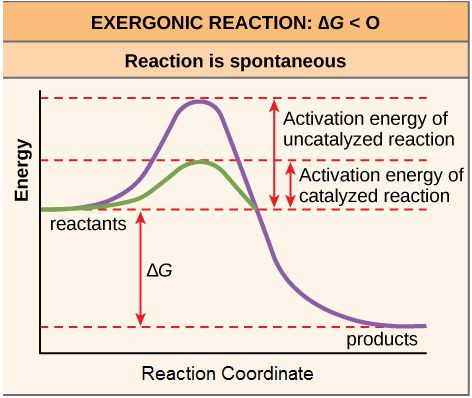
Reaction coordinate diagram for an exergonic reaction
On this diagram:
- ΔG = vertical difference between reactants and products.
- Ea = height from reactants up to the peak of the curve.
The figure also shows two pathways. The higher peak is the uncatalyzed reaction, and the lower peak is the catalyzed reaction.
Notice something important:
ΔG depends only on the starting and ending points.
Ea depends on the pathway.
If is very large:
- Very few collisions have enough energy.
- Rate is extremely small.
- Reaction may be unobservable.
This explains why many thermodynamically favored processes barely occur.
What Kinetic Control Means
A reaction is under kinetic control when:
- (products favored)
- But the reaction does not occur at a measurable rate
- Because the activation energy is very high
This does not mean:
- The system is at equilibrium.
- The reaction is nonspontaneous.
- The reaction is impossible.
It means the reaction is so slow that you don’t detect meaningful change.
AP-style questions often describe a reaction that is “thermodynamically favorable but no observable reaction occurs.” The correct reasoning is high activation energy leading to kinetic control.
How Catalysts Remove Kinetic Control
A catalyst provides an alternate pathway with a lower activation energy.
It changes:
- The mechanism
- The rate constant
- The speed of the reaction
It does not change:
- ΔG
- ΔH
- The equilibrium constant
- The energies of reactants or products
On a free energy diagram, the catalyst lowers the height of the activation barrier without changing the overall energy difference between reactants and products.

Catalyzed vs. uncatalyzed free energy diagram
The peak for the catalyzed pathway is lower, but the starting and ending energy levels are the same. That is why ΔG°rxn is unchanged.
Lower means:
- More particles can overcome the barrier.
- Reaction proceeds at a measurable rate.
- The reaction is no longer under kinetic control.
This is why adding a catalyst can suddenly make a previously “dead” reaction proceed rapidly.
Thermodynamic Control vs Kinetic Control
Here’s how to keep them straight:
| Thermodynamic Control | Kinetic Control |
|---|---|
| Determined by ΔG | Determined by activation energy |
| Focus on product stability | Focus on reaction rate |
| Describes equilibrium position | Describes how fast equilibrium is approached |
| Products lower in free energy | High energy barrier limits reaction |
In this topic, the most tested idea is simple:
A reaction can be spontaneous and still not happen at a noticeable rate.
Key Takeaways
Kinetic Control
A situation where reaction rate, often limited by high activation energy, prevents noticeable product formation.
Thermodynamic Favorability and Reaction Rate
A negative ΔG means a process is favorable, but it may still occur extremely slowly.
Thermodynamic Control
Reaction behavior determined mainly by the free-energy difference between reactants and products.
Thermodynamically Favored but Not at Equilibrium
A system may have a favorable forward process yet remain far from equilibrium if rate is negligible.
Catalyst and Kinetic Control
A catalyst provides a lower-energy pathway, increasing rate without changing overall thermodynamic favorability.
Diamond to Graphite Conversion
A spontaneous carbon allotrope change with negative ΔG that occurs extremely slowly because of a large barrier.
Hydrogen Peroxide Decomposition with Iodide Catalyst
A usually slow favorable reaction that becomes measurable when iodide lowers the activation energy.
Activation Energy and Kinetic Control
A large activation-energy barrier can keep a thermodynamically favored reaction extremely slow.
Notes
Kinetic Control
A situation where reaction rate, often limited by high activation energy, prevents noticeable product formation.
Thermodynamic Favorability and Reaction Rate
A negative ΔG means a process is favorable, but it may still occur extremely slowly.
Thermodynamic Control
Reaction behavior determined mainly by the free-energy difference between reactants and products.
Thermodynamically Favored but Not at Equilibrium
A system may have a favorable forward process yet remain far from equilibrium if rate is negligible.
Catalyst and Kinetic Control
A catalyst provides a lower-energy pathway, increasing rate without changing overall thermodynamic favorability.
Diamond to Graphite Conversion
A spontaneous carbon allotrope change with negative ΔG that occurs extremely slowly because of a large barrier.
Hydrogen Peroxide Decomposition with Iodide Catalyst
A usually slow favorable reaction that becomes measurable when iodide lowers the activation energy.
Activation Energy and Kinetic Control
A large activation-energy barrier can keep a thermodynamically favored reaction extremely slow.
