Topic 1.1 Notes – Moles and Molar Mass
1. The Mole and Why It Exists
In the lab, you can measure grams on a balance. You cannot count individual atoms or molecules. They’re far too small and there are way too many of them.
Chemistry needs a bridge between:
- Mass (grams) → what you measure
- Particles (atoms, molecules, formula units) → what reacts
That bridge is the mole (mol).
A mole is just a counting unit, like a dozen.
But instead of 12 items:
This number is Avogadro’s number, written as:
The unit “per mole” means every mole contains that many particles.
“Particles” depends on the substance:
- → atoms
- → molecules
- → formula units
- → ions (if specified)
On tests, students often lose points because they say “atoms” when they should say “molecules.” Always match the particle to the substance.
2. Atomic Mass and Molar Mass
Now we need to connect mass to moles.
Atomic Mass (amu)
On the periodic table, each element has an atomic mass listed in atomic mass units (amu).
- This is the average mass of one atom.
- Example: One atom of magnesium has a mass of about 24.31 amu.
You never weigh something in amu in lab. It’s a microscopic unit. But it leads directly to something useful.
Molar Mass (g/mol)
The molar mass is the mass of one mole of a substance, in grams per mole (g/mol).
Here’s the key connection:
The numerical value of atomic mass in amu = the numerical value of molar mass in g/mol.
If one Mg atom has a mass of 24.31 amu,
then one mole of Mg atoms has a mass of 24.31 g.
That’s why the mole works. Nature is built so that amu and g/mol line up perfectly.
Calculating Molar Mass of a Compound
Let’s find the molar mass of .
- Identify elements: Al, S, O
- Multiply atomic mass × subscript
- Al:
- S:
- O:
- Add them:
Total ≈ 342.14 g/mol
Parentheses matter. The 3 multiplies everything inside .
This calculation shows up constantly in both MCQs and FRQs.
3. The Conversion Roadmap
All conversions in this unit follow the same pattern. This roadmap shows how grams, moles, and particles connect.
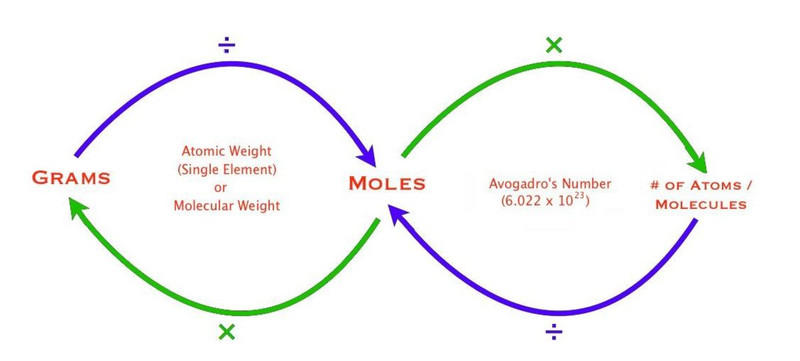
Grams-moles-particles conversion roadmap
Everything goes through moles.
Two essential relationships:
- = moles
- = mass (g)
- = molar mass (g/mol)
and
4. Dimensional Analysis in Action
Dimensional analysis is unit cancellation. Units guide you.
Example: Grams → Atoms
How many oxygen atoms are in 18.0 g of ?
Step 1: grams → moles
Molar mass of = 32.00 g/mol
Step 2: moles → molecules
Step 3: molecules → atoms
Each molecule has 2 O atoms:
Students often forget this last multiplication. Subscripts are mole ratios within a compound.
5. Common AP Traps
- Mixing up atoms vs molecules vs formula units
- Forgetting to multiply by subscripts
- Using atomic mass (amu) in place of molar mass (g/mol)
- Not tracking units through dimensional analysis
- Rounding too early and losing sig figs
If a calculation feels messy, pause and ask: Am I in moles yet?
Key Takeaways
Molar Mass
The mass of one mole of a substance, usually expressed in g/mol.
Formula Units
The lowest whole-number ratio of ions in an ionic compound, counted as particles in a mole.
Calculating Molar Mass
Add each element's atomic mass multiplied by its subscript in the chemical formula.
Moles-Mass Equation
n = m/M, where m is mass in grams and M is molar mass.
Subscripts and Particle Ratios
Subscripts show atom ratios in a formula and determine particle-to-atom conversion relationships.
Mole and Avogadro's Number
One mole contains 6.022 × 10^23 representative particles of a substance.
Atomic Mass and Molar Mass Relationship
A particle's average mass in amu equals that substance's molar mass numerically in g/mol.
Dimensional Analysis
A conversion method using molar mass or Avogadro's number so units cancel correctly.
Notes
Molar Mass
The mass of one mole of a substance, usually expressed in g/mol.
Formula Units
The lowest whole-number ratio of ions in an ionic compound, counted as particles in a mole.
Calculating Molar Mass
Add each element's atomic mass multiplied by its subscript in the chemical formula.
Moles-Mass Equation
n = m/M, where m is mass in grams and M is molar mass.
Subscripts and Particle Ratios
Subscripts show atom ratios in a formula and determine particle-to-atom conversion relationships.
Mole and Avogadro's Number
One mole contains 6.022 × 10^23 representative particles of a substance.
Atomic Mass and Molar Mass Relationship
A particle's average mass in amu equals that substance's molar mass numerically in g/mol.
Dimensional Analysis
A conversion method using molar mass or Avogadro's number so units cancel correctly.
