Topic 1.3 Notes – Elemental Composition of Pure Substances
1. What a Pure Substance Is
A pure substance has a constant composition and the same properties throughout any sample. If you scoop some from one side of the beaker or the other, it’s chemically identical.
There are two types:
- Elements
- Made of one type of atom.
- Examples: , , .
- Even if it’s diatomic like , it’s still one element.
- Compounds
- Made of two or more different elements chemically bonded in a fixed ratio.
- Examples: , , .
That “fixed ratio” idea is everything in this topic.
Molecules vs Formula Units
Compounds can be organized two ways:
Molecular substances
- Exist as discrete molecules.
- The formula shows the actual number of atoms in one molecule.
- means 2 H and 1 O in one molecule.
- means 2 C and 6 H bonded together.
Ionic substances
- Exist as a lattice of positive and negative ions.
- No individual “molecules.”
- The formula shows the lowest whole-number ratio of ions, called a formula unit.
- means 1 for every 1 .
- means 2 for every 3 .
In a solid like , the ions form a repeating three-dimensional lattice rather than separate molecules.
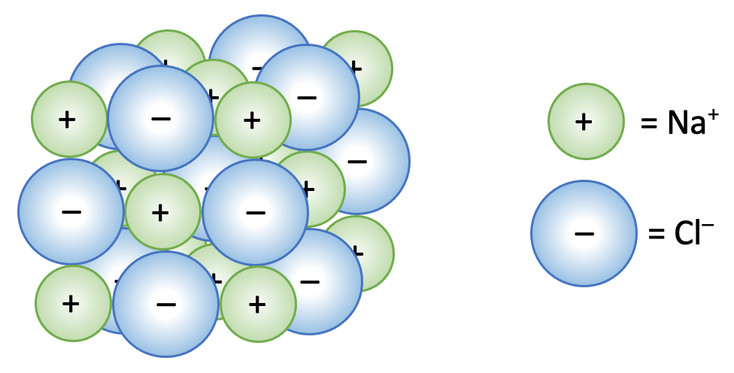
Ionic lattice of sodium chloride
Whether molecular or ionic, the formula tells you a fixed ratio of elements.
2. The Law of Definite Proportions
The law of definite proportions (law of constant composition) states:
A pure compound always contains the same elements in the same mass ratio, no matter the sample size.
If you analyze 5 g of or 500 g of , the ratio of carbon mass to oxygen mass is identical.
For example, in :
- 1 C atom → 12.01 g/mol
- 2 O atoms → g/mol
Mass ratio C:O is , which simplifies to about .
That ratio never changes for pure .
If the mass ratio changes, it is a different compound. That’s how chemists know identity.
On tests, they may give two samples and ask if they’re the same compound. Compare mass ratios, not total masses.
3. Empirical Formula
The empirical formula shows the lowest whole-number ratio of atoms in a compound.
It does not show:
- The actual number of atoms in a molecule.
- The structure.
Example:
- Molecular formula:
- Empirical formula:
Divide all subscripts by 4.
Relationship:
where is a whole number.
For ionic compounds, the formula unit is already empirical. You never reduce or further.
The empirical formula connects directly to the law of definite proportions because it reflects the constant ratio of atoms.
4. Finding an Empirical Formula from Composition Data
This is the skill they love to test.
You might get percent composition or actual masses.
The Process
- If given percentages, assume 100 g
- 40.0% C → 40.0 g C
- If one element is missing, subtract from 100%.
- Convert grams to moles
- Divide all mole amounts by the smallest value
- This gives a mole ratio.
- Make subscripts whole numbers
- 1.5 → multiply all by 2
- 1.33 or 1.67 → multiply all by 3
- 1.25 or 0.75 → multiply all by 4
Example setup (different numbers than you’ve probably seen):
A compound is 52.2% C, 13.0% H, and 34.8% O.
Assume 100 g:
- 52.2 g C → mol
- 13.0 g H → mol
- 34.8 g O → mol
Divide by 2.175:
- C:
- H:
- O:
Empirical formula:
Notice we only round at the very end. Rounding early is how students lose points.
5. Connecting Mass Ratios and Formulas
This is the core idea tying everything together:
- Formulas give mole ratios.
- Mole ratios determine mass ratios.
- Mass data must be converted to moles before writing formulas.
You never write subscripts from grams directly.
On FRQs, they may give experimental percent composition and ask you to justify a formula. The justification must show:
- Conversion to moles
- Division by smallest
- Whole-number ratio
- Final formula
If your mole ratio doesn’t reduce cleanly, check your arithmetic before multiplying.
Key Takeaways
Pure Substance
Matter with a constant composition made of only one kind of particle.
Elements and Compounds
Elements contain one type of atom; compounds contain two or more elements chemically combined.
Molecule vs. Formula Unit
Molecules are discrete covalent particles; formula units are lowest whole-number ratios in ionic compounds.
Law of Definite Proportions / Law of Constant Composition
A pure compound always contains the same elements in the same mass ratio.
Empirical Formula
The lowest whole-number ratio of atoms of each element in a compound.
Empirical Formula from Percent Composition
Assume 100 g, convert each element to moles, divide by the smallest, then multiply to whole numbers.
Percent Composition by Mass
The percent of a compound's total mass contributed by each element.
Formula Unit
The lowest whole-number ratio of ions represented in an ionic compound.
Notes
Pure Substance
Matter with a constant composition made of only one kind of particle.
Elements and Compounds
Elements contain one type of atom; compounds contain two or more elements chemically combined.
Molecule vs. Formula Unit
Molecules are discrete covalent particles; formula units are lowest whole-number ratios in ionic compounds.
Law of Definite Proportions / Law of Constant Composition
A pure compound always contains the same elements in the same mass ratio.
Empirical Formula
The lowest whole-number ratio of atoms of each element in a compound.
Empirical Formula from Percent Composition
Assume 100 g, convert each element to moles, divide by the smallest, then multiply to whole numbers.
Percent Composition by Mass
The percent of a compound's total mass contributed by each element.
Formula Unit
The lowest whole-number ratio of ions represented in an ionic compound.
