Topic 3.9 Notes – Separation of Solutions and Mixtures
1. Why Dissolved Substances Can’t Be Separated by Filtration
A solution is a homogeneous mixture. That means the solute particles are dispersed at the molecular or ionic level in the solvent.
In a true solution:
- Solute particles are extremely small (atoms, ions, or molecules).
- They are surrounded and stabilized by intermolecular forces (IMFs) with solvent particles.
- They pass straight through filter paper because filters only trap larger, undissolved particles.
Filtration works for heterogeneous mixtures, like sand + water.
- Residue stays on the filter (insoluble solid).
- Filtrate passes through (liquid + dissolved substances).
If something is dissolved, filtration cannot separate it. So chemists instead use differences in:
- Intermolecular interactions
- Boiling points (vapor pressures)
Those differences are what chromatography and distillation exploit.
2. The Two Major Separation Methods You Must Know
A. Chromatography
Chromatography separates substances dissolved in a liquid. It works because different molecules interact differently with two phases:
- Mobile phase → the moving solvent
- Stationary phase → a solid or coated surface
Each component distributes itself between these two phases.
- Stronger attraction to stationary phase → moves less
- Stronger attraction to mobile phase → moves more
Separation happens because molecules move at different speeds.
Paper Chromatography
- Stationary phase: Polar cellulose paper
- Mobile phase: Solvent rising by capillary action
Because the paper is polar:
- Polar substances stick more → travel shorter distance
- Nonpolar substances stick less → travel farther
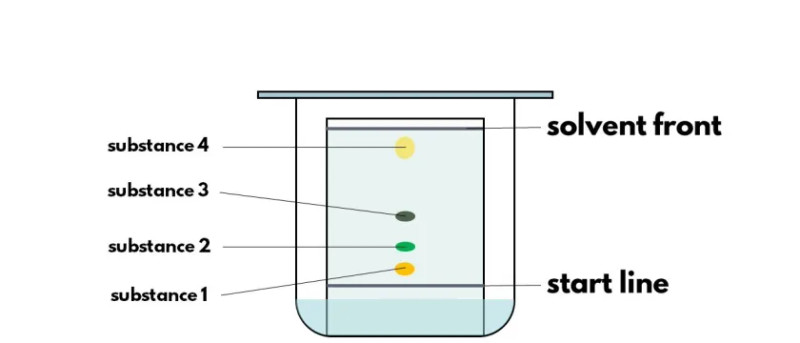
In a setup like this, the solvent rises up the paper and carries the dissolved components with it. When you interpret results, the spot that moved the least in a polar stationary system is usually the most polar substance.
Thin-Layer Chromatography (TLC)
- Stationary phase: Polar silica (SiO₂)
- Mobile phase: Liquid solvent in chamber
Same polarity logic as paper chromatography.
TLC often uses the Rf value:
- Larger → weaker attraction to stationary phase
- Smaller → stronger attraction to stationary phase
On a test, if one compound has and another has , the 0.25 compound is interacting more strongly with the polar stationary phase.
Column Chromatography
- Stationary phase packed into a column (silica or alumina)
- Mobile phase flows downward
- Substances separate into visible bands
Stronger IMF with stationary phase → slower movement → elutes later.
Same principle. Just a different setup.
B. Distillation
Distillation separates liquid-liquid mixtures.
Instead of surface attraction, it relies on boiling point differences, which come from IMF strength.
Key relationships:
- Stronger IMFs → lower vapor pressure → higher boiling point
- Weaker IMFs → higher vapor pressure → lower boiling point
When heated:
- The liquid with the lowest boiling point vaporizes first.
- Vapor is condensed and collected separately.
In a distillation setup, the mixture is heated in a flask, vapor travels through a condenser, and the condensed liquid is collected in a separate container. If two liquids differ greatly in boiling point, they separate easily. If their boiling points are close, separation is harder.
3. Types of Distillation
| Feature | Simple Distillation | Fractional Distillation |
|---|---|---|
| Boiling point difference | Large difference | Small difference |
| Vaporization-condensation steps | One | Many (fractionating column) |
| Purity | Lower | Higher |
Fractional distillation includes a fractionating column, which causes repeated vaporization-condensation cycles. Each cycle improves separation.
If boiling points are only a few degrees apart, simple distillation won’t give good purity.
4. How Intermolecular Forces Control Separation
Everything connects back to IMF strength.
Stronger IMFs mean:
- Higher boiling point
- Lower vapor pressure
- Greater attraction to polar stationary phases
- Slower movement in chromatography
Weaker IMFs mean:
- Lower boiling point
- Higher vapor pressure
- Faster movement in chromatography
- More likely to vaporize first
When explaining results, always tie your answer to relative IMF strength. That’s what graders look for.
5. Interpreting Experimental Results
You should be able to explain:
In chromatography
- Why one spot traveled farther (weaker attraction to stationary phase).
- Which compound is more polar (moves less in polar stationary system).
- What a larger or smaller implies about polarity.
In distillation
- Which liquid distills first (lower boiling point → weaker IMFs).
- Why fractional distillation improves purity (multiple vaporization-condensation cycles).
- How boiling point differences reflect IMF differences.
Most free-response questions don’t ask you to name the technique. They show results and expect you to explain them in terms of intermolecular forces and molecular interactions.
Key Takeaways
Filtration
Separates an insoluble solid from a liquid by passing the mixture through a porous barrier.
Chromatography
Separates mixture components by different attractions to a mobile phase and a stationary phase.
Stationary Phase and Mobile Phase
Stationary phase stays fixed; mobile phase moves and carries dissolved substances through or across it.
Paper, Thin-Layer, and Column Chromatography
Paper uses cellulose, TLC uses coated silica plates, and column uses packed solid adsorbent in a tube.
Chromatography and Polarity
More polar substances usually stick more to polar stationary phases and travel shorter distances.
Chromatogram
The separation pattern showing component positions after chromatography, used to compare relative polarity.
Distillation
Separates liquids by heating so the more volatile component vaporizes first and then condenses.
Simple Distillation vs. Fractional Distillation
Simple uses one vaporization-condensation step for larger boiling-point differences; fractional uses many steps for closer boiling points.
Boiling Point, Vapor Pressure, and Intermolecular Forces in Distillation
Weaker intermolecular forces give higher vapor pressure and lower boiling point, so that component distills first.
Rf Value
The ratio of a substance’s travel distance to the solvent front’s distance.
Notes
Filtration
Separates an insoluble solid from a liquid by passing the mixture through a porous barrier.
Chromatography
Separates mixture components by different attractions to a mobile phase and a stationary phase.
Stationary Phase and Mobile Phase
Stationary phase stays fixed; mobile phase moves and carries dissolved substances through or across it.
Paper, Thin-Layer, and Column Chromatography
Paper uses cellulose, TLC uses coated silica plates, and column uses packed solid adsorbent in a tube.
Chromatography and Polarity
More polar substances usually stick more to polar stationary phases and travel shorter distances.
Chromatogram
The separation pattern showing component positions after chromatography, used to compare relative polarity.
Distillation
Separates liquids by heating so the more volatile component vaporizes first and then condenses.
Simple Distillation vs. Fractional Distillation
Simple uses one vaporization-condensation step for larger boiling-point differences; fractional uses many steps for closer boiling points.
Boiling Point, Vapor Pressure, and Intermolecular Forces in Distillation
Weaker intermolecular forces give higher vapor pressure and lower boiling point, so that component distills first.
Rf Value
The ratio of a substance’s travel distance to the solvent front’s distance.
