Topic 5.11 Notes – Catalysis
1. What a Catalyst Is
A catalyst is a substance that increases the rate of a reaction by changing the mechanism.
Here’s what that means in practice:
- It provides a pathway with a lower activation energy, .
- It is used in one step of the mechanism.
- It is regenerated in a later step.
- Its net concentration stays constant.
- It does not change:
- The equilibrium constant
- The equilibrium position
So equilibrium is reached faster, but it’s the same equilibrium.
If you add all elementary steps together and the catalyst cancels out, that’s your confirmation it’s truly a catalyst.
The big picture:
Change the mechanism → change the activation energy → change the rate.
2. How Catalysts Change the Reaction Pathway
When a catalyst is added, you’re not just “speeding up” the same reaction. You are introducing a new mechanism.
Lower Activation Energy
On a reaction coordinate diagram:
- Reactant energy stays the same.
- Product energy stays the same.
- The highest peak (activation energy) becomes lower.
- Sometimes the reaction now has multiple peaks because there are new intermediates.
Here’s what that looks like on a reaction coordinate diagram comparing uncatalyzed and catalyzed pathways:
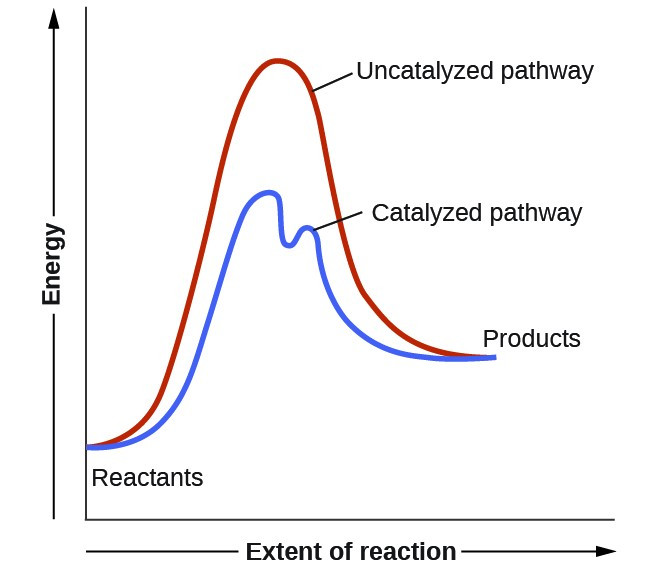
Reaction coordinate diagram: catalyzed vs. uncatalyzed pathways
The key is that the highest barrier is reduced.
Sometimes one big step becomes two smaller steps. Even if there are more steps, the tallest hill is shorter, so the reaction goes faster.
Effective Collisions
For rate to increase, one (or both) must happen:
- More effective collisions
- Lower minimum energy required for reaction
Catalysts help by:
- Holding reactants in the right orientation
- Stabilizing the transition state
- Forming reactive intermediates
On AP questions, if they ask why the rate increases, mention:
- Lower
- More effective collisions
- New mechanism
Those phrases matter.
3. What Happens to the Catalyst in a Mechanism
In a catalyzed mechanism, look for this pattern:
- Appears as a reactant early
- Appears as a product later
- Does not appear in the overall balanced equation
Example pattern:
Step 1:
Step 2:
The catalyst is often involved in the rate-determining step, then regenerated afterward.
Students sometimes think “it was used up, so it’s not a catalyst.” It’s allowed to be temporarily consumed. What matters is the net concentration stays constant.
If it never comes back, it wasn’t a catalyst.
4. Types of Catalytic Mechanisms
Different catalysts lower in different ways.
A. Binding Catalysis (including enzymes)
The catalyst binds to the reactant(s) and forms a new intermediate.
Pattern:
- Catalyst + Reactant → Bound complex
- Complex → Product + Catalyst
Effects:
- Better orientation
- Stabilized transition state
- Lower activation energy
Enzymes work this way. The enzyme-substrate complex is the new intermediate.
B. Acid-Base Catalysis
Here the catalyst transfers a proton (H⁺).
- A reactant may become protonated (more electrophilic).
- Or deprotonated (more nucleophilic).
This creates:
- A new intermediate
- New elementary steps
- A lower activation energy
Important detail:
The proton donor or acceptor is regenerated at the end.
If you see H⁺ appear in one step and reappear later, that’s acid catalysis.
C. Surface Catalysis (Heterogeneous Catalysis)
This happens on a solid surface.
- Reactants bind to the surface.
- They may form covalent bonds with surface atoms.
- New surface-bound intermediates form.
- New elementary steps involve those bound species.
Common in industrial reactions using metal catalysts.
Why this lowers :
- Weakens existing bonds
- Brings reactants close together
- Provides a new bond-breaking pathway
On exams, if they mention “adsorbed to surface” or “bound to metal,” think surface catalysis.
Key Takeaways
Catalyst
A substance that changes a reaction mechanism, lowers activation energy, and is regenerated overall.
Catalyzed vs. Uncatalyzed Reaction Pathway
The catalyzed pathway uses different elementary steps and a lower activation energy than the original pathway.
How Catalysts Increase Reaction Rate
They increase effective collisions and/or provide an alternate pathway with lower activation energy.
Catalyst Binding to Reactants
Temporary binding can orient reactants favorably or lower activation energy by forming a new intermediate.
Catalyst-Bound Intermediate
A temporary species formed when a catalyst is attached to one or more reactants.
Covalent Bonding in Catalysis
Some catalysts form temporary covalent bonds with reactants, creating alternate intermediates and reaction steps.
Enzymes as Catalysts
Biological catalysts that bind substrates, orient them, and lower activation energy for reaction.
Catalyst in a Reaction Mechanism
It is consumed in one step and regenerated later, so its overall amount stays constant.
Acid-Base Catalysis
Catalysis by proton transfer that forms new intermediates and elementary steps with lower activation energy.
Surface Catalysis
Catalysis on a solid surface where reactants form bound intermediates and react through new steps.
Notes
Catalyst
A substance that changes a reaction mechanism, lowers activation energy, and is regenerated overall.
Catalyzed vs. Uncatalyzed Reaction Pathway
The catalyzed pathway uses different elementary steps and a lower activation energy than the original pathway.
How Catalysts Increase Reaction Rate
They increase effective collisions and/or provide an alternate pathway with lower activation energy.
Catalyst Binding to Reactants
Temporary binding can orient reactants favorably or lower activation energy by forming a new intermediate.
Catalyst-Bound Intermediate
A temporary species formed when a catalyst is attached to one or more reactants.
Covalent Bonding in Catalysis
Some catalysts form temporary covalent bonds with reactants, creating alternate intermediates and reaction steps.
Enzymes as Catalysts
Biological catalysts that bind substrates, orient them, and lower activation energy for reaction.
Catalyst in a Reaction Mechanism
It is consumed in one step and regenerated later, so its overall amount stays constant.
Acid-Base Catalysis
Catalysis by proton transfer that forms new intermediates and elementary steps with lower activation energy.
Surface Catalysis
Catalysis on a solid surface where reactants form bound intermediates and react through new steps.
