Topic 4.8 Notes – Introduction to Acid-Base Reactions
1. Brønsted-Lowry Acid-Base Reactions
At this level, acid-base reactions are proton-transfer reactions.
- A proton (H⁺) is a hydrogen atom with no electrons.
- A Brønsted-Lowry acid donates a proton.
- A Brønsted-Lowry base accepts a proton.
General pattern:
Notice there’s an acid and base on both sides. That’s because when one species donates H⁺, it turns into something that could accept it back.
Conjugate Acid-Base Pairs
A conjugate acid-base pair differs by exactly one H⁺.
If you look at:
Match them up:
- and → differ by one H⁺
- and → differ by one H⁺
Now decide roles:
- gained H⁺ → it’s the base
- lost H⁺ → it’s the acid
Quick check that saves points on MCQs:
- More H = conjugate acid
- Fewer H = conjugate base
If it doesn’t differ by one H⁺, it’s not a conjugate pair.
2. The Role of Water in Acid-Base Reactions
AP Chemistry focuses on aqueous acid-base reactions. Water is not just a solvent. It actively participates.
Water Is Amphiprotic
Water can:
- Accept H⁺ → becomes
- Donate H⁺ → becomes
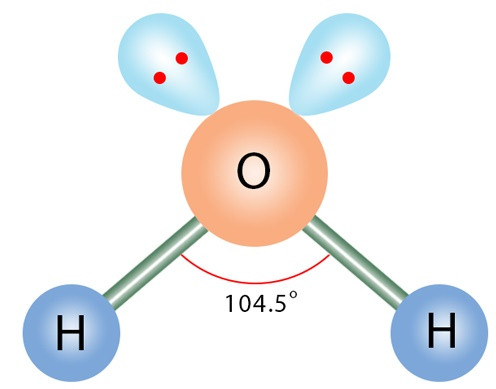
Water molecule showing bent geometry and lone pairs
Water’s two lone pairs on oxygen allow it to accept H⁺ (forming H₃O⁺), and its O-H bonds allow it to donate H⁺ (leaving OH⁻).
Because free H⁺ does not float around in solution, acids in water form hydronium:
And bases can pull H⁺ from water:
How to Spot Amphiprotic Species
They must:
- Have a removable H
- Have a lone pair to accept H⁺
Examples:
If a question asks which species can act as both acid and base, look for both features.
Important boundary: Lewis acid-base theory is not tested here. Stay focused on proton transfer in water.
3. Strength of Acids and Bases and Conjugate Pairs
Here’s the relationship students mix up:
- Strong acid → weak conjugate base
- Weak acid → stronger conjugate base
- Strong base → weak conjugate acid
Why?
If an acid gives up H⁺ easily, its conjugate base has little desire to grab it back.
Example:
What “Strong” Means
- Strong acids/bases completely ionize in water.
- Weak acids/bases establish equilibrium.
Reaction direction favors the side with the weaker acid and weaker base.
If you’re asked which way equilibrium lies, compare strengths. The stronger acid reacts with the stronger base to make weaker partners.
Students often think strong reacts to make strong. It’s the opposite. The system moves toward stability.
4. Acid-Base Neutralization Reactions
A neutralization reaction forms water and a salt.
At the particle level (for strong acid + strong base):
That net ionic equation is worth memorizing.
Writing a Net Ionic Equation
Suppose:
Steps:
- Dissociate strong electrolytes:
- Cancel spectator ions (, ).
- Final:
Do not dissociate:
- Weak acids (like )
- Weak bases
- Solids
That mistake shows up constantly on tests.
5. Stoichiometry of Acid-Base Reactions
These are limiting reactant problems with dilution at the end.
Suppose you mix:
- 0.150 M , 40.0 mL
- 0.200 M , 25.0 mL
Step 1. Convert to moles
1:1 ratio → KOH is limiting.
Step 2. Subtract reacted moles
0.00600 − 0.00500 = 0.00100 mol excess
Step 3. Divide by total volume
Total volume = 0.0650 L
Since acid is in excess, solution is acidic.
Always:
- Add volumes
- Track moles first, not concentration
- Only one of or is in excess after strong acid-strong base neutralization (both are always nonzero due to water autoionization)
Key Takeaways
Brønsted-Lowry Acid and Base
An acid donates H+; a base accepts H+ in a proton-transfer reaction.
Relative Strengths of Conjugate Pairs
Strong acids have weak conjugate bases, and strong bases have weak conjugate acids.
Reaction Direction in Acid-Base Equilibria
Proton transfer favors formation of the weaker acid and weaker base.
Amphiprotic Substance
A species that can either donate a proton or accept a proton.
Water's Role in Acid-Base Reactions
In aqueous solution, H2O can accept H+ to form H3O+ or donate H+ to form OH-.
Conjugate Acid-Base Pair
Two species that differ by one proton; the acid has one more H+.
Acids and Bases in Water
In water, acids donate H+ to H2O and bases accept H+ from H2O.
Notes
Brønsted-Lowry Acid and Base
An acid donates H+; a base accepts H+ in a proton-transfer reaction.
Relative Strengths of Conjugate Pairs
Strong acids have weak conjugate bases, and strong bases have weak conjugate acids.
Reaction Direction in Acid-Base Equilibria
Proton transfer favors formation of the weaker acid and weaker base.
Amphiprotic Substance
A species that can either donate a proton or accept a proton.
Water's Role in Acid-Base Reactions
In aqueous solution, H2O can accept H+ to form H3O+ or donate H+ to form OH-.
Conjugate Acid-Base Pair
Two species that differ by one proton; the acid has one more H+.
Acids and Bases in Water
In water, acids donate H+ to H2O and bases accept H+ from H2O.
