Topic 9.7 Notes – Coupled Reactions
1. What Makes a Reaction Thermodynamically Favorable or Unfavorable
At constant temperature and pressure, Gibbs free energy change, ΔG°, determines spontaneity.
- ΔG° < 0 → thermodynamically favorable (spontaneous under standard conditions)
- ΔG° > 0 → thermodynamically unfavorable (nonspontaneous under standard conditions)
- ΔG° = 0 → system is at equilibrium
This connects directly to the equilibrium constant:
Where:
- = 8.314 J·mol·K
- = temperature in Kelvin
- = equilibrium constant
So:
- K > 1 → lnK > 0 → ΔG° < 0 → products favored
- K < 1 → lnK < 0 → ΔG° > 0 → reactants favored
If a reaction has ΔG° > 0, it will not occur on its own under standard conditions. That’s a thermodynamics statement. It says nothing about how fast it would go. Rate is a kinetics issue.
Now the question becomes: how can we make a reaction with ΔG° > 0 actually happen?
2. Two Ways to Drive a Thermodynamically Unfavorable Reaction
a. Using an External Energy Source
An outside energy input can make the overall process favorable.
Common AP examples:
- Electrical energy
- Drives an electrolytic cell
- Forces a nonspontaneous redox reaction to occur
- Used to charge a battery by pushing electrons “uphill”
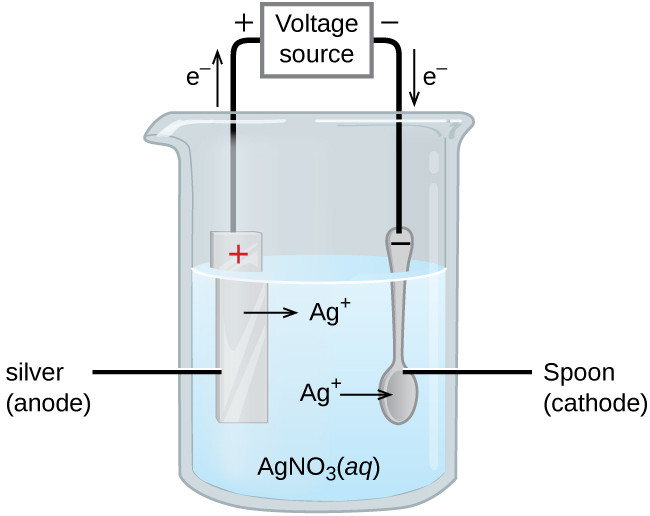
Electrolytic cell for silver plating
In the silver-plating setup shown, the power supply pulls electrons from the silver anode and pushes them onto the spoon cathode, forcing in solution to be reduced onto the spoon.
In an electrolytic cell:
- The redox reaction has ΔG° > 0
- The power supply provides electrical work
- The combined system (reaction + electricity) proceeds
- Light energy
- Photosynthesis uses light to convert and into glucose.
- Light energy is converted into chemical potential energy stored in bonds.
The reaction itself is not spontaneous. The energy input drives it.
On exams, if you see “electrolytic cell” or “light-driven reaction,” think external energy overcomes positive ΔG°.
b. Coupling to a Favorable Reaction
Instead of adding electricity or light, you can pair a nonspontaneous reaction with a spontaneous one.
Two reactions are coupled when:
- They share a common intermediate
- That intermediate cancels when the reactions are added
- The total free energy change is:
Because ΔG° is a state function, it’s additive, just like ΔH in Hess’s Law.
If:
- Reaction 1: ΔG° > 0
- Reaction 2: ΔG° < 0
- The negative value is larger in magnitude
Then:
- ΔG°₍overall₎ < 0
- The combined process is thermodynamically favorable.
3. How Reaction Coupling Works
Let’s walk through the logic using a generic setup.
Step 1: Identify the reactions
Suppose:
Notice B is produced in one and consumed in the other. That makes it a candidate for an intermediate.
Step 2: Add the reactions
Cancel B:
Add ΔG° values:
Now the overall reaction is spontaneous.
Key rules you must remember on tests:
- If you multiply a reaction by a factor, multiply ΔG° by the same factor.
- If intermediates do not cancel completely, the reactions are not properly coupled.
- This process is mathematically identical to Hess’s Law.
4. Common Intermediates and Why They Matter
An intermediate:
- Is formed in one reaction
- Is consumed in another
- Does not appear in the overall balanced equation
Without a shared intermediate, one reaction cannot directly “pull” the other forward.
On FRQs, they often give you two equations and ask whether coupling is possible. Scan for a species that appears as a product in one and a reactant in the other. Then check if scaling will allow full cancellation.
5. Biological and Real-World Examples of Coupling
a. ATP Hydrolysis
In cells:
Many cellular processes have ΔG° > 0. Cells chemically link them to ATP hydrolysis through shared intermediates. When added together, the overall ΔG° becomes negative.
ATP does not magically “release energy.” Its hydrolysis is chemically coupled through real reaction steps.
b. Industrial Chemistry
In metallurgy, a metal oxide that does not decompose spontaneously can be combined with a strongly spontaneous oxidation reaction. The favorable reaction drives the overall process so that ΔG°₍overall₎ < 0.
You may see this framed as adding equations and calculating total ΔG°.
Key Takeaways
Thermodynamically Unfavorable Reaction / Nonspontaneous Reaction
A process with positive ΔG that does not occur on its own.
External Energy Source
Added energy, such as electricity or light, used to drive a nonspontaneous process.
Coupled Reactions
A spontaneous and nonspontaneous reaction linked by shared intermediates to give an overall negative ΔG.
Common Intermediate
A species produced in one step and consumed in another, canceling in the overall reaction.
Overall ΔG In A Coupled System
Add the ΔG values of the individual reactions; the total must be negative.
Scaling Reactions In Coupling Calculations
When a reaction is multiplied, multiply its ΔG by the same factor.
Electrolytic Cell
An electrochemical cell that uses electrical energy to force a nonspontaneous redox reaction.
Charging A Battery
Using electrical energy to reverse the spontaneous cell reaction and store chemical energy.
Photosynthesis As An Energy-Driven Process
Light energy drives the overall conversion of carbon dioxide and water into glucose and oxygen.
ATP To ADP Coupling
ATP hydrolysis releases free energy that can drive otherwise unfavorable biological reactions.
Notes
Thermodynamically Unfavorable Reaction / Nonspontaneous Reaction
A process with positive ΔG that does not occur on its own.
External Energy Source
Added energy, such as electricity or light, used to drive a nonspontaneous process.
Coupled Reactions
A spontaneous and nonspontaneous reaction linked by shared intermediates to give an overall negative ΔG.
Common Intermediate
A species produced in one step and consumed in another, canceling in the overall reaction.
Overall ΔG In A Coupled System
Add the ΔG values of the individual reactions; the total must be negative.
Scaling Reactions In Coupling Calculations
When a reaction is multiplied, multiply its ΔG by the same factor.
Electrolytic Cell
An electrochemical cell that uses electrical energy to force a nonspontaneous redox reaction.
Charging A Battery
Using electrical energy to reverse the spontaneous cell reaction and store chemical energy.
Photosynthesis As An Energy-Driven Process
Light energy drives the overall conversion of carbon dioxide and water into glucose and oxygen.
ATP To ADP Coupling
ATP hydrolysis releases free energy that can drive otherwise unfavorable biological reactions.
