Topic 2.2 Notes – Intramolecular Force and Potential Energy
Intramolecular Forces and Potential Energy
Intramolecular forces are the forces within a compound that hold atoms together. In AP Chem, that means:
- Covalent bonds (shared electrons)
- Ionic attractions (electrostatic attraction between cations and anions)
Bonding makes sense when you think in terms of potential energy (PE).
- When atoms are far apart, PE is defined as ~0.
- When they bond, the system’s PE decreases.
- Lower PE = greater stability.
Bond formation releases energy because the system moves to a lower PE.
Bond breaking requires energy because you’re pulling atoms up out of that low-energy state.
Everything in this topic comes back to one idea:
Atoms arrange themselves at the distance where potential energy is minimized.
That distance shows up clearly on a graph.
Potential Energy vs. Internuclear Distance
This graph is one of the most testable visuals in Unit 2. Take a second to connect the shape of the curve to what we just discussed about stability and potential energy.
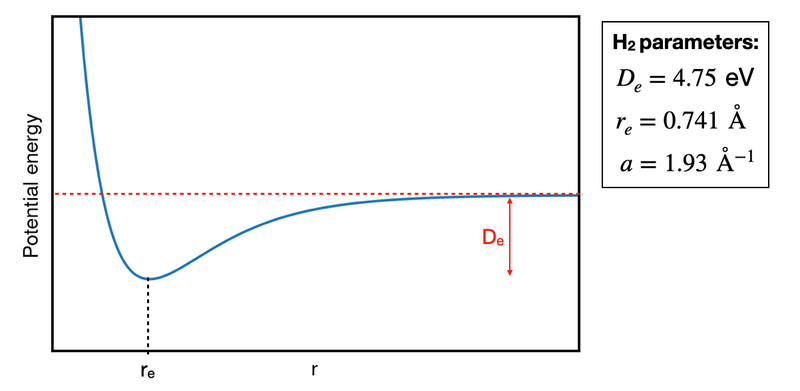
Potential energy curve for H₂
Three regions to understand
1. At large distances
- PE ≈ 0
- Atoms don’t interact
- No bond
2. As atoms move closer
- Electron-nucleus attractions increase
- PE decreases (more negative)
- System becomes more stable
3. Very short distances
- Nucleus-nucleus and electron-electron repulsion dominates
- PE increases sharply
- System becomes unstable
Equilibrium bond length
- The lowest point on the curve (labeled on the graph)
- Attractive and repulsive forces are balanced
- The actual bond length
Bond energy
- The energy required to separate atoms to infinite distance
- Shown as the vertical distance from the minimum up to PE = 0 (labeled )
- Deeper well = stronger bond
A common MCQ move is showing two curves and asking which bond is stronger. The deeper curve always corresponds to higher bond energy.
Now let’s connect that to covalent bonding.
Covalent Bonds and Bond Length
Two big factors affect covalent bond strength and length:
Bond order
Bond order = number of shared electron pairs.
| Bond Type | Shared Pairs | Bond Length | Bond Energy |
|---|---|---|---|
| Single | 1 pair | Longest | Lowest |
| Double | 2 pairs | Shorter | Higher |
| Triple | 3 pairs | Shortest | Highest |
More shared electrons means:
- Greater electron density between nuclei
- Stronger attraction
- Shorter bond length
- Larger bond energy
On a PE graph, a triple bond would have a deeper minimum and slightly shorter equilibrium distance than a single bond.
Atomic size
Larger atoms have larger radii. That increases internuclear distance.
- Down a group → atoms get larger
- Bond length increases
- Bond energy decreases
On a PE curve:
- Larger atoms → minimum shifts right
- Weaker bond → well is shallower
If you compare and , the iodine bond is longer and weaker. That’s periodic trends plus PE reasoning working together.
Ionic Bonds and Coulomb’s Law
Ionic bonding strength is explained by Coulomb’s law. Conceptually:
- Attraction increases with larger charges
- Attraction increases with smaller distance between ion centers
The relationship is:
Where:
- = ionic charges
- = distance between nuclei
Effect of charge
Compare:
- and
- and
The second pair has larger charges, so the electrostatic attraction is stronger. That leads to larger lattice energy and stronger ionic bonding.
Effect of size
Smaller ions bring charges closer together.
- Smaller → stronger attraction
- Larger → weaker attraction
So the strongest ionic interactions happen between:
- Highly charged ions
- Small ions
On FRQs, you’re often asked to justify which ionic compound has stronger attractions. The scoring almost always requires mentioning charge magnitude and distance between nuclei explicitly.
Key Takeaways
Potential Energy Vs. Internuclear Distance Graph
A curve showing how energy changes as bonded atoms move closer together or farther apart.
Equilibrium Bond Length
The internuclear distance where potential energy is lowest and the bonded atoms are most stable.
Bond Energy
The energy required to separate bonded atoms from their equilibrium distance to infinite separation.
Bond Strength and Potential Energy
Stronger bonds have larger bond energies and lower minimum potential energies than weaker bonds.
Potential Energy Curve Regions
Very close atoms repel strongly, intermediate distances attract and bond, and far-apart atoms have near-zero interaction.
Bond Order
The number of shared electron pairs between atoms: single, double, or triple.
Single, Double, And Triple Bonds
Single: 2 shared electrons, longest, weakest; double: 4, intermediate; triple: 6, shortest, strongest.
Atomic Size and Covalent Bond Length
Larger bonded atoms generally form longer covalent bonds because their nuclei are farther apart.
Coulomb's Law and Ionic Interaction Strength
Electrostatic attraction is stronger for oppositely charged, smaller, and more highly charged ions.
Internuclear Distance
The distance between the nuclei of two bonded or interacting atoms.
Notes
Potential Energy Vs. Internuclear Distance Graph
A curve showing how energy changes as bonded atoms move closer together or farther apart.
Equilibrium Bond Length
The internuclear distance where potential energy is lowest and the bonded atoms are most stable.
Bond Energy
The energy required to separate bonded atoms from their equilibrium distance to infinite separation.
Bond Strength and Potential Energy
Stronger bonds have larger bond energies and lower minimum potential energies than weaker bonds.
Potential Energy Curve Regions
Very close atoms repel strongly, intermediate distances attract and bond, and far-apart atoms have near-zero interaction.
Bond Order
The number of shared electron pairs between atoms: single, double, or triple.
Single, Double, And Triple Bonds
Single: 2 shared electrons, longest, weakest; double: 4, intermediate; triple: 6, shortest, strongest.
Atomic Size and Covalent Bond Length
Larger bonded atoms generally form longer covalent bonds because their nuclei are farther apart.
Coulomb's Law and Ionic Interaction Strength
Electrostatic attraction is stronger for oppositely charged, smaller, and more highly charged ions.
Internuclear Distance
The distance between the nuclei of two bonded or interacting atoms.
