Topic 9.8 Notes – Galvanic (Voltaic) and Electrolytic Cells
1. What an Electrochemical Cell Is
An electrochemical cell is a setup where a redox reaction and electron flow are physically separated so we can capture or control electrical energy.
First, lock in the redox basics:
- Oxidation = loss of electrons
- Reduction = gain of electrons
- Oxidation occurs at the anode
- Reduction occurs at the cathode
- Electrons always flow anode → cathode
That last line is always true. Do not let diagrams flip you around.
What’s happening at the particulate level
- Electrons move through a wire.
- Ions move through solution (and salt bridge) to maintain charge balance.
- At an electrode, atoms can dissolve into solution or plate onto the surface.
- Gas may form if a half-reaction produces a gas.
What you might observe (macroscopic level)
- A voltmeter reads a voltage.
- An electrode gains or loses mass.
- Bubbles form.
- The solution’s color changes as ion concentrations change.
On tests, they love asking you to connect what you see to what particles are doing. For example, if an electrode’s mass decreases, that metal is being oxidized.
2. The Components of an Electrochemical Cell and What Each Does
A standard galvanic cell looks like this:
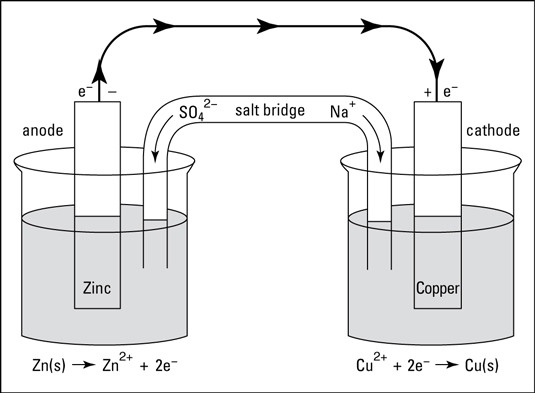
Daniell galvanic cell (Zn-Cu voltaic cell)
This example uses zinc as the anode and copper as the cathode. Keep that specific setup in mind as we break down each component.
a. Electrodes
- Solid conductors where half-reactions occur.
- Anode → oxidation.
- Cathode → reduction.
In the diagram, zinc is the anode where , and copper is the cathode where .
Two types:
- Active electrodes (like Zn, Cu) participate in the reaction.
- Inert electrodes (Pt, graphite) only provide a surface.
Mass changes:
- Metal oxidized → electrode mass decreases.
- Metal ion reduced → electrode mass increases.
b. Solutions in the Half-Cells
Each half-cell contains ions involved in its half-reaction.
As the reaction runs:
- Oxidation produces metal ions → concentration increases.
- Reduction consumes metal ions → concentration decreases.
That concentration change is often how FRQs test whether you understand which half-reaction is happening.
c. Salt Bridge
The salt bridge contains inert ions (like , ).
Its job is to maintain electrical neutrality.
- Anions move toward the anode (where positive charge builds).
- Cations move toward the cathode (where positive charge is removed).
In the diagram, notice that negative ions flow into the zinc half-cell and positive ions flow into the copper half-cell to keep charge balanced.
Without the salt bridge, charge buildup would stop electron flow.
d. External Wire and Measuring Device
- The wire allows electron flow.
- A voltmeter measures cell potential .
- In electrolytic cells, a battery pushes electrons in a nonspontaneous direction.
Electrons flow through the wire from the zinc anode to the copper cathode, which is why the voltmeter can detect a potential difference.
3. Galvanic vs Electrolytic Cells
Here’s the big-picture comparison:
| Feature | Galvanic (Voltaic) | Electrolytic |
|---|---|---|
| Spontaneity | Spontaneous | Nonspontaneous |
| Energy conversion | Chemical → electrical | Electrical → chemical |
| > 0 | < 0 | |
| External battery? | No | Yes |
In both types:
- Oxidation is still at the anode.
- Reduction is still at the cathode.
- Electrons still flow anode → cathode.
Students often mix that up in electrolytic cells. Don’t.
Macroscopic clues:
- Galvanic cells produce voltage on their own.
- Electrolytic cells require enough applied voltage to overcome .
- Gas formation is common in electrolytic setups.
4. Cell Potential and Reaction Direction
Cell potential measures the driving force for electron transfer.
Standard Reduction Potentials
- All values are written as reductions.
- Units are volts.
- More positive → stronger tendency to be reduced.
Calculating
Rules you must follow:
- Use reduction potentials as given.
- If you reverse a half-reaction, change the sign.
- Do not multiply values when balancing electrons.
If , the reaction is spontaneous (galvanic).
If , it’s nonspontaneous (electrolytic).
Connection to thermodynamics:
- Spontaneous → .
- Nonspontaneous → .
AP questions often hide this connection. If they give you a positive cell potential, you immediately know the sign of .
5. Reading and Analyzing Cell Diagrams
When you see a cell diagram, you should automatically ask:
- Which species is oxidized?
- Which is reduced?
- Where is the anode? Cathode?
- Which way do electrons flow?
- How does electrode mass change?
- Is the reaction spontaneous?
Fast strategy:
- Identify the half-reaction with the higher reduction potential. That is the cathode.
- The other is the anode.
- Electrons flow anode → cathode.
- Calculate to confirm spontaneity.
The AP will not assess labeling electrodes as positive or negative. Focus on oxidation, reduction, and electron flow instead.
Key Takeaways
Electrochemistry
The study of redox reactions that convert chemical energy and electrical energy into each other.
Electrochemical Cell
A device in which separated half-reactions transfer electrons through a wire and ions through solution.
Half-Reactions
Separate oxidation and reduction equations that show electron loss and gain in a redox process.
Standard Reduction Potentials
Tabulated voltages for reduction half-reactions under standard conditions, used to calculate overall cell voltage.
Anode and Cathode
Anode is where oxidation occurs; cathode is where reduction occurs in all electrochemical cells.
Electron Flow in Electrochemical Cells
Electrons move through the wire from the anode to the cathode.
Half-Cell Solutions
Solutions containing the ions involved in each electrode reaction, allowing charge transfer and reaction progress.
Voltmeter / Current-Measuring Device
An external device connected to the circuit to measure the cell's potential difference or current.
Electrode Mass Changes
The oxidation electrode loses mass, while the reduction electrode gains mass when solid metal is deposited.
Gas Evolution at an Electrode
Gas forms at an electrode when a half-reaction produces a gaseous product, often seen as bubbles.
Galvanic vs. Electrolytic Cells
Spontaneous cells generate electrical energy, while nonspontaneous cells require external electrical energy.
Cell Potential Calculations
Overall voltage equals cathode reduction potential minus anode reduction potential; reversing changes sign only.
Salt Bridge
A tube of inert ions that maintains neutrality by sending anions to the anode and cations to the cathode.
Electrodes
Conductive surfaces where redox occurs; some are inert and only provide electron-transfer surfaces.
Current
The flow of positive charge through a circuit, opposite the direction of electron flow.
Notes
Electrochemistry
The study of redox reactions that convert chemical energy and electrical energy into each other.
Electrochemical Cell
A device in which separated half-reactions transfer electrons through a wire and ions through solution.
Half-Reactions
Separate oxidation and reduction equations that show electron loss and gain in a redox process.
Standard Reduction Potentials
Tabulated voltages for reduction half-reactions under standard conditions, used to calculate overall cell voltage.
Anode and Cathode
Anode is where oxidation occurs; cathode is where reduction occurs in all electrochemical cells.
Electron Flow in Electrochemical Cells
Electrons move through the wire from the anode to the cathode.
Half-Cell Solutions
Solutions containing the ions involved in each electrode reaction, allowing charge transfer and reaction progress.
Voltmeter / Current-Measuring Device
An external device connected to the circuit to measure the cell's potential difference or current.
Electrode Mass Changes
The oxidation electrode loses mass, while the reduction electrode gains mass when solid metal is deposited.
Gas Evolution at an Electrode
Gas forms at an electrode when a half-reaction produces a gaseous product, often seen as bubbles.
Galvanic vs. Electrolytic Cells
Spontaneous cells generate electrical energy, while nonspontaneous cells require external electrical energy.
Cell Potential Calculations
Overall voltage equals cathode reduction potential minus anode reduction potential; reversing changes sign only.
Salt Bridge
A tube of inert ions that maintains neutrality by sending anions to the anode and cations to the cathode.
Electrodes
Conductive surfaces where redox occurs; some are inert and only provide electron-transfer surfaces.
Current
The flow of positive charge through a circuit, opposite the direction of electron flow.
