Topic 8.6 Notes – Molecular Structure of Acids and Bases
1. Acid and Base Strength Comes from Conjugate Stability
You already know the Brønsted-Lowry definitions:
- Acid = proton () donor
- Base = proton () acceptor
- Every acid forms a conjugate base
- Every base forms a conjugate acid
The strength relationship is always inverse:
- Strong acid → very weak, very stable conjugate base
- Weak acid → relatively stronger conjugate base
- Strong base → very weak conjugate acid
- Weak base → relatively stronger conjugate acid
So when you see a structure, mentally do this:
- Remove (if analyzing an acid).
- Add (if analyzing a base).
- Ask: How stable is the resulting species?
Stability of charge is the whole game.
2. What Makes an Acid Strong or Weak
Acid strength depends on two big things:
- How easy it is to break the H-X bond
- How stable the conjugate base is
a. H-X Bond Strength and Periodic Trends
If the H-X bond is weak, it’s easier to lose .
Down a group (like the halogens):
Acidity increases going down because:
- Atoms get larger
- H-X bond gets longer and weaker
- Easier to remove
Across a period:
- More electronegative atoms stabilize negative charge better.
- So acids generally get stronger left → right.
Students often mix this up. Down a group, size dominates. Across a period, electronegativity dominates.
b. Electronegativity and Inductive Effects
If nearby atoms are very electronegative, they pull electron density toward themselves.
That:
- Increases polarity of the O-H or H-X bond
- Stabilizes the negative charge in the conjugate base
- Increases acid strength
This is called the inductive effect.
The closer the electronegative atom is to the acidic hydrogen, the stronger the effect.
AP questions love showing you two similar structures with one extra electronegative atom and asking which is more acidic. Look for what stabilizes the negative charge.
c. Resonance Stabilization of the Conjugate Base
If the conjugate base can delocalize its negative charge, it becomes much more stable.
Here’s the classic comparison between a carboxylic acid and an alcohol. Focus on how the negative charge is distributed in each conjugate base.
| Carboxylic Acid (RCOOH) | Alcohol (ROH) |
|---|---|
| Conjugate base is RCOO⁻ | Conjugate base is RO⁻ |
| Negative charge delocalized over two O atoms (resonance) | Negative charge stuck on one O |
| More stable conjugate base → stronger acid | Less stable conjugate base → much weaker acid |
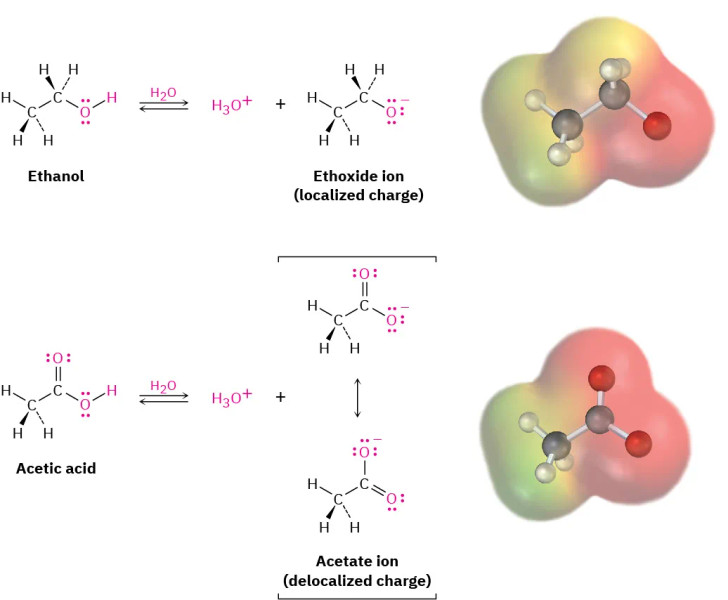
Localized vs delocalized negative charge in ethoxide and acetate
The alcohol’s conjugate base has the charge confined to one oxygen. The carboxylate spreads that charge over two oxygens through resonance, which makes it much more stable.
Resonance stabilization is one of the most powerful acid-strength factors you’ll see.
d. Oxyacids and Oxidation State
Oxyacids look like .
Acid strength increases when:
- Z is very electronegative
- Z has a high oxidation state
That pulls electron density away from O-H and stabilizes the conjugate base.
This explains why these are strong acids:
- (first proton)
Their conjugate bases are extremely stabilized by resonance and inductive effects.
e. Strong Acids to Recognize
You are expected to know these without hesitation:
- , ,
- (first proton only)
If you see one of these, assume complete dissociation.
3. What Makes a Base Strong or Weak
For bases, flip the thinking. Add and look at the conjugate acid.
a. Strong Bases: Group I and II Hydroxides
Strong bases include:
- Group I: , ,
- Group II: , ,
They:
- Dissociate completely in water
- Produce
- Have extremely weak conjugate acids ()
So strong base → very weak conjugate acid.
b. Nitrogenous Bases
Common weak bases:
- Amines like
Nitrogen has a lone pair that accepts :
More electron density on nitrogen → stronger base.
Alkyl groups push electron density toward N, slightly increasing basicity.
c. Carboxylate Ions as Weak Bases
Carboxylate ions () are weak bases because:
- Their negative charge is already resonance-stabilized
- They are comfortable as they are
- They don’t strongly attract
Stable anion → weak base.
4. Predicting Strength from Structure
When comparing molecules:
- Identify the acidic hydrogen.
- Draw the conjugate base.
- Look for:
- Resonance?
- Electronegative atoms?
- Inductive effects?
- Atom size?
- More stable conjugate species → stronger parent acid.
On FRQs, they expect you to justify with structure language like “the conjugate base is stabilized by resonance” or “the negative charge is localized on a less electronegative atom.” Be specific.
Key Takeaways
Acid and Base Strength vs. Conjugate Stability
Stronger acids have weaker, more stable conjugate bases; stronger bases have weaker conjugate acids.
Acidic Proton Identification
Hydrogens bonded to electronegative atoms or in acidic groups are most likely to transfer as H+.
H-X Bond Strength and Binary Acid Strength
Weaker H-X bonds give stronger acids; for hydrogen halides, acidity increases down the group.
Electronegativity and Acid Strength
More electronegative atoms stabilize negative charge in the conjugate base, increasing acid strength.
Inductive Effects
Electron-withdrawing atoms pull electron density through sigma bonds, stabilizing nearby negative charge.
Resonance Stabilization and Acid Strength
Delocalizing negative charge over multiple atoms stabilizes the conjugate base and strengthens the acid.
Oxyacid Strength
Stronger oxyacids have more electron-withdrawing central atoms or higher oxidation states, weakening the O-H bond.
Strong Acids
HCl, HBr, HI, HNO3, HClO4, and the first proton of H2SO4 dissociate essentially completely in water.
Carboxylic Acids
Organic acids containing a COOH group that are weak acids because their conjugate bases are resonance-stabilized.
Carboxylic Acids vs. Alcohols
COOH compounds are more acidic than ROH compounds because carboxylate ions are resonance-stabilized but alkoxides are not.
Strong Bases: Group I and II Hydroxides
Alkali metal hydroxides and Ca(OH)2, Sr(OH)2, Ba(OH)2 dissociate completely to produce OH-.
Carboxylate Ions
Resonance-stabilized conjugate bases of carboxylic acids that are weak bases and can accept H+.
Electron-Donating Groups and Amine Basicity
Alkyl groups increase amine basicity by donating electron density to nitrogen's lone pair.
Common Weak Bases
Ammonia, amines, and carboxylate ions are weak bases that only partially react with water.
Notes
Acid and Base Strength vs. Conjugate Stability
Stronger acids have weaker, more stable conjugate bases; stronger bases have weaker conjugate acids.
Acidic Proton Identification
Hydrogens bonded to electronegative atoms or in acidic groups are most likely to transfer as H+.
H-X Bond Strength and Binary Acid Strength
Weaker H-X bonds give stronger acids; for hydrogen halides, acidity increases down the group.
Electronegativity and Acid Strength
More electronegative atoms stabilize negative charge in the conjugate base, increasing acid strength.
Inductive Effects
Electron-withdrawing atoms pull electron density through sigma bonds, stabilizing nearby negative charge.
Resonance Stabilization and Acid Strength
Delocalizing negative charge over multiple atoms stabilizes the conjugate base and strengthens the acid.
Oxyacid Strength
Stronger oxyacids have more electron-withdrawing central atoms or higher oxidation states, weakening the O-H bond.
Strong Acids
HCl, HBr, HI, HNO3, HClO4, and the first proton of H2SO4 dissociate essentially completely in water.
Carboxylic Acids
Organic acids containing a COOH group that are weak acids because their conjugate bases are resonance-stabilized.
Carboxylic Acids vs. Alcohols
COOH compounds are more acidic than ROH compounds because carboxylate ions are resonance-stabilized but alkoxides are not.
Strong Bases: Group I and II Hydroxides
Alkali metal hydroxides and Ca(OH)2, Sr(OH)2, Ba(OH)2 dissociate completely to produce OH-.
Carboxylate Ions
Resonance-stabilized conjugate bases of carboxylic acids that are weak bases and can accept H+.
Electron-Donating Groups and Amine Basicity
Alkyl groups increase amine basicity by donating electron density to nitrogen's lone pair.
Common Weak Bases
Ammonia, amines, and carboxylate ions are weak bases that only partially react with water.
