Topic 3.2 Notes – Properties of Solids
1. How Particle Structure Determines Solid Properties
In a solid, particles are fixed in place and only vibrate. What those particles are, and how strongly they attract each other, controls the properties you measure in lab.
Here’s the core relationship you should always think about:
- Stronger attractions → higher melting point
- Stronger attractions → higher boiling point
- Stronger attractions → lower vapor pressure
Why vapor pressure and boiling point track so cleanly with force strength:
When a substance vaporizes, particles must completely overcome attractions. Stronger forces make that harder.
Melting is slightly subtler. During melting, particles are rearranged but not fully separated, so melting points correlate with force strength, but trends can be less perfectly ordered.
Crystalline Solids
Most solids you’ll see on the AP exam are crystalline solids:
- Particles arranged in a repeating 3D pattern
- The smallest repeating piece is a unit cell
- Definite melting point
Particulate diagrams are huge on tests. You might see a diagram and have to identify the solid type based on:
- What the particles are (ions? molecules? atoms?)
- How they’re arranged
- What forces connect them
Here’s a visual comparison to anchor the four structures. Notice how the top row shows alternating charged particles (ionic), the next row shows discrete molecules packed together (molecular), the third row shows extended covalent networks, and the bottom row shows metal atoms in a uniform array:

Arrangements of particles in ionic, molecular, network covalent, and metallic solids
2. The Four Types of Crystalline Solids
Ionic Solids
Particles: Cations and anions
Force: Electrostatic (Coulombic) attraction
Properties
- High melting and boiling points
- Low vapor pressure
- Hard but brittle
- Conduct electricity only when molten or dissolved
Why brittle?
If layers shift, like charges line up → strong repulsion → the crystal fractures.
Strength increases with:
- Larger ionic charge
- Smaller ionic radius
That’s straight Coulomb’s law logic.
A classic trap on tests: solid ionic compounds do not conduct. Ions must be mobile.
Covalent Network Solids
Particles: Atoms connected in an extended network
Force: Covalent bonds throughout
Only formed from nonmetals or metalloids (like C, Si).
Properties
- Extremely high melting points
- Extremely low vapor pressure
- Very hard and rigid (3D networks)
- Usually poor conductors
Two important structures:
- 3D networks (diamond, SiO₂)
- Fixed bond angles
- Very hard
- Nonconductive
- 2D layered networks (graphite)
- Strong bonds within layers
- Weak forces between layers
- Layers slide → soft
- Delocalized electrons → conducts
Graphite is a favorite AP example because it breaks the “covalent = nonconductive” assumption.
Molecular Solids
Particles: Discrete molecules
Force: Intermolecular forces (LDF, dipole-dipole, hydrogen bonding)
Properties
- Low melting and boiling points
- Higher vapor pressure
- Soft or brittle
- Do not conduct electricity
Electrons are localized in covalent bonds, so there are no mobile charge carriers.
Melting point depends on:
- Strength of IMFs
- Molecular size and shape (packing efficiency)
These can include very large molecules like polymers.
Metallic Solids
Particles: Metal cations
Force: Metallic bonding (delocalized valence electrons)
Think of positive metal ions arranged in a lattice, surrounded by a sea of mobile valence electrons:
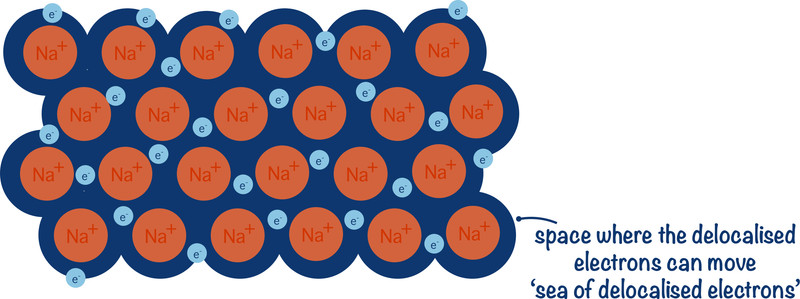
Metallic bonding: lattice of metal cations in a sea of delocalized electrons
Properties
- Conduct electricity and heat (in solid state)
- Malleable
- Ductile
- Variable melting points
- Shiny
Layers can shift without breaking attraction because the electron sea adjusts and continues to hold the metal cations together.
Alloys
Mixtures of metals that retain conductivity.
- Substitutional: similar-sized atoms replace host atoms
- Interstitial: small atoms fill gaps
→ Lattice becomes more rigid
→ Decreased malleability and ductility
Steel is a classic interstitial example.
3. Comparing the Four Solid Types
| Type | Particles | Forces | Melting Point | Conductivity | Mechanical Behavior |
|---|---|---|---|---|---|
| Ionic | Ions | Electrostatic | High | Molten/dissolved only | Hard, brittle |
| Covalent Network | Atoms | Covalent bonds | Very high | Usually no (except graphite) | Very hard (3D) or soft (layered) |
| Molecular | Molecules | IMFs | Low | No | Soft or brittle |
| Metallic | Metal atoms | Metallic bonding | Variable | Yes (solid) | Malleable, ductile |
General bonding strength trend:
Covalent network ≈ Ionic > Metallic > Molecular
Vapor pressure trend goes in the opposite direction.
4. Large Biomolecules and Polymers
Large molecules form molecular solids, but their properties depend heavily on noncovalent interactions.
These interactions can be:
- Intermolecular (between different molecules)
- Intramolecular (within one large molecule)
Forces involved:
- Hydrogen bonding
- Dipole-dipole
- London dispersion
These interactions determine:
- 3D shape
- Flexibility
- Mechanical strength
- Biological function
Examples:
- Protein folding depends on intramolecular hydrogen bonding.
- DNA’s double helix is stabilized by hydrogen bonds between base pairs.
- Polymer strength depends on interactions between chains.
On free-response questions, they often expect you to link shape → noncovalent interactions → macroscopic property.
Key Takeaways
Crystalline Solids
Solids with particles arranged in a regular, repeating pattern called a crystal lattice.
Crystal Lattice and Unit Cell
A repeating 3D arrangement of particles; the unit cell is its smallest repeating unit.
Particulate-Level Representations of Solids
Diagrams showing atoms, ions, or molecules arranged to reveal forces and solid structure.
Intermolecular Force Strength and Phase Change Properties
Stronger attractions give lower vapor pressure and generally higher boiling and melting points.
Types of Solids
Ionic: ions; molecular: molecules with IMFs; covalent network: bonded networks; metallic: metal atoms with mobile electrons.
Ionic Solid Brittleness
Shifting layers place like charges adjacent, causing repulsion and fracture.
Diamond and Graphite
Diamond is a hard 3D network insulator; graphite is layered, soft, and electrically conductive.
Ionic Solids
Crystalline solids of cations and anions with high melting points, brittleness, and conductivity only when ions move.
Metallic Solids
Solids of metal cores in a sea of mobile, delocalized valence electrons.
Properties of Metallic Solids
They conduct heat and electricity and are malleable and ductile because mobile electrons maintain bonding.
Alloys
Metal mixtures form substitutional or interstitial structures, and interstitial atoms make the lattice more rigid.
Molecular Solids
Solids of discrete molecules held by intermolecular forces, usually with low melting points and poor conductivity.
Covalent Network Solids
Solids of atoms covalently bonded in 2D or 3D networks, giving very high melting points and hardness.
Biomolecules and Polymers in Solids
Their shapes and properties depend on noncovalent interactions within one molecule or between molecules.
Crystal Lattice
A regular, repeating three-dimensional arrangement of particles in a crystalline solid.
Unit Cell
The smallest repeating structural unit that builds an entire crystal lattice.
Notes
Crystalline Solids
Solids with particles arranged in a regular, repeating pattern called a crystal lattice.
Crystal Lattice and Unit Cell
A repeating 3D arrangement of particles; the unit cell is its smallest repeating unit.
Particulate-Level Representations of Solids
Diagrams showing atoms, ions, or molecules arranged to reveal forces and solid structure.
Intermolecular Force Strength and Phase Change Properties
Stronger attractions give lower vapor pressure and generally higher boiling and melting points.
Types of Solids
Ionic: ions; molecular: molecules with IMFs; covalent network: bonded networks; metallic: metal atoms with mobile electrons.
Ionic Solid Brittleness
Shifting layers place like charges adjacent, causing repulsion and fracture.
Diamond and Graphite
Diamond is a hard 3D network insulator; graphite is layered, soft, and electrically conductive.
Ionic Solids
Crystalline solids of cations and anions with high melting points, brittleness, and conductivity only when ions move.
Metallic Solids
Solids of metal cores in a sea of mobile, delocalized valence electrons.
Properties of Metallic Solids
They conduct heat and electricity and are malleable and ductile because mobile electrons maintain bonding.
Alloys
Metal mixtures form substitutional or interstitial structures, and interstitial atoms make the lattice more rigid.
Molecular Solids
Solids of discrete molecules held by intermolecular forces, usually with low melting points and poor conductivity.
Covalent Network Solids
Solids of atoms covalently bonded in 2D or 3D networks, giving very high melting points and hardness.
Biomolecules and Polymers in Solids
Their shapes and properties depend on noncovalent interactions within one molecule or between molecules.
Crystal Lattice
A regular, repeating three-dimensional arrangement of particles in a crystalline solid.
Unit Cell
The smallest repeating structural unit that builds an entire crystal lattice.
