Topic 4.1 Notes – Introduction for Reactions
1. Physical Changes vs Chemical Changes
What a Physical Change Is
A physical change alters form or appearance but keeps the chemical composition the same. The particles are still the same atoms bonded in the same way.
Common examples:
- Phase changes
Ice, water, and steam are all still . - Dissolving (forming mixtures)
Salt dissolving in water separates ions, but it’s still chemically. - Cutting, crushing, grinding
Smaller pieces, same substance.
No new substance forms. Many physical changes are reversible by physical means (like freezing or evaporating), but reversibility alone does not define them. The key is composition does not change.
What a Chemical Change Is
A chemical change produces one or more new substances with different compositions.
At the particle level:
- Bonds break
- Atoms rearrange
- New bonds form
For example:
Magnesium and oxygen become magnesium oxide. Different formula, different properties.
Evidence of a Chemical Change
These are clues. One by itself is suggestive, not absolute proof.
- Temperature change (heat absorbed or released)
- Light produced (like burning magnesium)
- Gas formation (bubbles not from boiling)
- Precipitate formation (solid forms from two solutions)
- Color change (not just dilution)
On tests, they love giving you lab observations and asking whether a chemical reaction occurred. Always ask yourself: Did the composition change?
Physical vs Chemical Change Comparison
| Feature | Physical Change | Chemical Change |
|---|---|---|
| Composition | Same substance | New substance(s) formed |
| Particles | Same atoms bonded the same way | Atoms rearranged into new bonds |
| Common Evidence | Change in state, size, or mixture | Gas, precipitate, heat/light, color change |
| Example | Melting ice | Iron rusting |
If identity changes, it’s chemical. If identity stays the same, it’s physical.
2. What a Chemical Reaction Is
A chemical reaction is the process that causes a chemical change. Reactants become products through rearrangement of atoms.
Two core ideas:
- Atoms are conserved (law of conservation of mass).
- Matter is reorganized, not created or destroyed.
When you balance equations later in this unit, you’re enforcing conservation of atoms. If 4 oxygen atoms start on the left, 4 must end on the right.
Chemical reactions are about rearrangement, not disappearance.
3. How to Read a Chemical Equation
Take this example:
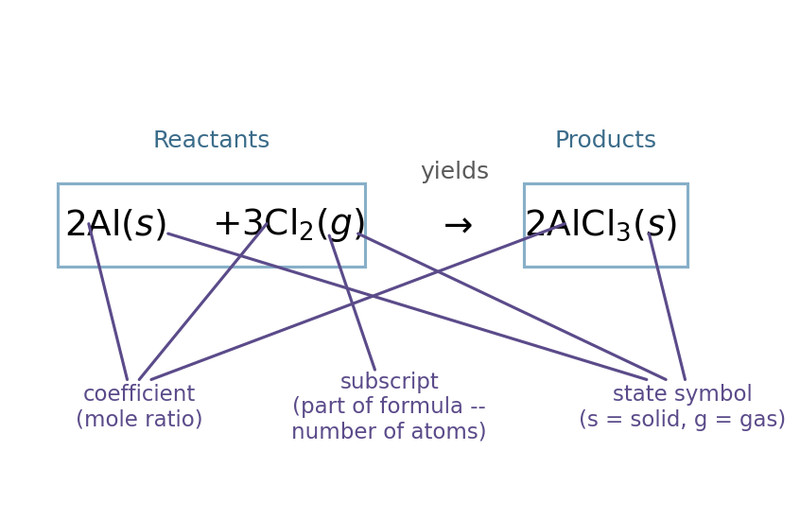
Parts of a chemical equation
Each piece of the equation has a specific meaning.
Break it down:
- Reactants are on the left.
- Products are on the right.
- The arrow (→) means “yields.”
- Coefficients (big numbers in front) show relative amounts and are adjusted to balance.
- Subscripts (small numbers in formulas) define the substance itself.
Changing a subscript changes the compound.
Students often try to balance by changing subscripts. That changes the identity. Only coefficients can change.
4. The Five Main Types of Chemical Reactions
These are patterns. Recognizing them helps you predict products.
a. Synthesis (Combination)
General form:
Two or more substances combine into one product.
Example:
Pattern: many → one.
b. Decomposition
General form:
One compound breaks into simpler substances.
Example:
Pattern: one → many.
c. Combustion
For hydrocarbons:
Must include as a reactant.
Example:
If you see a carbon-hydrogen compound reacting with oxygen, think combustion immediately.
d. Single Replacement
General form:
One element replaces another.
Example:
Often involves electron transfer. One switch happens.
e. Double Replacement
General form:
Two ionic compounds exchange partners.
Example:
Often forms:
- A precipitate
- Water (acid-base)
- A gas
Two switches happen.
| Type | General Pattern | How to Recognize |
|---|---|---|
| Synthesis | A + B → AB | Multiple reactants, one product |
| Decomposition | AB → A + B | One reactant splits |
| Combustion | Hydrocarbon + O₂ | CO₂ and H₂O produced |
| Single Replacement | Element + Compound | One element swaps |
| Double Replacement | Compound + Compound | Ions exchange, often precipitate |
5. Connecting Evidence to Reaction Types
When lab observations show:
- Solid forms from two solutions → usually double replacement.
- Metal reacts with acid and bubbles form → often single replacement.
- Hydrocarbon burns in oxygen → combustion.
- One compound breaks apart when heated → decomposition.
- Two elements combine → synthesis.
On quizzes, they’ll describe what you see in a beaker. Translate observation → composition change → reaction type.
Key Takeaways
Physical Change
A change in form or properties that does not alter a substance's chemical composition.
Evidence of Chemical Change
Possible signs include heat or light, gas formation, precipitate formation, and color change.
Phase Change and Mixture Formation/Separation
Common physical changes where state or arrangement changes, but chemical identity stays the same.
Precipitate
An insoluble solid that forms when two aqueous solutions react.
Types of Chemical Reactions
Synthesis: A + B → AB; decomposition: AB → A + B; single replacement: AB + C → AC + B; double replacement: AB + CD → AD + CB; combustion: hydrocarbon + O2 → CO2 + H2O.
Chemical Change and Chemical Reaction
A process in which atoms rearrange to form new substances with different compositions.
Chemical Equation
A symbolic representation of a reaction showing reactants, products, formulas, and relative amounts.
Notes
Physical Change
A change in form or properties that does not alter a substance's chemical composition.
Evidence of Chemical Change
Possible signs include heat or light, gas formation, precipitate formation, and color change.
Phase Change and Mixture Formation/Separation
Common physical changes where state or arrangement changes, but chemical identity stays the same.
Precipitate
An insoluble solid that forms when two aqueous solutions react.
Types of Chemical Reactions
Synthesis: A + B → AB; decomposition: AB → A + B; single replacement: AB + C → AC + B; double replacement: AB + CD → AD + CB; combustion: hydrocarbon + O2 → CO2 + H2O.
Chemical Change and Chemical Reaction
A process in which atoms rearrange to form new substances with different compositions.
Chemical Equation
A symbolic representation of a reaction showing reactants, products, formulas, and relative amounts.
