Topic 3.1 Notes – Intermolecular and Interparticle Forces
1. What Intermolecular and Interparticle Forces Are
Intermolecular forces (IMFs) are electrostatic attractions between separate particles. Those particles can be:
- Neutral molecules
- Atoms (like noble gases)
- Ions
They are weaker than intramolecular forces (covalent, ionic, metallic bonds) because:
- They act over larger distances.
- They often involve partial charges instead of full charges.
All IMFs come from Coulombic attraction between:
- Full charges (ions)
- Permanent partial charges (dipoles)
- Temporary dipoles (fluctuating electron clouds)
Everything in this unit follows one chain:
Structure → electron distribution → charge separation → force strength
If you can explain how structure affects electron distribution, you can explain the IMF strength. That’s what FRQs usually want.
2. Types of Intermolecular and Interparticle Forces
London Dispersion Forces (LDFs)
These exist in all atoms and molecules.
They come from:
- Constant motion of electrons
- Temporary uneven distribution
- A temporary dipole that induces another dipole nearby
The sequence below shows how an instantaneous dipole forms in one atom, induces a dipole in a neighbor, and creates an attractive intermolecular force.
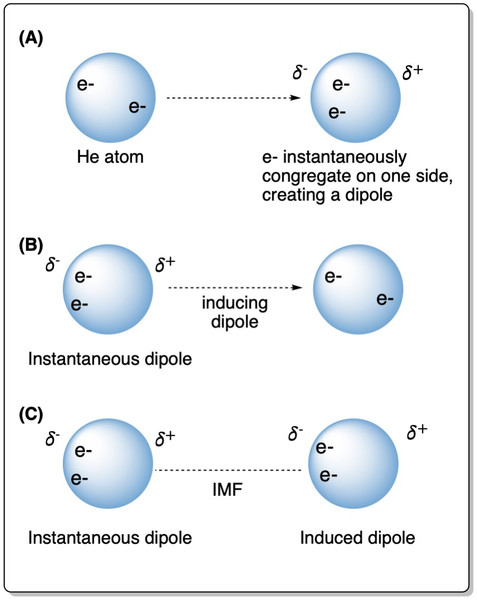
Formation of a London dispersion force
What increases LDF strength?
- More electrons → larger electron cloud → more polarizable
- Larger size
- Greater surface contact (long chains > compact shapes)
- Presence of π bonds (π electrons are more easily distorted)
Huge exam idea:
A large nonpolar molecule can have stronger overall IMFs than a small polar molecule because dispersion can dominate.
Also important:
London dispersion forces are a type of van der Waals force, but those terms are not interchangeable.
Dipole-Dipole Forces
These occur between polar molecules.
A polar molecule has a permanent dipole moment because of unequal electronegativity and molecular shape.
The diagrams below show that opposite partial charges attract and like partial charges repel. On the exam, you usually focus on the attractive orientation where δ+ is near δ−.
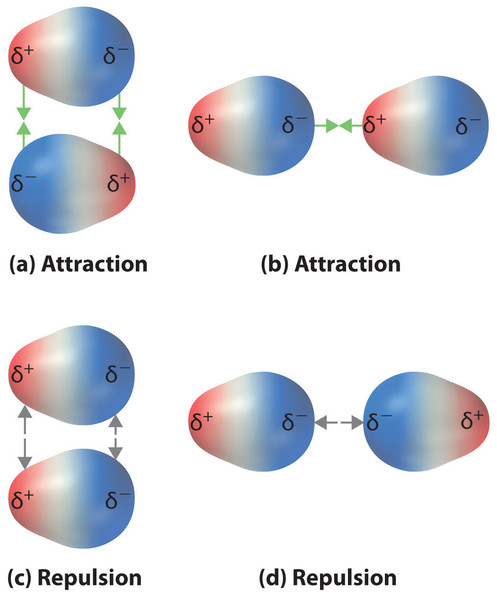
Attractive and repulsive dipole orientations
Strength depends on:
- Magnitude of dipole
- Distance between molecules
- Orientation (δ+ to δ− is attractive)
Because polar molecules also have dispersion forces, dipole-dipole interactions add to the total attraction. That’s why polar substances of similar size usually have higher boiling points than nonpolar ones.
Hydrogen Bonding
This is a strong special case of dipole-dipole.
It only happens when:
- H is bonded to N, O, or F
- That H is attracted to a lone pair on N, O, or F on another molecule (or another part of the same molecule)
Why it’s strong:
- Very polar bond
- Small atoms allow close approach
- Large partial charges
It can be:
- Intermolecular (between molecules)
- Intramolecular (within one large molecule)
Hydrogen bonding dramatically increases boiling points.
Dipole-Induced Dipole Forces
These occur between:
- A polar molecule
- A nonpolar molecule
The permanent dipole distorts the electron cloud of the nonpolar molecule.
Always attractive.
Stronger when:
- The polar molecule has a large dipole
- The nonpolar molecule is highly polarizable
Ion-Dipole Forces
Between:
- An ion
- A polar molecule
Stronger than dipole-dipole because ions have full charges.
Orientation matters:
- Cations align with δ− ends
- Anions align with δ+ ends
This explains why ionic compounds dissolve in polar solvents like water.
Ion-Ion Forces
These are attractions between fully charged ions in ionic solids.
Strongest interaction here.
Responsible for high melting points of ionic compounds.
3. Relative Strength and Structure Effects
General trend from weakest to strongest:
London dispersion < dipole-induced dipole < dipole-dipole < hydrogen bonding < ion-dipole < ion-ion
When comparing same substance:
- More electrons → stronger LDF
- More surface area → stronger LDF
- Greater polarity → stronger dipole forces
When comparing different substances, check:
- Is it polar?
- How large is it?
- Does it contain N-H, O-H, or F-H?
- Are ions present?
In many AP questions, you’re given boiling points. Your job is to justify the ranking using structure and the types of forces present. Always mention dispersion forces because they are always present.
4. Noncovalent Interactions in Large Biomolecules
Large biomolecules rely on many weak forces working together.
Examples:
- Hydrogen bonds stabilize protein secondary structure
- Ion-ion interactions between charged side chains
- Dipole-dipole between polar groups
- London dispersion between nonpolar regions
Individually weak. Collectively powerful.
That cumulative effect determines 3D structure and biological function.
Key Takeaways
Intermolecular Vs. Intramolecular Forces
Between molecules: dispersion, dipole-dipole, hydrogen bonding, ion-dipole; within particles: covalent, ionic, metallic bonding.
London Dispersion Forces
Attractions from Coulombic interactions between temporary, fluctuating dipoles in all atoms and molecules.
Polarizability
How easily an electron cloud is distorted; it increases with more electrons, larger size, and pi bonding.
Contact Area and Dispersion Strength
Greater surface contact between molecules increases dispersion attractions by allowing more electron-cloud interactions.
London Dispersion Forces Vs. Van Der Waals Forces
Dispersion is one specific weak attraction; van der Waals is a broader category and not synonymous.
Dipole-Induced Dipole Interactions
Attractions between a polar molecule and a nonpolar molecule whose electron cloud becomes temporarily distorted.
Ion-Dipole Forces
Attractions between an ion and the oppositely charged end of a polar molecule.
Orientation Dependence Of Dipole-Dipole And Ion-Dipole Forces
Opposite charges aligned closer give stronger attraction; like-charge alignment gives weaker or repulsive interactions.
Hydrogen Bonding
A strong attraction between H bonded to N, O, or F and a lone pair on N, O, or F.
Intermolecular Vs. Intramolecular Hydrogen Bonding
Between separate molecules or between different regions of the same large molecule containing suitable N, O, or F sites.
Noncovalent Interactions In Biomolecules
Hydrogen bonding, ionic attractions, dipole interactions, and dispersion forces within or between large biomolecules.
Relative Strength Of Intermolecular Forces
Generally ion-dipole and hydrogen bonding exceed dipole-dipole, while dispersion varies with size and polarizability.
Dipole Moments And Dipole-Dipole Interactions
A permanent molecular dipole creates attractions between polar molecules when opposite partial charges align.
Temporary Dipole
A momentary uneven electron distribution that creates partial charges in an atom or molecule.
Notes
Intermolecular Vs. Intramolecular Forces
Between molecules: dispersion, dipole-dipole, hydrogen bonding, ion-dipole; within particles: covalent, ionic, metallic bonding.
London Dispersion Forces
Attractions from Coulombic interactions between temporary, fluctuating dipoles in all atoms and molecules.
Polarizability
How easily an electron cloud is distorted; it increases with more electrons, larger size, and pi bonding.
Contact Area and Dispersion Strength
Greater surface contact between molecules increases dispersion attractions by allowing more electron-cloud interactions.
London Dispersion Forces Vs. Van Der Waals Forces
Dispersion is one specific weak attraction; van der Waals is a broader category and not synonymous.
Dipole-Induced Dipole Interactions
Attractions between a polar molecule and a nonpolar molecule whose electron cloud becomes temporarily distorted.
Ion-Dipole Forces
Attractions between an ion and the oppositely charged end of a polar molecule.
Orientation Dependence Of Dipole-Dipole And Ion-Dipole Forces
Opposite charges aligned closer give stronger attraction; like-charge alignment gives weaker or repulsive interactions.
Hydrogen Bonding
A strong attraction between H bonded to N, O, or F and a lone pair on N, O, or F.
Intermolecular Vs. Intramolecular Hydrogen Bonding
Between separate molecules or between different regions of the same large molecule containing suitable N, O, or F sites.
Noncovalent Interactions In Biomolecules
Hydrogen bonding, ionic attractions, dipole interactions, and dispersion forces within or between large biomolecules.
Relative Strength Of Intermolecular Forces
Generally ion-dipole and hydrogen bonding exceed dipole-dipole, while dispersion varies with size and polarizability.
Dipole Moments And Dipole-Dipole Interactions
A permanent molecular dipole creates attractions between polar molecules when opposite partial charges align.
Temporary Dipole
A momentary uneven electron distribution that creates partial charges in an atom or molecule.
