Topic 8.11 Notes – pH and Solubility
1. How pH Can Change the Solubility of a Salt
Every slightly soluble salt dissolves according to a solubility equilibrium:
That equilibrium has a Ksp expression. If ion concentrations change, the reaction shifts according to Le Châtelier’s principle.
Here’s the key connection:
- pH only matters if one of the dissolved ions reacts with H⁺ or OH⁻.
- If H⁺ or OH⁻ removes (or adds) one of the ions in the equilibrium, then Q changes relative to Ksp.
- When , more solid dissolves.
- When , precipitation is favored.
If neither ion reacts with H⁺ or OH⁻, changing pH does nothing to solubility. (A common ion effect can still matter, but that’s separate from pH.)
So the whole question becomes: Does one of the ions behave as an acid or base?
2. When pH Affects Solubility
a. Salts with Basic Anions
These anions are the conjugate bases of weak acids, such as:
- (from )
- (from HF)
- (from HCN)
- (from acetic acid)
Because they come from weak acids, they are basic and react with H⁺:
In an acidic solution:
- H⁺ removes .
- decreases.
- .
- The equilibrium shifts right.
- Solubility increases.
The weaker the original acid, the stronger the base, and the bigger this effect.
b. Metal Hydroxides
Metal hydroxides dissolve like this:
In an acidic solution:
- H⁺ reacts with to form water.
- drops.
- decreases.
- The reaction shifts right.
- Solubility increases.
This is why many metal hydroxides dissolve better in acid. The diagram below shows H⁺ removing , which lowers and drives the dissolution equilibrium to the right.
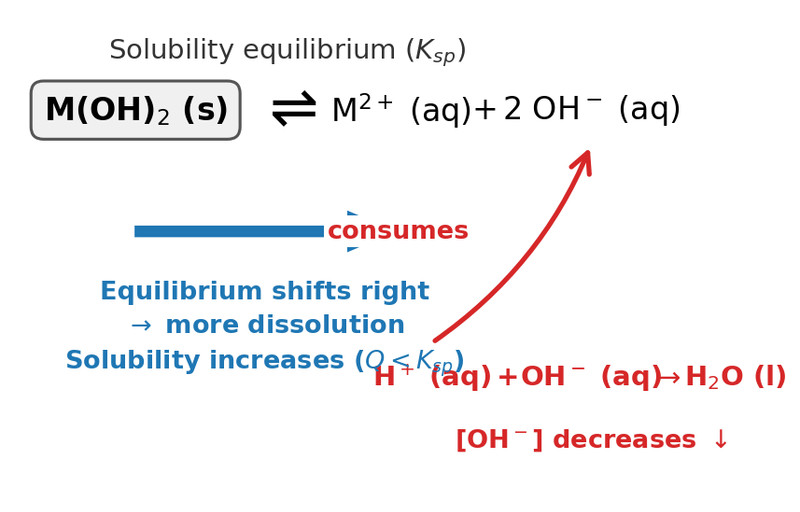
Effect of acid on metal hydroxide solubility
c. Salts with Acidic Cations
Some cations act as weak acids. The classic example is:
is the conjugate acid of the weak base .
In a basic solution:
- OH⁻ reduces .
- This shifts the equilibrium to the right.
- decreases.
- .
- The solid dissolves more.
- Solubility increases in basic solution.
So salts containing acidic cations become more soluble in base.
d. Ions from Strong Acids or Strong Bases
Examples:
- ,
- ,
These are neutral spectators. They do not react with H⁺ or OH⁻.
Result:
- Solubility is unaffected by pH.
If solubility changes here, it’s because of a common ion, not pH itself.
3. Acidic vs Basic Conditions Summary
| Condition | More Soluble | Why |
|---|---|---|
| Acidic (high H⁺) |
| H⁺ removes A⁻ or OH⁻, lowering Q and shifting right |
| Basic (high OH⁻) |
| OH⁻ lowers effective [H⁺], reducing the acidic cation concentration |
| Acidic or Basic |
| No reaction with H⁺ or OH⁻ |
Also remember:
- Hydroxides are less soluble in basic solution due to the common ion .
- Salts with basic anions are less soluble in basic solution for the same reason.
4. How to Answer AP Questions About pH and Solubility
This topic is qualitative. No math with pH-dependent Ksp is required.
When you see one of these questions:
- Write the dissolution equilibrium.
- Ask: does any ion react with H⁺ or OH⁻?
- Decide whether that ion’s concentration increases or decreases.
- State:
- What happens to Q
- Which direction equilibrium shifts
- Whether solubility increases or decreases
Full-credit explanations always connect:
- Ion concentration change
- vs
- Direction of shift
If you skip one of those links, you usually lose the point on FRQs.
Key Takeaways
pH-Sensitive Solubility
Solubility changes with pH when a salt contains a weak acid/base ion or OH−.
Acidic Solution Effect on Salts with Basic Anions
Lower pH increases solubility when the anion is the conjugate base of a weak acid.
Basic Solution Effect on Salts with Acidic Cations
Higher pH increases solubility when the cation is the conjugate acid of a weak base.
Le Châtelier's Principle in pH and Solubility
Removing a dissolved acidic or basic ion shifts dissolution right; adding it shifts dissolution left.
Weak Acid and Weak Base Ions vs Strong Acid/Base Ions
Conjugates of weak acids or bases react with H+ or OH−; conjugates of strong acids or bases are insignificant.
pH-Neutral Salts
Salts made from insignificant ions have solubilities largely unaffected by pH alone.
Hydroxide Salt Solubility and pH
Lower pH increases hydroxide salt solubility, while higher pH decreases it by common-ion effect.
Notes
pH-Sensitive Solubility
Solubility changes with pH when a salt contains a weak acid/base ion or OH−.
Acidic Solution Effect on Salts with Basic Anions
Lower pH increases solubility when the anion is the conjugate base of a weak acid.
Basic Solution Effect on Salts with Acidic Cations
Higher pH increases solubility when the cation is the conjugate acid of a weak base.
Le Châtelier's Principle in pH and Solubility
Removing a dissolved acidic or basic ion shifts dissolution right; adding it shifts dissolution left.
Weak Acid and Weak Base Ions vs Strong Acid/Base Ions
Conjugates of weak acids or bases react with H+ or OH−; conjugates of strong acids or bases are insignificant.
pH-Neutral Salts
Salts made from insignificant ions have solubilities largely unaffected by pH alone.
Hydroxide Salt Solubility and pH
Lower pH increases hydroxide salt solubility, while higher pH decreases it by common-ion effect.
