Topic 6.3 Notes – Heat Transfer and Thermal Equilibrium
1. Temperature as Average Kinetic Energy
Temperature is a measure of the average kinetic energy (KE) of particles in a substance.
Kinetic energy depends on speed:
So if particles move faster, their kinetic energy is greater.
Here’s the key distinction students mix up:
- Temperature → average kinetic energy
- Total thermal energy → depends on amount of substance and temperature
Two beakers can be at the same temperature but contain different total energy if one has more particles.
What this means conceptually:
- A warmer object has particles with greater average KE
- A cooler object has particles with lower average KE
- A temperature difference = a difference in average KE
That difference is what drives energy transfer.
2. What Heat Transfer Is at the Particle Level
When two objects at different temperatures touch, their particles collide.
Imagine fast-moving particles in a hot metal rod hitting slower particles in a cooler one.
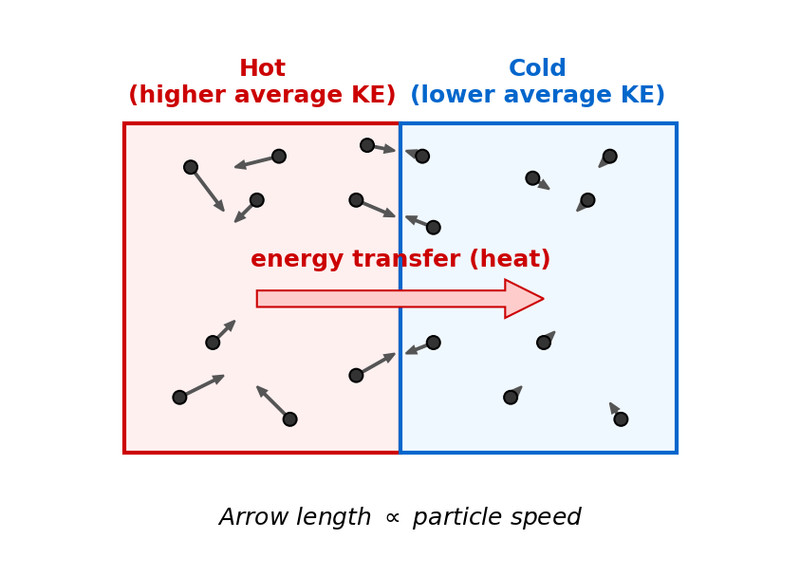
Particle-level model of heat transfer from hot to cold
The longer arrows represent faster particles with higher average kinetic energy. The shorter arrows represent slower particles with lower average kinetic energy.
What happens during those collisions?
- Faster particles collide with slower ones.
- Energy is transferred during the collision.
- The faster particle loses some KE.
- The slower particle gains KE.
That transfer of energy due to a temperature difference is called:
- Heat transfer
- Heat exchange
- Transfer of energy as heat
Heat is not a substance. It is energy in transit because of a temperature difference.
Energy flows:
- From higher average KE → lower average KE
- From hot → cold
- From source → sink
On tests, if they ask why energy flows, the answer should mention collisions between particles with different kinetic energies, not “heat rises” or something vague.
3. What Determines Energy Transfer in Collisions
Unequal kinetic energies
If two colliding particles have different speeds:
- The faster one can transfer energy to the slower one.
- Over many collisions, the temperature difference shrinks.
If both substances already have the same average KE, collisions still happen, but there is no net energy transfer.
Constant random motion
Particles are always moving:
- In solids, they vibrate.
- In liquids and gases, they move more freely.
- Collisions are constant and random.
The bigger the temperature difference, the larger the difference in average KE, and the stronger the “driving force” for heat transfer.
Connection to collision theory
You’ve learned that reactions require:
- Proper orientation
- Enough energy to overcome activation energy
For heat transfer, orientation does not matter in the same way. Bonds are not being broken. Energy is simply being redistributed through collisions.
If the AP asks you to compare reaction collisions vs. heat transfer collisions, that’s the distinction they’re looking for.
4. Thermal Equilibrium
Eventually, the two objects reach thermal equilibrium.
This means:
- Their average kinetic energies are equal
- Their temperatures are equal
- There is no net transfer of energy
At equilibrium, particles on both sides are moving with similar speeds, and energy crosses the boundary in both directions equally.
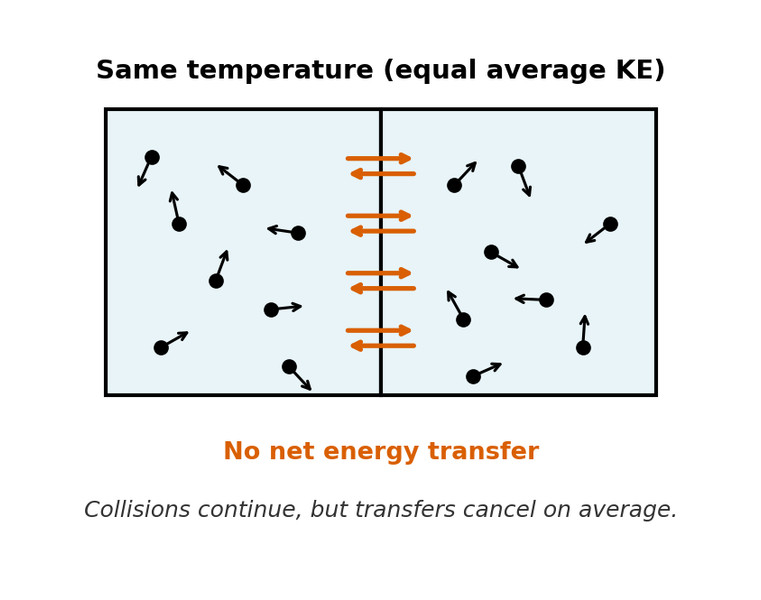
Important nuance: collisions do not stop.
Energy is still exchanged in both directions. But the energy transferred from A to B equals the energy transferred from B to A.
On free-response questions, a strong explanation includes the phrase “no net transfer of energy” and connects it to equal average kinetic energy.
5. The Zeroth Law of Thermodynamics
The Zeroth Law makes temperature logically consistent.
It states:
If object A is in thermal equilibrium with B,
and B is in thermal equilibrium with C,
then A is in thermal equilibrium with C.
Think about how a thermometer actually measures temperature:

Zeroth Law illustrated with a thermometer
This law:
- Defines temperature as a measurable property
- Explains why thermometers work
- Establishes that equal temperature means equal average KE
Without this idea, temperature comparisons would not be meaningful.
Key Takeaways
Thermal Contact
A condition where two bodies can exchange energy through collisions between their particles.
Direction Of Heat Flow
Energy as heat flows from the warmer body to the cooler body.
No Net Energy Transfer At Thermal Equilibrium
Energy still moves both ways, but equal transfers cause no overall change.
Zeroth Law Of Thermodynamics
If A is in thermal equilibrium with B, and B with C, then A with C.
Temperature, Average Kinetic Energy, and Thermal Equilibrium
Equal temperature means equal average kinetic energy, so no net heat flows between bodies.
Heat Transfer Through Molecular Collisions
Collisions transfer kinetic energy from faster particles to slower particles in thermal contact.
Notes
Thermal Contact
A condition where two bodies can exchange energy through collisions between their particles.
Direction Of Heat Flow
Energy as heat flows from the warmer body to the cooler body.
No Net Energy Transfer At Thermal Equilibrium
Energy still moves both ways, but equal transfers cause no overall change.
Zeroth Law Of Thermodynamics
If A is in thermal equilibrium with B, and B with C, then A with C.
Temperature, Average Kinetic Energy, and Thermal Equilibrium
Equal temperature means equal average kinetic energy, so no net heat flows between bodies.
Heat Transfer Through Molecular Collisions
Collisions transfer kinetic energy from faster particles to slower particles in thermal contact.
