Topic 3.13 Notes – Beer-Lambert Law
1. How Light Absorption Is Measured
When a beam of light passes through a solution, some photons are absorbed by molecules or ions and the rest pass through.
- Incident light, = light entering the sample
- Transmitted light, = light that exits
- Absorbance, = how much light is absorbed (unitless)
A spectrophotometer shines a selected wavelength through a cuvette and measures transmitted light. It then converts that into absorbance.
Here’s the basic idea visually:
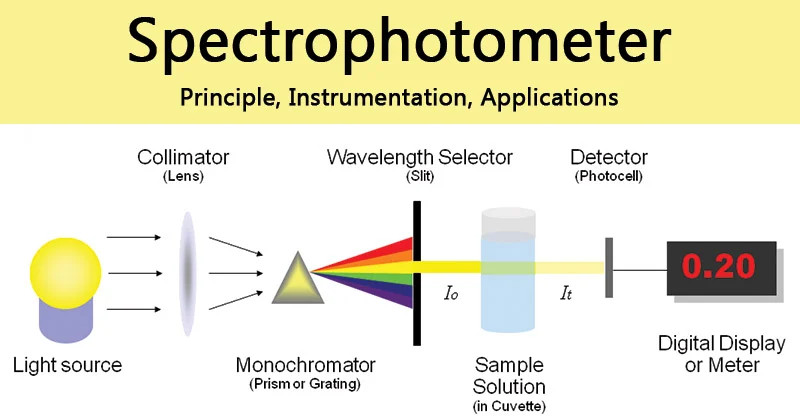
Basic components of a spectrophotometer
Light from the source is narrowed and filtered so only one wavelength reaches the cuvette. The detector compares the light entering the sample () to the light that exits () and the instrument reports absorbance.
Absorbance increases when:
- Concentration increases → more absorbing particles in the path
- Path length increases → light travels through more solution
- Molar absorptivity is large → each particle absorbs strongly at that wavelength
The key physical idea is particle count in the light’s path. More particles means more chances for photons to be absorbed.
2. The Beer-Lambert Law
The quantitative relationship is:
Where:
- = absorbance (unitless)
- = molar absorptivity in
- Measures how strongly a species absorbs light at a specific wavelength
- = path length in cm
- Usually 1.0 cm cuvette
- = concentration in mol/L
What each variable means physically
- Increasing increases the number of absorbing particles per volume.
- Increasing increases how many particles the light encounters.
- Increasing means each particle is more effective at absorbing that wavelength.
All three are directly proportional to . If any one doubles (with the others constant), absorbance doubles.
On AP questions, they often change one variable and ask how changes. Think proportional reasoning, not memorization.
3. Why Beer’s Law Is Linear
If wavelength and path length are held constant, then and are constants. The equation becomes:
This has the form , where slope .
That means a graph of absorbance vs. concentration is a straight line through the origin in the ideal case.
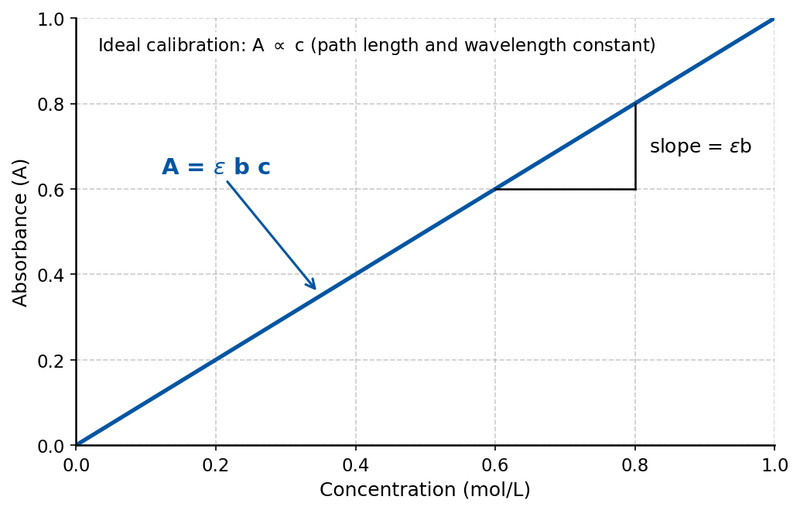
Ideal Beer’s Law calibration curve
This linearity is why spectrophotometry works for finding unknown concentrations. You measure the absorbance, use the straight-line calibration curve, and read back to the concentration.
If concentration doubles, absorbance doubles. If concentration is zero, absorbance should be zero. On real data, slight deviations happen, but AP problems usually assume ideal behavior.
4. Choosing the Wavelength
Absorbance depends on wavelength because depends on wavelength.
A solution appears a certain color because it transmits that color and absorbs its complement.
Examples:
- Blue solution → absorbs orange light
- Yellow solution → absorbs violet light
Chemists typically set the spectrophotometer to , the wavelength of maximum absorbance.
Why?
- is largest at
- Absorbance is highest for a given concentration
- Small concentration changes produce noticeable changes in
In most AP-level experiments:
- is fixed (same cuvette)
- Wavelength is fixed (at )
So absorbance depends only on concentration.
That’s a favorite test move. They’ll describe constant path length and wavelength, then expect you to conclude .
5. Using Beer’s Law to Determine Concentration
Direct calculation
If , , and are known:
Example idea: If absorbance is 0.800, , and , then
Check units cancel properly. They love unit consistency on FRQs.
Calibration curve method
More common in labs:
- Prepare standard solutions of known concentrations
- Measure absorbance of each
- Plot vs.
- Draw best-fit line
- Measure absorbance of unknown
- Use line to determine its concentration
This shows up in free-response questions where they give you a table of data and expect you to interpret slope or use the equation of the line.
Higher absorbance always corresponds to higher concentration under constant conditions.
Key Takeaways
Monochromator
The spectrophotometer component that isolates a narrow band of wavelengths from white light.
Cuvette / Path Length
A transparent sample holder whose width sets the light-travel distance, usually measured in centimeters.
Incident Light and Transmitted Light
I0 is light entering the sample; I is light leaving after some has been absorbed.
Absorbance
A unitless measure of how much light a sample absorbs at a given wavelength.
Molar Absorptivity
A wavelength-specific constant showing how strongly a substance absorbs light, symbolized by epsilon.
Beer-Lambert Law / Beer's Law
A = epsilonbc, relating absorbance to molar absorptivity, path length, and concentration.
Direct Proportionality in Beer-Lambert Law
With wavelength and path length constant, absorbance increases linearly as concentration increases.
Wavelength of Maximum Absorbance
The wavelength where a substance absorbs most strongly, giving the greatest measurement sensitivity.
Complementary Colors and Absorption
Solutions absorb light best in the color opposite their observed color on the visible spectrum.
Solving for Concentration with Beer-Lambert Law
Rearrange A = epsilonbc to c = A divided by epsilon times b.
Spectrophotometry and Spectrophotometer
A method using an instrument to measure transmitted light and determine sample absorbance.
Optimum Wavelength
The wavelength of maximum absorbance used to give the most sensitive measurements.
Notes
Monochromator
The spectrophotometer component that isolates a narrow band of wavelengths from white light.
Cuvette / Path Length
A transparent sample holder whose width sets the light-travel distance, usually measured in centimeters.
Incident Light and Transmitted Light
I0 is light entering the sample; I is light leaving after some has been absorbed.
Absorbance
A unitless measure of how much light a sample absorbs at a given wavelength.
Molar Absorptivity
A wavelength-specific constant showing how strongly a substance absorbs light, symbolized by epsilon.
Beer-Lambert Law / Beer's Law
A = epsilonbc, relating absorbance to molar absorptivity, path length, and concentration.
Direct Proportionality in Beer-Lambert Law
With wavelength and path length constant, absorbance increases linearly as concentration increases.
Wavelength of Maximum Absorbance
The wavelength where a substance absorbs most strongly, giving the greatest measurement sensitivity.
Complementary Colors and Absorption
Solutions absorb light best in the color opposite their observed color on the visible spectrum.
Solving for Concentration with Beer-Lambert Law
Rearrange A = epsilonbc to c = A divided by epsilon times b.
Spectrophotometry and Spectrophotometer
A method using an instrument to measure transmitted light and determine sample absorbance.
Optimum Wavelength
The wavelength of maximum absorbance used to give the most sensitive measurements.
