Topic 7.1 Notes – Introduction to Equilibrium
1. Reversible Processes and Dynamic Equilibrium
A reversible process can proceed in both directions under the same conditions. In chemical equations, that’s shown with a double arrow:
This means reactants form products and products can reform reactants.
Everyday reversible processes
You’ve already seen these:
- Physical changes
- (evaporation and condensation)
- (gas dissolving and escaping)
- (dissolution and precipitation)
- Chemical changes
- Acid-base reactions (proton transfer), like
- Redox reactions (electron transfer), where oxidation and reduction can reverse under the right conditions
When a reversible process occurs in a closed system (no matter enters or leaves), it can reach equilibrium.
What equilibrium actually means
At equilibrium:
- The forward rate = reverse rate
- Concentrations (or partial pressures) are constant
- Reactants and products are present
Constant does not mean equal. You can have much more product than reactant at equilibrium. What’s equal are the rates.
That distinction shows up all the time in multiple-choice questions.
2. What Equilibrium Looks Like Experimentally
If you’re observing a system at equilibrium:
- No visible change (color, pressure, etc.)
- Measurable quantities stop changing over time
- The reaction is still happening
Students often think “no change” means “no reaction.” It means no net change.
Why the system must be closed
In a closed container:
- Concentrations only change because of the forward and reverse reactions.
- The system can self-adjust until rates become equal.
In an open system:
- Gas can escape.
- A product can be removed.
- Matter changes for reasons other than the reaction.
That prevents true equilibrium. If a question describes gas bubbling out into the air, that’s not an equilibrium situation.
3. How Equilibrium Is Established Over Time
Take a simple reaction:
Imagine starting with only A.
- At the beginning:
- is high → forward rate is fast
- is near zero → reverse rate is slow
- As B forms:
- decreases → forward rate slows
- increases → reverse rate speeds up
- Eventually:
- Forward rate = reverse rate → equilibrium
Concentration vs. Time Graph
Here’s what that looks like on a concentration-time graph.
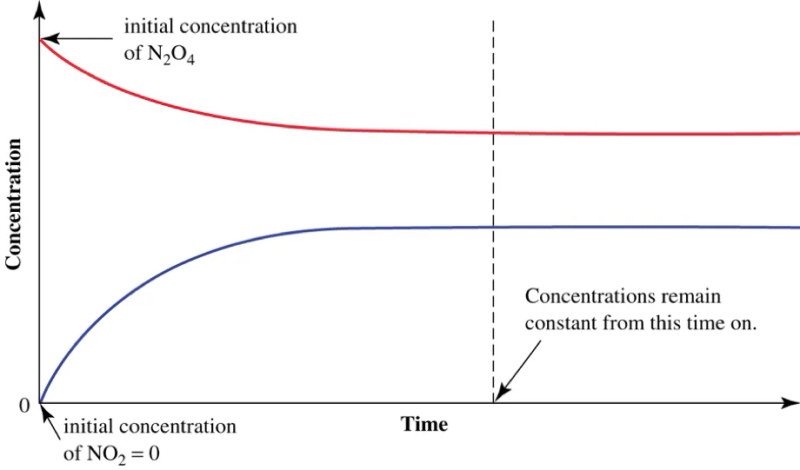
Concentration vs. time for a reversible reaction
This example shows , but the shape is the same for any reversible reaction.
Notice:
- Lines become flat at equilibrium.
- Final concentrations are different.
- The “flat” region means constant concentration, not zero rate.
You may be asked to explain why a line levels off. The correct reasoning is that the forward and reverse rates are equal.
Rate vs. Time Graph
Rates tell the same story from a different angle.
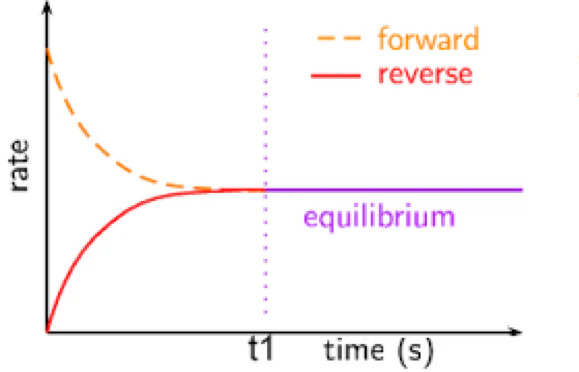
Forward and reverse rates approaching equilibrium
At equilibrium:
- Rates are equal and constant.
- They are usually not zero.
If a question asks what happens before equilibrium, talk about changing concentrations affecting rate.
4. The Dynamic Nature of Equilibrium
Equilibrium is dynamic.
At equilibrium:
- Particles are still colliding.
- Bonds are still breaking and forming.
- A is turning into B.
- B is turning back into A.
There is no net change because both happen at the same rate.
Think of it like water flowing into and out of a tank at the same speed. The water level stays constant, even though water is moving.
This idea is huge on the AP exam. If you ever write that “the reaction stops at equilibrium,” you will lose points.
5. Connecting Rates to the Equilibrium Constant
For a simple reaction :
Forward rate:
Reverse rate:
At equilibrium:
Rearranging gives a constant ratio:
That ratio is the equilibrium constant, K.
Important conceptual points:
- reflects how far the reaction proceeds toward products.
- is constant at a given temperature.
- Changing initial concentrations does not change .
- Changing temperature does change .
For this topic, focus on the idea that equal rates lead to a constant ratio of products to reactants.
Key Takeaways
Reversible Reaction
A reaction that proceeds in both forward and reverse directions under the same conditions.
Forward Reaction and Reverse Reaction
The forward direction forms products from reactants; the reverse direction reforms reactants from products.
Double Arrow, ⇌
The symbol showing a reaction is reversible and can establish equilibrium.
Reversible Physical and Chemical Processes
Examples include evaporation-condensation, dissolution-precipitation, gas absorption-desorption, acid-base, and redox reactions.
Closed System
A system where matter does not enter or leave, allowing equilibrium to be established.
Dynamic Equilibrium
A state where forward and reverse processes continue at equal rates with constant amounts.
Equilibrium Observations
At equilibrium, rates are equal while concentrations remain constant but are not usually equal.
Equilibrium Graphs
Graphs show concentrations leveling off and forward and reverse rates becoming equal over time.
Notes
Reversible Reaction
A reaction that proceeds in both forward and reverse directions under the same conditions.
Forward Reaction and Reverse Reaction
The forward direction forms products from reactants; the reverse direction reforms reactants from products.
Double Arrow, ⇌
The symbol showing a reaction is reversible and can establish equilibrium.
Reversible Physical and Chemical Processes
Examples include evaporation-condensation, dissolution-precipitation, gas absorption-desorption, acid-base, and redox reactions.
Closed System
A system where matter does not enter or leave, allowing equilibrium to be established.
Dynamic Equilibrium
A state where forward and reverse processes continue at equal rates with constant amounts.
Equilibrium Observations
At equilibrium, rates are equal while concentrations remain constant but are not usually equal.
Equilibrium Graphs
Graphs show concentrations leveling off and forward and reverse rates becoming equal over time.
