Topic 2.5 Notes – Lewis Diagrams
1. What Lewis Diagrams Are
A Lewis diagram shows only valence electrons and how atoms use them to bond.
It’s based on two big ideas:
- Octet rule: atoms tend to gain, lose, or share electrons to reach 8 valence electrons (like noble gases).
- Localized electron model: electrons are drawn in specific places, either:
- Lone pairs (nonbonding electrons on one atom)
- Bonding pairs (shared between atoms, drawn as lines)
Valence Electrons Refresher
You must count these correctly.
- For main-group elements, valence electrons = group number
- Group 1 → 1 valence electron
- Group 16 → 6 valence electrons
- Only valence electrons appear in Lewis structures.
- For ions:
- Add electrons for negative charge
- Subtract electrons for positive charge
If your total electron count is off, the entire structure will be wrong. This is one of the most common test mistakes.
2. The Two Types of Lewis Diagrams
a. Ionic Compounds
Ionic compounds form from electron transfer (metal → nonmetal).
You do not draw shared bonds. You show separate ions.
Example idea:
- Ca loses 2 electrons →
- Each F gains 1 electron →
- Two fluoride ions balance one calcium ion.
How to draw:
- Write correct formula (charges must cancel).
- Draw each ion separately.
- Use brackets around each ion.
- Put the charge outside the brackets.
- Show full octet on the anion.
You can draw two separate fluoride ions or draw one with a coefficient 2 outside the bracket.
Important pattern:
- Metals → cations
- Nonmetals → anions
- Total compound must be neutral
On multiple-choice questions, they love to test whether you balance the charges correctly before drawing anything.
b. Covalent Molecules and Polyatomic Ions
Covalent bonds form by sharing electrons.
Here electrons are placed between atoms as bonds.
Key structural rules:
- Count total valence electrons (adjust for charge).
- Choose central atom:
- Usually least electronegative
- Never hydrogen
- Often carbon if present
- Connect atoms with single bonds first.
- Fill octets on outer atoms.
- Put remaining electrons on central atom.
- If central atom lacks octet, form multiple bonds.
For polyatomic ions:
- Enclose entire structure in brackets.
- Show overall charge outside.
- Make sure electron count matches the charge.
3. Step-by-Step Process for Drawing a Covalent Lewis Structure
Let’s organize it clearly. Follow this same order every time so you don’t miss points.
- Count total valence electrons
Include charge adjustment. - Draw skeletal structure
Connect atoms with single bonds (2 electrons per bond). - Subtract bonding electrons
Keep track as you go. - Complete octets on outer atoms
- Place leftover electrons on central atom
- If central atom does not have 8 electrons:
- Convert lone pairs on neighboring atoms into double or triple bonds.
- Final check:
- Total electrons equal your starting count.
- Octet rule satisfied (unless exception).
- Brackets and charges shown if ion.
Here’s the whole process as a quick-reference flowchart you can picture during a test:
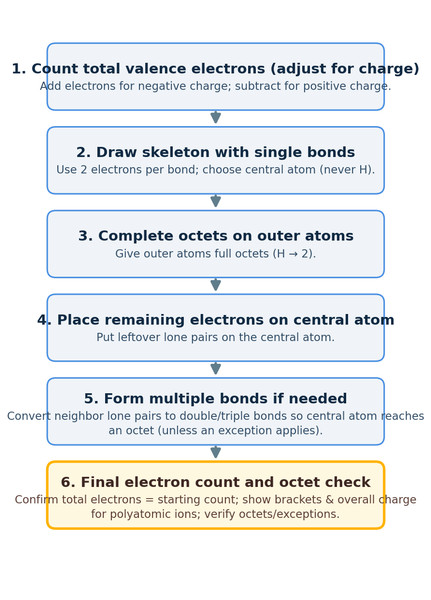
Lewis structure drawing flowchart
That last step saves people on tests. Always recount.
4. Exceptions to the Octet Rule
These show up a lot on quizzes.
a. Incomplete Octet
Some atoms are stable with fewer than 8 electrons:
- H → 2 electrons max
- Be → often 4 electrons
- B → often 6 electrons
If you force boron to have 8, you probably did something wrong.
b. Expanded Octet
Atoms in period 3 or below can exceed 8 electrons.
Common examples:
- P, S, Cl, Xe
Rules:
- Only the central atom expands.
- Period 2 elements (C, N, O, F) never expand.
c. Odd Number of Valence Electrons
If total valence electrons is odd, one atom will have an unpaired electron. Not every atom can satisfy the octet.
d. Multiple Bonds
Double bond = 4 shared electrons
Triple bond = 6 shared electrons
You form these when there aren’t enough electrons to give everyone an octet using single bonds alone.
5. Common Mistakes to Avoid
- Forgetting to adjust for ionic charge.
- Expanding octet on period 2 elements.
- Choosing hydrogen as central atom.
- Not using brackets for polyatomic ions.
- Forgetting final electron count check.
Most incorrect answers come from skipping that final recount.
Key Takeaways
Lewis Diagram / Lewis Structure
A drawing that shows valence electrons, lone pairs, and bonding pairs in a molecule or ion.
Localized Electron Model
A model where electrons are assigned to specific atoms or shared between specific atoms.
Lone Pairs and Bonding Pairs
Lone pairs stay on one atom; bonding pairs are shared between atoms in a bond.
Octet Rule and Common Exceptions
Most atoms seek eight electrons; H has 2, Be 4, B 6, and some larger atoms exceed 8.
Expanded Octet
A central atom in period 3 or higher can hold more than eight valence electrons.
Odd-Electron Species
Molecules or ions with an odd total of valence electrons cannot give every atom a full octet.
Multiple Bonds
Double and triple bonds form when atoms must share more than one electron pair.
Drawing Covalent Lewis Diagrams
Count valence electrons, choose a central atom, add single bonds, complete octets, then adjust bonds or lone pairs.
Counting Valence Electrons for Lewis Structures
Add all valence electrons from each atom, adjusting for ionic charge by adding or subtracting electrons.
Choosing the Central Atom
Usually place the least electronegative atom in the center, but hydrogen is never central.
Ionic Lewis Diagrams
Show transferred electrons, then place each ion in brackets with its charge outside.
Lewis Structures for Polyatomic Ions
Draw the covalent structure, adjust electrons for charge, and enclose the ion in brackets.
Notes
Lewis Diagram / Lewis Structure
A drawing that shows valence electrons, lone pairs, and bonding pairs in a molecule or ion.
Localized Electron Model
A model where electrons are assigned to specific atoms or shared between specific atoms.
Lone Pairs and Bonding Pairs
Lone pairs stay on one atom; bonding pairs are shared between atoms in a bond.
Octet Rule and Common Exceptions
Most atoms seek eight electrons; H has 2, Be 4, B 6, and some larger atoms exceed 8.
Expanded Octet
A central atom in period 3 or higher can hold more than eight valence electrons.
Odd-Electron Species
Molecules or ions with an odd total of valence electrons cannot give every atom a full octet.
Multiple Bonds
Double and triple bonds form when atoms must share more than one electron pair.
Drawing Covalent Lewis Diagrams
Count valence electrons, choose a central atom, add single bonds, complete octets, then adjust bonds or lone pairs.
Counting Valence Electrons for Lewis Structures
Add all valence electrons from each atom, adjusting for ionic charge by adding or subtracting electrons.
Choosing the Central Atom
Usually place the least electronegative atom in the center, but hydrogen is never central.
Ionic Lewis Diagrams
Show transferred electrons, then place each ion in brackets with its charge outside.
Lewis Structures for Polyatomic Ions
Draw the covalent structure, adjust electrons for charge, and enclose the ion in brackets.
