Topic 1.5 Notes – Atomic Structure and Electron Configuration
1. Atomic Structure and Coulombic Attraction
Every atom contains three subatomic particles:
- Protons
- Charge = +1
- Mass ≈ 1 amu
- Located in the nucleus
- Neutrons
- Charge = 0
- Mass ≈ 1 amu
- Located in the nucleus
- Electrons
- Charge = -1
- Mass ≈ 0 amu (very small)
- Found outside the nucleus
The atomic number equals the number of protons. In a neutral atom, electrons = protons.
The key force holding electrons near the nucleus is electrostatic attraction. Opposite charges attract, and the strength of that attraction follows Coulomb’s law:
- Larger charges → stronger attraction
- Smaller distance → much stronger attraction (because of )
This explains two big ideas you’ll use all year:
- Electrons closer to the nucleus have lower energy.
- Electrons farther away are easier to remove.
When you justify ionization energy on a test, your reasoning almost always traces back to charge and distance.
2. Energy Levels, Sublevels, and Electron Organization
Electrons don’t sit randomly. They occupy specific energy levels.
Shells (Principal Energy Levels)
- Labeled
- As increases:
- Distance from nucleus increases
- Energy increases
The outermost shell is the valence shell.
Subshells (Sublevels)
Each shell contains subshells:
- s → max 2 electrons
- p → max 6
- d → max 10
- f → max 14
These subshells correspond directly to the blocks of the periodic table.

Periodic table divided into s, p, d, and f blocks
The left two columns are the s-block, the right six columns are the p-block, the middle transition metals are the d-block, and the bottom rows are the f-block. If you can read these blocks, you can write electron configurations without memorizing a long energy chart.
Core vs Valence Electrons
- Valence electrons = electrons in the highest level (for main-group elements, only s and p)
- Core electrons = inner electrons
Example:
Phosphorus →
Valence electrons are in : → 5 valence electrons.
3. The Rules for Writing Ground-State Electron Configurations
Three rules control how electrons fill orbitals.
Aufbau Principle
Electrons fill orbitals in order of increasing energy.
Order (follow periodic table layout):
1s → 2s → 2p → 3s → 3p → 4s → 3d → 4p → 5s → 4d → 5p → 6s → 4f → 5d → 6p
Notice 4s fills before 3d. That detail matters later for ions.
Pauli Exclusion Principle
- Max 2 electrons per orbital
- Must have opposite spins
No orbital can hold more than two electrons.
Hund’s Rule
In equal-energy orbitals (like the three p orbitals):
- Fill singly first
- Then pair
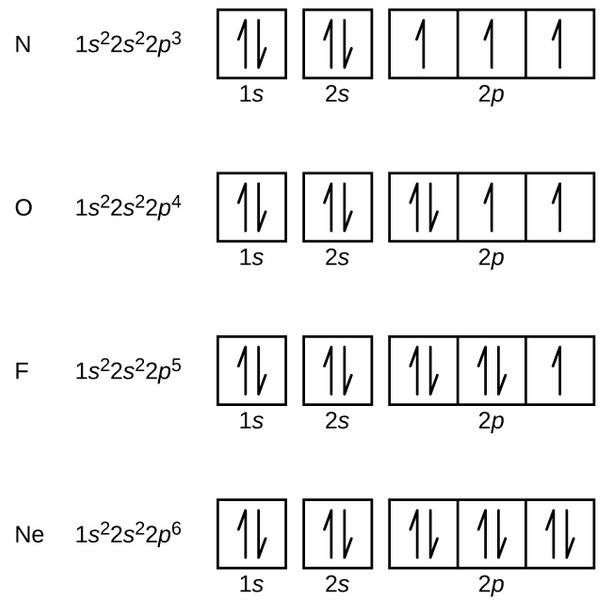
Orbital box diagrams illustrating Hund’s rule (N → Ne)
In the 2p orbitals for N, O, F, and Ne, notice how each box gets one electron before any pairing happens.
This reduces electron-electron repulsion.
Quantum numbers exist behind all this, but assigning them is not tested on the AP exam.
4. How to Write Electron Configurations
Example: Sulfur (atomic number 16)
- 16 electrons total
- Fill in order:
Check: 2 + 2 + 6 + 2 + 4 = 16 ✔
Noble Gas Shortcut
Use the previous noble gas in brackets.
Sulfur becomes:
This saves time and reduces mistakes.
Writing Ions
Cations: remove electrons from the highest level first.
Example:
Fe =
Fe²⁺: remove 4s electrons first →
That 4s-before-3d removal shows up constantly on tests.
Anions: add electrons following Aufbau order.
5. Electron Configuration and Ionization Energy
Ionization energy = energy required to remove an electron.
Think Coulomb’s law every time.
Ionization energy increases when:
- Nuclear charge increases (more protons)
- Atomic radius decreases (smaller )
- Effective nuclear charge increases (less shielding)
Ionization energy decreases when:
- Electron is farther from nucleus
- More core electrons shield the attraction
When comparing two atoms, your explanation should include words like:
- “greater nuclear charge”
- “smaller radius”
- “stronger attraction between nucleus and valence electron”
If those ideas aren’t in your answer, you’re probably not scoring full credit.
Key Takeaways
Coulomb's Law
Electrostatic force is proportional to charge product and inversely proportional to distance squared.
Shells, Subshells, Core Electrons, and Valence Electrons
Shells are energy levels; subshells are s, p, d, f; inner electrons are core, outer are valence.
Subshells
s holds 2 electrons, p 6, d 10, and f 14.
Aufbau Principle
Electrons fill the lowest-energy orbitals available before occupying higher-energy orbitals.
Pauli Exclusion Principle
An orbital can hold at most two electrons, and they must have opposite spins.
Hund's Rule
Electrons occupy equal-energy orbitals singly before any pairing occurs.
Ground-State Electron Configuration
The lowest-energy arrangement of an atom's or ion's electrons among orbitals.
Noble Gas Shortcut
Use the previous noble gas in brackets, then write only the remaining outer subshells.
Orbital Diagram
A box-and-arrow model showing orbital occupancy and electron spins in each subshell.
Valence Electrons from Electron Configuration
Count electrons in the highest principal energy level, usually the outer s and p subshells.
Electron Configuration of Ions
Add electrons for anions and remove highest-energy outer electrons for cations.
Effective Nuclear Charge and Shielding
Inner electrons reduce nuclear attraction, so outer electrons feel less than the full nuclear charge.
Ionization Energy
The energy needed to remove an electron, which increases with stronger nucleus-electron attraction.
Subatomic Particles
Atoms contain protons and neutrons in the nucleus and electrons outside it.
Notes
Coulomb's Law
Electrostatic force is proportional to charge product and inversely proportional to distance squared.
Shells, Subshells, Core Electrons, and Valence Electrons
Shells are energy levels; subshells are s, p, d, f; inner electrons are core, outer are valence.
Subshells
s holds 2 electrons, p 6, d 10, and f 14.
Aufbau Principle
Electrons fill the lowest-energy orbitals available before occupying higher-energy orbitals.
Pauli Exclusion Principle
An orbital can hold at most two electrons, and they must have opposite spins.
Hund's Rule
Electrons occupy equal-energy orbitals singly before any pairing occurs.
Ground-State Electron Configuration
The lowest-energy arrangement of an atom's or ion's electrons among orbitals.
Noble Gas Shortcut
Use the previous noble gas in brackets, then write only the remaining outer subshells.
Orbital Diagram
A box-and-arrow model showing orbital occupancy and electron spins in each subshell.
Valence Electrons from Electron Configuration
Count electrons in the highest principal energy level, usually the outer s and p subshells.
Electron Configuration of Ions
Add electrons for anions and remove highest-energy outer electrons for cations.
Effective Nuclear Charge and Shielding
Inner electrons reduce nuclear attraction, so outer electrons feel less than the full nuclear charge.
Ionization Energy
The energy needed to remove an electron, which increases with stronger nucleus-electron attraction.
Subatomic Particles
Atoms contain protons and neutrons in the nucleus and electrons outside it.
