Topic 3.10 Notes – Solubility
1. What Solubility Is
Solubility is the maximum amount of solute that dissolves in a given amount of solvent at a specific temperature (and pressure for gases).
A solution is a homogeneous mixture:
- Solute = dissolved substance
- Solvent = dissolving medium
What “dissolving” means at the particle level
Three things happen:
Solute-solute attractions break
(ionic bonds or intermolecular forces between solute particles)Solvent-solvent attractions partially break
(like hydrogen bonding between water molecules)New solute-solvent attractions form
Dissolving happens when:
- The new solute-solvent interactions are comparable in strength to the original attractions.
- The system becomes more dispersed (entropy increases).
That’s the logic behind the rule you’ve heard a hundred times:
Substances with similar intermolecular forces tend to dissolve in each other.
“Like dissolves like.”
This is the core idea they test. Everything else supports it.
2. Intermolecular Forces and “Like Dissolves Like”
Solubility depends on the type and strength of intermolecular forces (IMF).
Ionic compounds in water
- Ionic solids are held together by ion-ion attractions.
- Water is polar and forms ion-dipole attractions with ions.
- If ion-dipole forces are strong enough to replace ion-ion forces, the compound dissolves.
Water stabilizes separated ions.
Nonpolar solvents cannot stabilize charges well → ionic compounds are usually insoluble in nonpolar solvents.
Polar molecular substances
- Have dipole-dipole forces and often hydrogen bonding.
- Dissolve in polar solvents (especially water).
- Example pattern: molecules with -OH or -NH groups are often water-soluble because they hydrogen bond.
Hydrogen bonding is especially important for water solubility.
Nonpolar molecular substances
- Dominated by London dispersion forces (LDF).
- Dissolve in nonpolar solvents (like hexane).
- Do not dissolve in water.
Water molecules prefer hydrogen bonding with each other rather than interacting with nonpolar molecules, so the mixture separates.
Miscibility of liquids
- Miscible → mix in all proportions (ethanol + water)
- Immiscible → separate layers (oil + water)
This is still about matching intermolecular forces.
Big-picture comparison
| Type of Substance | Main Forces Within Solute | Dissolves Best In |
|---|---|---|
| Ionic compounds | Ion-ion | Polar solvents (ion-dipole) |
| Polar molecules | Dipole-dipole, H-bonding | Polar solvents |
| Nonpolar molecules | London dispersion | Nonpolar solvents |
If you see a question asking why something is insoluble, talk about mismatch of intermolecular forces.
3. Saturation and Solubility Curves
Saturated, Unsaturated, Supersaturated
Saturated
Maximum dissolved at that temperature. Extra solid won’t dissolve.Unsaturated
Below the maximum. More solute can dissolve.Supersaturated
More dissolved than normally allowed. Unstable. Crystals form if disturbed.
Supersaturated solutions are made by:
- Dissolving solute at high temperature
- Slowly cooling without disturbance
Reading solubility curves
AP questions often give a graph like the one below, with temperature on the x-axis and grams of solute per 100 g of water on the y-axis.
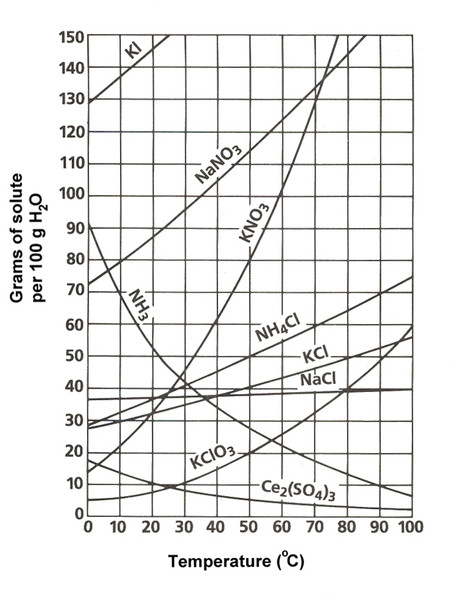
Typical solubility curves for common substances
Each line represents a different substance. To classify a solution at a given temperature:
- On the curve → saturated
- Below the curve → unsaturated
- Above the curve → supersaturated
Be ready to:
- Compare solubility at different temperatures
- Predict precipitation when temperature decreases
A classic test move is cooling a saturated solution and asking how much solid forms.
4. Factors That Affect Solubility
Temperature
Solids in liquids
- Usually: ↑ temperature → ↑ solubility
- Higher kinetic energy helps overcome solute-solute attractions.
Gases in liquids
- ↑ temperature → ↓ solubility
- Gas particles escape more easily.
This is why warm soda goes flat faster.
Pressure (gases only)
Increasing pressure increases gas solubility.
Conceptually related to Henry’s Law:
More pressure above the liquid forces more gas into solution.
Pressure has negligible effect on solids and liquids. That distinction shows up often in MCQs.
Nature of solute and solvent
This is the most important factor for this topic.
Solubility depends on whether solute-solvent interactions are comparable in strength to solute-solute and solvent-solvent interactions.
Lock this in:
- Ionic + polar → usually soluble
- Polar + polar → soluble
- Nonpolar + nonpolar → soluble
- Polar + nonpolar → generally insoluble
When you justify answers, always talk about specific intermolecular forces. Saying “like dissolves like” alone usually isn’t enough for full credit.
Key Takeaways
Solubility
The maximum amount of solute that dissolves in a given solvent under specific conditions.
Miscibility
The ability of two liquids to mix completely and form one homogeneous phase.
Saturated, Unsaturated, and Supersaturated Solutions
At maximum dissolved solute, below that amount, and above that amount in an unstable state, respectively.
Pressure and Gas Solubility
Increasing pressure increases the solubility of gases, but has little effect on solids or liquids.
Intermolecular Forces and Solubility
Solubility is greatest when solute-solvent attractions closely match or exceed particle-particle attractions.
Solubility Curve
A graph showing how a substance's solubility changes with temperature.
Notes
Solubility
The maximum amount of solute that dissolves in a given solvent under specific conditions.
Miscibility
The ability of two liquids to mix completely and form one homogeneous phase.
Saturated, Unsaturated, and Supersaturated Solutions
At maximum dissolved solute, below that amount, and above that amount in an unstable state, respectively.
Pressure and Gas Solubility
Increasing pressure increases the solubility of gases, but has little effect on solids or liquids.
Intermolecular Forces and Solubility
Solubility is greatest when solute-solvent attractions closely match or exceed particle-particle attractions.
Solubility Curve
A graph showing how a substance's solubility changes with temperature.
