Topic 4.4 Notes – Physical and Chemical Changes
What Makes a Change Chemical vs Physical
There are two main types of interactions:
- Intramolecular bonds
These are bonds within a substance.- Covalent bonds
- Ionic bonds
- Intermolecular forces (IMFs)
These are attractions between particles.- Hydrogen bonding
- Dipole-dipole forces
- London dispersion forces
- Ion-dipole forces
The classification rule:
- Chemical change → involves breaking and/or forming intramolecular bonds.
- Physical change → involves changes in intermolecular forces or particle arrangement only.
Connecting Macroscopic and Particulate Levels
On tests, you’re almost never done after saying “chemical” or “physical.” You need to explain why.
- Macroscopic level = what you observe (color change, solid forming, temperature change).
- Particulate level = what atoms, ions, or molecules are doing.
Strong AP-style reasoning sounds like:
A precipitate forms, which indicates new ionic bonds formed between ions, so the process is chemical.
The bond explanation is what earns the point.
Chemical Processes
A chemical process involves breaking and/or forming covalent or ionic bonds.
At the particle level:
- Atoms rearrange.
- Old bonds break.
- New bonds form.
- A new substance with new properties appears.
Common macroscopic evidence:
- Gas formation (not just boiling)
- Precipitate formation
- Unexpected color change
- Heat or light produced (like combustion)
Example:
When propane burns,
- C-H and O=O bonds break.
- C=O and O-H bonds form.
- Completely new substances form.
That is clearly chemical.
Energy changes do not determine the classification. Physical processes can also absorb or release energy.
Physical Processes
A physical process changes the form, phase, or arrangement of matter without changing chemical identity.
At the particle level:
- Molecules stay the same.
- Only IMFs are broken or formed.
- Particle spacing or motion changes.
Classic example: melting ice. The molecules are the same in all three phases. What changes is how closely they are packed and how strongly they interact.
In melting:
- Hydrogen bonds between water molecules are partially broken.
- The molecules themselves do not change.
- Still water → physical change.
Other examples:
- Boiling ethanol
- Crushing a crystal
- Mixing sand and sugar
Dissolution of Ionic Compounds
This is where students hesitate.
When dissolves in water:
- Ionic bonds in the crystal lattice are broken.
- Ion-dipole interactions form between ions and water.
The diagram shows a crystal breaking apart and an individual ion surrounded by water molecules in a hydration shell.
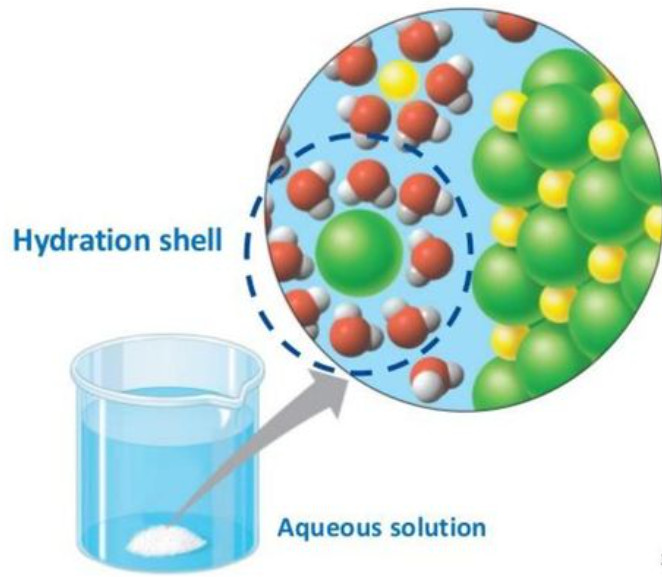
Hydration shell around an ion in aqueous solution
You are breaking chemical bonds in the solid, which sounds chemical. But:
- No new substance forms.
- The ions were already and .
- They are just separated and hydrated.
AP-level reasoning: this process is typically classified as physical, but you must justify it by discussing both the breaking of ionic bonds and formation of ion-dipole forces. The explanation matters more than the label.
Intramolecular Bonds vs Intermolecular Forces
| Feature | Intramolecular Bonds | Intermolecular Forces |
|---|---|---|
| Where they act | Within a compound | Between particles |
| Examples | Covalent, Ionic | H-bonding, Dipole-dipole, LDF, Ion-dipole |
| Relative strength | Strong | Weaker |
| Broken in | Chemical changes | Physical changes |
If a question mentions covalent bonds breaking, it’s chemical.
If it only mentions hydrogen bonding changing, it’s physical.
How to Justify Your Answer on a Test
When given a scenario:
- Identify what changes macroscopically.
- Ask what particles must be doing.
- State which interactions are broken and/or formed.
- Classify the process.
Example: A solid forms when two solutions mix.
That means ions combined to form a new ionic compound. New ionic bonds formed. That’s chemical.
Students often lose points by saying “a reaction happened” without mentioning bonds. Always bring it back to bond interactions.
Key Takeaways
Intramolecular Bonds
Bonds within a substance, such as covalent or ionic bonds between atoms or ions.
Intermolecular Forces
Attractions between separate particles, including hydrogen bonding, dipole forces, and dispersion forces.
Phase Change
A physical change between states of matter caused by changing intermolecular attractions.
Bond Breaking and Bond Formation
Reactants must break existing bonds and form new ones to rearrange into products.
Dissolution Of Salt In Water
An ambiguous process where ionic attractions break and ion-dipole interactions form in solution.
Ion-Dipole Interactions
Attractions between ions and polar molecules, such as dissolved ions and water molecules.
Reversibility Of Physical Changes
Many can be undone because the substance's chemical identity remains unchanged.
Chemical Vs. Physical Changes
Chemical changes alter intramolecular bonds, while physical changes mainly alter intermolecular attractions.
Notes
Intramolecular Bonds
Bonds within a substance, such as covalent or ionic bonds between atoms or ions.
Intermolecular Forces
Attractions between separate particles, including hydrogen bonding, dipole forces, and dispersion forces.
Phase Change
A physical change between states of matter caused by changing intermolecular attractions.
Bond Breaking and Bond Formation
Reactants must break existing bonds and form new ones to rearrange into products.
Dissolution Of Salt In Water
An ambiguous process where ionic attractions break and ion-dipole interactions form in solution.
Ion-Dipole Interactions
Attractions between ions and polar molecules, such as dissolved ions and water molecules.
Reversibility Of Physical Changes
Many can be undone because the substance's chemical identity remains unchanged.
Chemical Vs. Physical Changes
Chemical changes alter intramolecular bonds, while physical changes mainly alter intermolecular attractions.
