Topic 9.6 Notes – Free Energy of Dissolution
1. What Free Energy of Dissolution Is
When a salt dissolves, we ask one core question: Is the process thermodynamically favorable? That answer comes from Gibbs free energy.
- ΔG° < 0 → spontaneous → the substance dissolves (to some extent)
- ΔG° > 0 → nonspontaneous → essentially insoluble
- ΔH° = heat absorbed or released
- ΔS° = change in disorder
- T = temperature in Kelvin
Solubility depends on the combined effects of ΔH° and ΔS°. Large positive and negative contributions often nearly cancel, which is why predicting solubility can feel tricky.
2. The Three Energy Changes in Dissolution
When an ionic solid dissolves in water, three things happen at the same time. Seeing all three together helps you understand where ΔH° and ΔS° come from. The diagram shows and ions surrounded by water molecules in hydration shells.
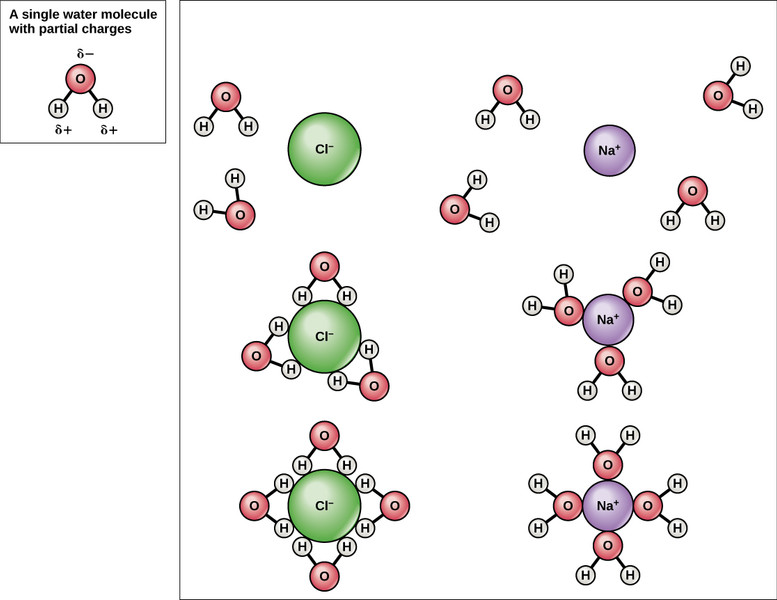
Hydration shells around Na+ and Cl− in water
a. Breaking the Lattice
Ions are pulled apart from the crystal.
- ΔH°: positive (energy required)
- ΔS°: positive (ordered solid → dispersed particles)
Stronger lattices mean:
- Smaller ions
- Higher charges like vs
- Strong electrostatic attraction
These salts are harder to dissolve.
b. Reorganizing the Solvent
Water molecules must separate to make room for ions.
- ΔH°: slightly positive
- ΔS°: negative (water becomes more ordered)
This step slightly opposes dissolution.
c. Hydration of Ions
Water surrounds ions with ion-dipole forces. Notice in the diagram that the oxygen ends of water point toward , and the hydrogen ends point toward .
- ΔH°: negative (energy released)
- ΔS°: usually negative (structured hydration shells)
Hydration is stronger for:
- Smaller ions
- Higher charges
Notice something important. Small, highly charged ions increase both lattice energy and hydration energy. That competition is why predictions are not obvious.
Overall:
3. Enthalpy of Dissolution
For ionic solids, we often simplify enthalpy to:
- Lattice energy → always positive
- Hydration energy → always negative
Two outcomes:
Exothermic Dissolution (ΔH° < 0)
Hydration outweighs lattice energy.
Solution warms.
Solubility often decreases as temperature increases.
Endothermic Dissolution (ΔH° > 0)
Lattice outweighs hydration.
Solution cools.
Solubility often increases as temperature increases.
Enthalpy alone does not decide solubility. Entropy and temperature can flip the outcome.
4. Entropy in Dissolution
Entropy measures overall disorder.
Two competing effects:
- Breaking a crystal → increases disorder
- Organizing water around ions → decreases disorder
Trends:
- Small, highly charged ions → strong hydration shells → more negative ΔS°
- Larger, lower-charge ions → smaller entropy decrease
For many salts, ΔS° is small. That means temperature becomes important because of the term.
5. How ΔH°, ΔS°, and Temperature Control Solubility
The signs of ΔH° and ΔS° determine temperature behavior.
| ΔH° | ΔS° | Spontaneity | Temperature Effect |
|---|---|---|---|
| − | + | Always spontaneous | Favorable at all T |
| − | − | Spontaneous at low T | Less soluble at high T |
| + | + | Spontaneous at high T | More soluble at high T |
| + | − | Never spontaneous | Insoluble at all T |
On tests, you’re often asked to justify why solubility increases or decreases with temperature. Tie it directly to the sign of ΔH° and how that affects ΔG° as T changes.
6. Why Predicting Solubility Is Hard
Here’s the part students underestimate.
- Lattice and hydration energies are both large and opposite in sign.
- Small changes in ion size or charge can flip ΔH°.
- Entropy effects may partially cancel too.
- Temperature multiplies ΔS°, so its impact grows at higher T.
On an FRQ, you usually aren’t calculating ΔG°. You’re explaining which factors increase or decrease it and comparing magnitudes qualitatively. If you clearly connect lattice strength, hydration strength, entropy change, and temperature to ΔG°, you earn the points.
Key Takeaways
Free Energy of Dissolution
The overall Gibbs free energy change when a solute dissolves in a solvent.
Lattice Enthalpy and Hydration Enthalpy
Lattice enthalpy is positive to separate ions; hydration enthalpy is negative when water surrounds ions.
Exothermic vs Endothermic Dissolution
Negative ΔH releases heat and warms solution; positive ΔH absorbs heat and cools solution.
Entropy Effects During Dissolution
Breaking a solid raises disorder, while forming organized solvent shells often lowers disorder.
Enthalpy-Entropy Scenarios for Solubility
Negative ΔH and positive ΔS always favor dissolving; positive ΔH and negative ΔS never do.
Temperature and Solubility
Higher temperature favors dissolution when ΔH is positive and disfavors it when ΔH is negative.
Ion Size and Charge Effects on Dissolution
Small, highly charged ions increase both lattice strength and hydration strength, creating competing effects.
Why Solubility Predictions Are Difficult
Large opposing enthalpy and entropy contributions often cancel, making overall free energy hard to predict.
Three Factors in Dissolution Free Energy
Lattice breaking, solvent reorganization, and solute-solvent interactions together determine overall dissolution free energy.
Enthalpy and Entropy of Dissolution
The overall heat and disorder changes together determine whether dissolving is thermodynamically favored.
Free Energy and Spontaneous Dissolution
Dissolving is thermodynamically favored when ΔG = ΔH - TΔS is negative.
Notes
Free Energy of Dissolution
The overall Gibbs free energy change when a solute dissolves in a solvent.
Lattice Enthalpy and Hydration Enthalpy
Lattice enthalpy is positive to separate ions; hydration enthalpy is negative when water surrounds ions.
Exothermic vs Endothermic Dissolution
Negative ΔH releases heat and warms solution; positive ΔH absorbs heat and cools solution.
Entropy Effects During Dissolution
Breaking a solid raises disorder, while forming organized solvent shells often lowers disorder.
Enthalpy-Entropy Scenarios for Solubility
Negative ΔH and positive ΔS always favor dissolving; positive ΔH and negative ΔS never do.
Temperature and Solubility
Higher temperature favors dissolution when ΔH is positive and disfavors it when ΔH is negative.
Ion Size and Charge Effects on Dissolution
Small, highly charged ions increase both lattice strength and hydration strength, creating competing effects.
Why Solubility Predictions Are Difficult
Large opposing enthalpy and entropy contributions often cancel, making overall free energy hard to predict.
Three Factors in Dissolution Free Energy
Lattice breaking, solvent reorganization, and solute-solvent interactions together determine overall dissolution free energy.
Enthalpy and Entropy of Dissolution
The overall heat and disorder changes together determine whether dissolving is thermodynamically favored.
Free Energy and Spontaneous Dissolution
Dissolving is thermodynamically favored when ΔG = ΔH - TΔS is negative.
