Topic 7.3 Notes – Reaction Quotient and Equilibrium Constant
1. The Reaction Quotient and the Equilibrium Constant
For a general reversible reaction:
the law of mass action gives this expression:
That structure never changes. What changes is which values you plug in.
- Equilibrium concentrations → this equals
- Concentrations at any time t → this equals
- For gases written with partial pressures → or
At equilibrium:
Think of it this way:
- Q = current ratio of products to reactants
- K = target ratio at equilibrium
Q moves toward K as the reaction shifts.
2. Writing Qc and Qp Correctly
General Forms
For
Concentration form (solutions):
Pressure form (gases only):
Rules you must follow every time:
- Products go on top.
- Reactants go on bottom.
- Coefficients become exponents.
- Use whatever values the problem gives you (initial, after disturbance, etc.).
The AP will not ask you to convert between and , but you do need to recognize whether concentrations or partial pressures are being used.
What Does NOT Appear in Q or K
Exclude:
- Pure solids (s)
- Pure liquids (l)
Their concentrations are constant, so they do not affect the ratio.
Include:
- Aqueous species (aq)
- Gases (g)
Example:
The solids disappear from the expression.
Students often lose easy points by including solids. If it says (s) or (l), leave it out.
3. Comparing Q and K to Predict Direction
This is the core skill.
After calculating Q, compare it to K.
| Comparison | Meaning | Shift |
|---|---|---|
| Too many reactants | Shifts right (makes products) | |
| At equilibrium | No net change | |
| Too many products | Shifts left (makes reactants) |
Another way to think about it:
- If Q is too small, the system makes more products.
- If Q is too big, the system makes more reactants.
4. Why the Reaction Shifts
Let’s say:
That means the numerator is too large. There are excess products.
The reaction consumes products and forms reactants.
Q decreases until .
If:
There are excess reactants.
The reaction forms more products.
Q increases until it equals K.
Here’s a simple visual way to remember it:
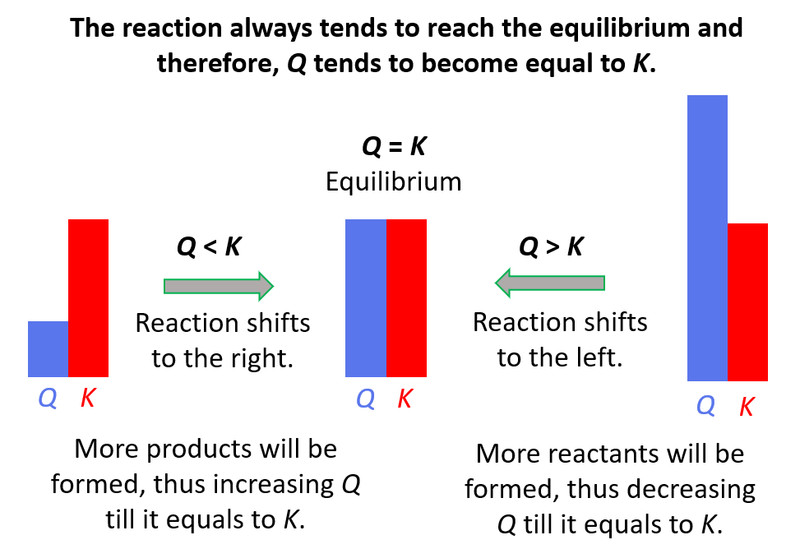
Comparing Q and K and the resulting shift in reaction direction
The system always adjusts to reach the equilibrium ratio, so Q moves toward K from either side.
5. Working Through a Q vs. K Problem
Example:
Given:
Step 1: Write Q
Step 2: Plug in
Step 3: Compare
So:
- Reaction shifts right
- More HI will form
Notice how mechanical this becomes once you write the expression correctly.
Common errors:
- Forgetting to square coefficients.
- Flipping numerator and denominator.
- Comparing backward (always write the inequality explicitly).
Key Takeaways
Qc and Qp
Qc uses molar concentrations; Qp uses gas partial pressures for the same reaction ratio.
Pure Solids and Pure Liquids in Q or K Expressions
They are omitted because their effective concentrations remain constant during the reaction.
Reaction Quotient (Q) and Equilibrium Constant (K)
One uses current concentrations or pressures, while the other uses equilibrium values only.
Comparing Q and K
Comparing these values predicts whether a reaction shifts left, right, or stays at equilibrium.
Writing Q and K Expressions
Write products over reactants, raise terms to coefficients, and omit pure solids and liquids.
Notes
Qc and Qp
Qc uses molar concentrations; Qp uses gas partial pressures for the same reaction ratio.
Pure Solids and Pure Liquids in Q or K Expressions
They are omitted because their effective concentrations remain constant during the reaction.
Reaction Quotient (Q) and Equilibrium Constant (K)
One uses current concentrations or pressures, while the other uses equilibrium values only.
Comparing Q and K
Comparing these values predicts whether a reaction shifts left, right, or stays at equilibrium.
Writing Q and K Expressions
Write products over reactants, raise terms to coefficients, and omit pure solids and liquids.
