Topic 3.7 Notes – Solutions and Mixtures
What Solutions Are
A solution is a homogeneous mixture. That means its macroscopic properties (color, density, concentration) are the same everywhere in the sample.
A heterogeneous mixture has visibly or measurably different regions. The properties depend on where you sample.
Here’s the visual difference:
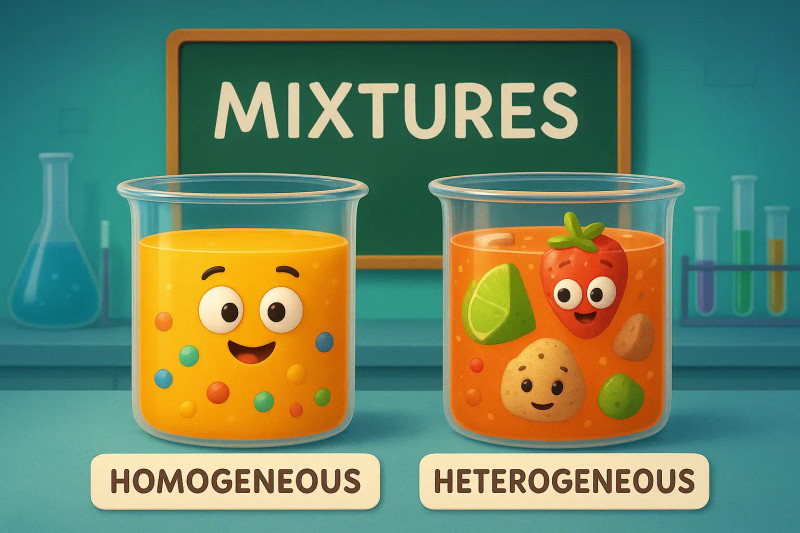
Homogeneous vs. heterogeneous mixtures
In the left beaker, the mixture looks uniform throughout. In the right beaker, you can clearly see different pieces and regions. If you scoop from the top or bottom of a homogeneous solution, you get the same composition. With a heterogeneous mixture, you might not.
Parts of a Solution
- Solute → the substance being dissolved (usually smaller amount)
- Solvent → the substance doing the dissolving (usually larger amount)
- Aqueous (aq) → solution where the solvent is water
Example: In , water is the solvent and sodium and chloride ions are the solute particles.
Solutions Can Exist in Any Phase
“Solution” does not mean liquid.
- Solid solutions → alloys like steel (iron + carbon)
- Liquid solutions → salt water, ethanol in water
- Gas solutions → air (mostly with , , etc.)
The key is uniform composition, not phase.
How Solutions Form at the Particle Level
When something dissolves, particles rearrange. Intermolecular forces (IMFs) are broken and formed.
Three energy-related steps happen:
- Separate solute particles (break solute-solute attractions)
- Separate solvent particles (break solvent-solvent attractions)
- Form solute-solvent attractions
This overall process is called solvation.
If the solvent is water, it’s called hydration.
For example, when dissolves:
- The ionic lattice is broken apart.
- Water molecules separate slightly.
- Water surrounds and ions.
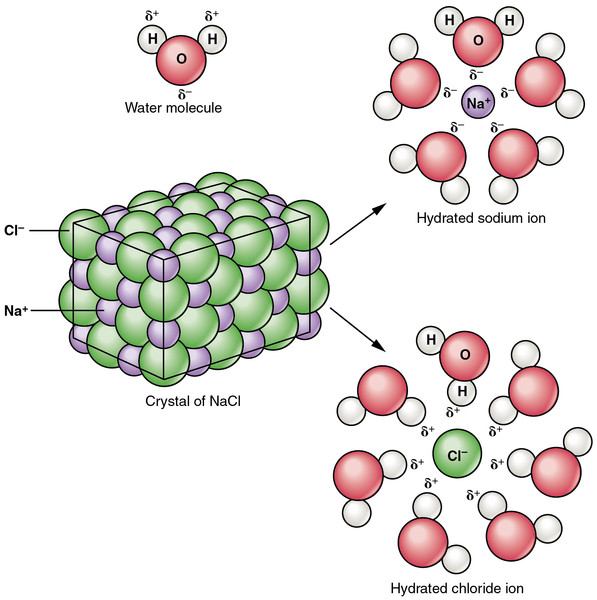
Hydration of NaCl in water
Notice the orientation of the water molecules. The partially negative oxygen atoms point toward , and the partially positive hydrogen atoms point toward . That orientation reflects ion-dipole attractions forming during hydration.
A solution forms when the new solute-solvent attractions are strong enough to compensate for what was broken. On exams, you’ll often explain dissolving in terms of IMF changes, not just “it mixes.”
Expressing Concentration with Molarity
Concentration tells you how much solute is present in a given amount of solution.
The main unit you need is molarity (M):
Units are mol/L.
Two details students miss:
- The numerator is moles of solute only.
- The denominator is total volume of the solution, not just solvent.
Rearranged Forms
Volume must be in liters.
Quick Example
Suppose you dissolve 0.75 mol of to make 0.300 L of solution.
If you were given 25.0 g instead, you would first convert grams → moles using molar mass.
Common mistakes I see:
- Forgetting to convert mL to L
- Plugging grams directly into the formula
- Using solvent volume instead of total solution volume
On free response, unit consistency is often where points are lost.
Dilution and the Relationship
Dilution lowers concentration by adding solvent.
The critical idea is this: moles of solute stay constant.
Since , then .
If no solute is added or removed:
- → initial
- → final
All volumes must use the same units.
Example
You have 0.800 M . You take 50.0 mL and dilute it to 200.0 mL. What is the new molarity?
Notice how concentration dropped because volume increased.
On tests, they love wording like “solution was diluted to a final volume of…” That phrase tells you which value is .
Key Takeaways
Homogeneous Mixture / Solution
A mixture with uniform composition whose macroscopic properties are the same throughout the sample.
Heterogeneous Mixture
A mixture with nonuniform composition whose macroscopic properties vary from one location to another.
Solute and Solvent
The dissolved substance is the solute, and the dissolving medium is the solvent.
Types of Solutions
Solutions can be solid, liquid, or gas, as long as composition is uniform throughout.
Aqueous
Dissolved in water, written as aq in a chemical equation.
Solvation and Hydration
Solvation is solvent attraction around solute particles; hydration is this process specifically in water.
Volume of Solution vs. Volume of Solvent
Molarity uses total solution volume, not just the volume of the solvent.
Dilution
Lowering concentration by adding solvent while keeping the amount of solute constant.
Dilution Equation
Use M1V1 = M2V2 because moles of solute stay constant during dilution.
Molarity
Moles of solute per liter of solution, used to calculate amount, volume, or concentration.
Notes
Homogeneous Mixture / Solution
A mixture with uniform composition whose macroscopic properties are the same throughout the sample.
Heterogeneous Mixture
A mixture with nonuniform composition whose macroscopic properties vary from one location to another.
Solute and Solvent
The dissolved substance is the solute, and the dissolving medium is the solvent.
Types of Solutions
Solutions can be solid, liquid, or gas, as long as composition is uniform throughout.
Aqueous
Dissolved in water, written as aq in a chemical equation.
Solvation and Hydration
Solvation is solvent attraction around solute particles; hydration is this process specifically in water.
Volume of Solution vs. Volume of Solvent
Molarity uses total solution volume, not just the volume of the solvent.
Dilution
Lowering concentration by adding solvent while keeping the amount of solute constant.
Dilution Equation
Use M1V1 = M2V2 because moles of solute stay constant during dilution.
Molarity
Moles of solute per liter of solution, used to calculate amount, volume, or concentration.
