Topic 2.7 Notes – VSEPR and Hybridization
1. What VSEPR and Hybridization Explain
Covalent bonds form when atomic orbitals overlap and electrons are shared. Those electron pairs repel each other because of Coulombic repulsion. VSEPR theory says electron domains arrange themselves to minimize that repulsion around a central atom.
To get the full picture, you combine:
- Lewis structure
- Shows connectivity
- Shows lone pairs
- Shows multiple bonds (bond order)
- VSEPR
- Predicts electron geometry (all electron domains)
- Predicts molecular geometry (positions of atoms only)
- Predicts approximate bond angles
- Hybridization
- Describes the arrangement of orbitals on the central atom
- Connects directly to ideal bond angles
- Limited to sp, sp², sp³ on the AP exam
From this chain, you should be able to determine:
- Molecular geometry
- Bond angles
- Bond order → relative bond length and bond energy
- Dipole moment (polar or nonpolar)
- Hybridization
Everything starts with a correct Lewis structure. If that’s wrong, everything downstream is wrong.
2. All Molecular Geometries You Need to Know
When you’re given a molecule, the logic always flows the same way:
- Draw the Lewis structure.
- Count electron domains around the central atom (bonding regions + lone pairs).
- A double or triple bond counts as one domain.
- Identify electron-domain geometry.
- Ignore lone pairs to name the molecular shape.
A. 2 Electron Domains
- Electron geometry: Linear
- Molecular shape: Linear (MX₂)
- Bond angle: 180°
- Hybridization: sp
Example:
B. 3 Electron Domains
- Electron geometry: Trigonal planar
| Formula | Shape | Angle | Hybridization |
|---|---|---|---|
| MX₃ | Trigonal planar | 120° | sp² |
| MX₂E | Bent | <120° | sp² |
Lone pairs repel more strongly than bonding pairs, so they compress bond angles.
C. 4 Electron Domains
- Electron geometry: Tetrahedral
| Formula | Shape | Angle | Hybridization |
|---|---|---|---|
| MX₄ | Tetrahedral | 109.5° | sp³ |
| MX₃E | Trigonal pyramidal | ~107° | sp³ |
| MX₂E₂ | Bent | ~104.5° | sp³ |
This is the family students mix up most. Remember: electron geometry stays tetrahedral even when the molecular shape changes.
D. 5 Electron Domains
- Electron geometry: Trigonal bipyramidal
- Angles: 90°, 120°, 180°
Lone pairs prefer equatorial positions because that creates fewer 90° repulsions. In the trigonal bipyramidal row of the chart below, notice the three equatorial positions in one plane and the two axial positions above and below.
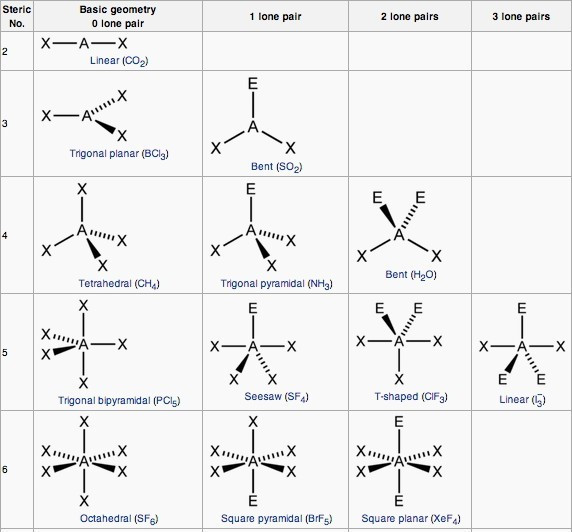
VSEPR molecular geometry summary chart
| Formula | Shape |
|---|---|
| MX₅ | Trigonal bipyramidal |
| MX₄E | Seesaw |
| MX₃E₂ | T-shaped |
| MX₂E₃ | Linear |
You only need the shapes. Hybridization with d orbitals is not tested.
E. 6 Electron Domains
- Electron geometry: Octahedral
- Angles: 90°
| Formula | Shape |
|---|---|
| MX₆ | Octahedral |
| MX₅E | Square pyramidal |
| MX₄E₂ | Square planar |
When there are two lone pairs, they sit opposite each other to minimize repulsion.
3. Sigma and Pi Bonds and Bond Order
Bond formation happens by orbital overlap.
Sigma (σ) Bonds
- Head-on overlap
- Stronger overlap → higher bond energy
- Every single bond is 1 σ
- Allows rotation
Pi (π) Bonds
- Side-by-side p orbital overlap
- Weaker than σ
- Prevents rotation
Bond composition:
- Single = 1σ
- Double = 1σ + 1π
- Triple = 1σ + 2π
The diagram below shows head-on overlap forming σ bonds on the left and side-by-side p orbital overlap forming a π bond on the right.
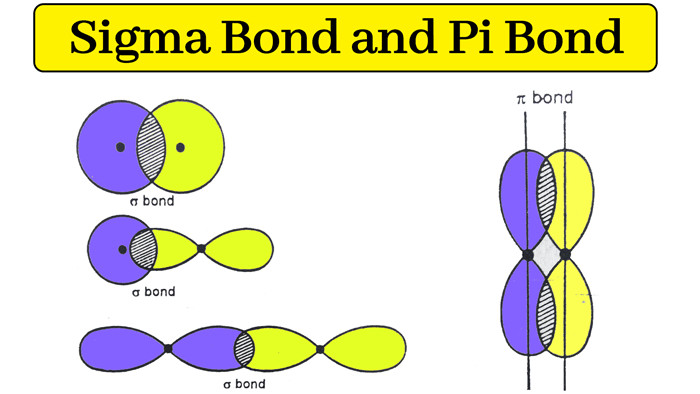
Sigma vs. pi orbital overlap
Important trends:
- Higher bond order → shorter bond length
- Higher bond order → greater bond energy
- π bonds create rigidity → geometric (cis/trans) isomers
On tests, they love asking which C-C bond is shortest. Triple wins every time.
4. Hybridization and Bond Angles
Hybridization matches the number of electron domains:
| Hybridization | Domains | Geometry | Ideal Angle |
|---|---|---|---|
| sp | 2 | Linear | 180° |
| sp² | 3 | Trigonal planar | 120° |
| sp³ | 4 | Tetrahedral | 109.5° |
Count domains. That number gives you hybridization.
Lone pairs change molecular shape, but hybridization depends on total domains.
5. Bond Length, Bond Energy, and Dipole Moment
Bond Length
Depends on:
- Bond order
- Triple < Double < Single
- Atomic radius
- Larger atoms → longer bonds
- Down a group → bonds get longer
If bond order is the same, compare atomic size.
Dipole Moment
A molecule is polar if bond dipoles do not cancel.
Think in three steps:
- Identify polar bonds (electronegativity difference).
- Determine molecular geometry.
- Add dipoles as vectors.
The diagram below compares a linear molecule, CO₂, with a bent molecule, H₂O.
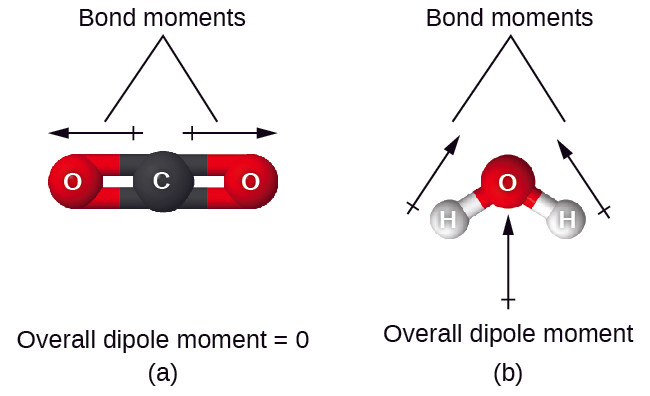
Dipole cancellation in CO₂ vs. net dipole in H₂O
CO₂ is linear, so the two C=O bond dipoles are equal and opposite and cancel. H₂O is bent, so the O-H bond dipoles add to produce a net dipole.
Symmetry cancels dipoles. Lone pairs often create asymmetry.
Linear with identical outer atoms is nonpolar. Bent and trigonal pyramidal are usually polar.
Key Takeaways
VSEPR Theory
Electron pairs arrange around a central atom to minimize Coulombic repulsion.
How To Determine Molecular Geometry
Draw the Lewis structure, count electron domains, find electron geometry, then ignore lone pairs for shape.
Electron Domains
Regions of electron density around a central atom, including bonds and lone pairs.
AXE Notation
A formula where A is central atom, X is bonded atoms, and E is lone pairs.
Electron-Domain Geometry Vs. Molecular Geometry
Electron geometry includes all domains; molecular geometry describes only atom positions.
Common VSEPR Shapes and Bond Angles
Linear 180°, trigonal planar 120°, bent <120° or <109.5°, tetrahedral 109.5°, trigonal pyramidal ~107°, trigonal bipyramidal 90°/120°/180°, seesaw distorted, T-shaped ~90°, octahedral 90°, square pyramidal <90°, square planar 90°.
Lone Pair Repulsion
Nonbonding pairs repel more strongly than bonding pairs and compress bond angles.
Octahedral Electron Geometry
Six electron domains arranged symmetrically with 90° angles between adjacent positions.
Hybridization
Mixing of valence orbitals to form equivalent orbitals that match electron-domain geometry.
Sp, Sp2, And Sp3 Hybridization
sp gives linear 180°, sp2 gives trigonal planar 120°, sp3 gives tetrahedral 109.5°.
Sigma And Pi Bonds
Sigma bonds form by head-on overlap; pi bonds form by sideways overlap of parallel p orbitals.
Single, Double, And Triple Bonds
Single bonds are 1σ, double bonds are 1σ+1π, and triple bonds are 1σ+2π.
Sigma Vs. Pi Bond Strength
Head-on overlap is stronger than sideways overlap, so sigma bonds have greater bond energy.
Bond Order, Bond Length, And Bond Energy
Higher bond order gives shorter, stronger bonds; lower bond order gives longer, weaker bonds.
Atomic Radius And Bond Length
For similar bond orders, larger bonded atoms form longer bonds than smaller atoms.
Resonance And Equal Bond Lengths
Delocalized bonding can make multiple bonds equivalent, giving the same intermediate bond length.
Counting Sigma And Pi Bonds
Count one sigma in every bond, then add one pi for each double and two for each triple.
Trigonal Bipyramidal Geometry
Five electron domains form three equatorial and two axial positions, with lone pairs equatorial first.
Molecular Polarity And Dipole Moment
A molecule is polar when polar bond dipoles do not cancel because of its geometry.
Pi Bonds And Geometric Isomerism
Pi bonds restrict rotation, allowing cis-trans isomers with different spatial arrangements across double bonds.
Bond Polarity
Unequal electron sharing in a bond caused by a difference in electronegativity.
Notes
VSEPR Theory
Electron pairs arrange around a central atom to minimize Coulombic repulsion.
How To Determine Molecular Geometry
Draw the Lewis structure, count electron domains, find electron geometry, then ignore lone pairs for shape.
Electron Domains
Regions of electron density around a central atom, including bonds and lone pairs.
AXE Notation
A formula where A is central atom, X is bonded atoms, and E is lone pairs.
Electron-Domain Geometry Vs. Molecular Geometry
Electron geometry includes all domains; molecular geometry describes only atom positions.
Common VSEPR Shapes and Bond Angles
Linear 180°, trigonal planar 120°, bent <120° or <109.5°, tetrahedral 109.5°, trigonal pyramidal ~107°, trigonal bipyramidal 90°/120°/180°, seesaw distorted, T-shaped ~90°, octahedral 90°, square pyramidal <90°, square planar 90°.
Lone Pair Repulsion
Nonbonding pairs repel more strongly than bonding pairs and compress bond angles.
Octahedral Electron Geometry
Six electron domains arranged symmetrically with 90° angles between adjacent positions.
Hybridization
Mixing of valence orbitals to form equivalent orbitals that match electron-domain geometry.
Sp, Sp2, And Sp3 Hybridization
sp gives linear 180°, sp2 gives trigonal planar 120°, sp3 gives tetrahedral 109.5°.
Sigma And Pi Bonds
Sigma bonds form by head-on overlap; pi bonds form by sideways overlap of parallel p orbitals.
Single, Double, And Triple Bonds
Single bonds are 1σ, double bonds are 1σ+1π, and triple bonds are 1σ+2π.
Sigma Vs. Pi Bond Strength
Head-on overlap is stronger than sideways overlap, so sigma bonds have greater bond energy.
Bond Order, Bond Length, And Bond Energy
Higher bond order gives shorter, stronger bonds; lower bond order gives longer, weaker bonds.
Atomic Radius And Bond Length
For similar bond orders, larger bonded atoms form longer bonds than smaller atoms.
Resonance And Equal Bond Lengths
Delocalized bonding can make multiple bonds equivalent, giving the same intermediate bond length.
Counting Sigma And Pi Bonds
Count one sigma in every bond, then add one pi for each double and two for each triple.
Trigonal Bipyramidal Geometry
Five electron domains form three equatorial and two axial positions, with lone pairs equatorial first.
Molecular Polarity And Dipole Moment
A molecule is polar when polar bond dipoles do not cancel because of its geometry.
Pi Bonds And Geometric Isomerism
Pi bonds restrict rotation, allowing cis-trans isomers with different spatial arrangements across double bonds.
Bond Polarity
Unequal electron sharing in a bond caused by a difference in electronegativity.
