Topic 7.10 Notes – Reaction Quotient and Le Châtelier’s Principle
1. What Q and K Represent
For a general reversible reaction:
the equilibrium constant is
For gases, you might see , which uses partial pressures instead of concentrations.
The reaction quotient, Q, has the exact same mathematical form.
The difference is timing:
- K uses equilibrium concentrations or pressures.
- Q uses concentrations or pressures at any moment.
That’s it. Same equation. Different data.
What Q tells you
- If → the system is at equilibrium.
- If → the reaction will shift forward (toward products).
- If → the reaction will shift reverse (toward reactants).
Why? Because equilibrium is defined as the state where that ratio equals K. If it doesn’t match, the system changes concentrations until it does.
On tests, they often give you initial concentrations after a disturbance and ask for direction only. You calculate Q and compare. No ICE table needed if you’re only predicting direction.
2. Comparing Q and K to Predict Direction
Here’s the logic laid out clearly:
| Comparison | What It Means | How System Responds |
|---|---|---|
| Q < K | Too few products (numerator too small) | Shifts right → makes more products |
| Q > K | Too many products (numerator too large) | Shifts left → makes more reactants |
| Q = K | Ratio is correct | No net change |
A quick example:
Suppose , and you calculate .
Since , the reaction shifts right. More forms.
The reaction always moves in whatever direction makes Q move toward K. That single sentence explains Le Châtelier’s Principle mathematically.
3. How Concentration and Pressure Disturb Equilibrium
A disturbance changes Q, not K (as long as temperature stays constant). Once Q changes, the system shifts until Q = K again.
A. Changes in Concentration
Because Q is a ratio of products over reactants:
- Add reactant → denominator increases → Q decreases → shift right
- Add product → numerator increases → Q increases → shift left
- Remove reactant → denominator decreases → Q increases → shift left
- Remove product → numerator decreases → Q decreases → shift right
K does not change.
A common trap on multiple choice: adding a solid or pure liquid does nothing if it’s not in the expression. Only species in the equilibrium expression affect Q.
B. Changes in Pressure (Gases Only)
For gases, use .
If volume decreases, total pressure increases, and all partial pressures increase proportionally.
Whether Q increases or decreases depends on the total moles of gas on each side.
Rule to remember:
- Increase pressure → shift toward fewer moles of gas
- Decrease pressure → shift toward more moles of gas
Here’s why. Suppose pressure doubles. Each partial pressure doubles, but they’re raised to their coefficients. The side with the larger total exponent (more gas moles) changes Q more. The diagram below shows two common cases you’ll see on exams.
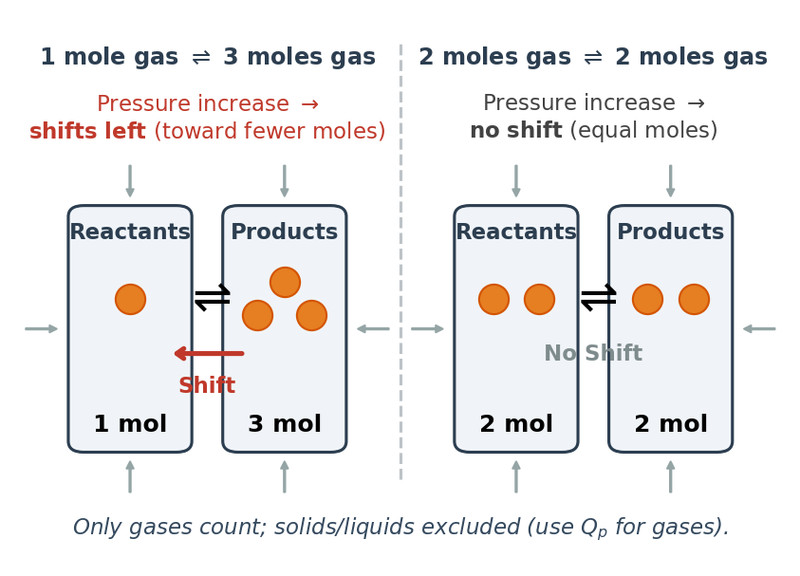
Pressure changes and moles of gas at equilibrium
On the left, increasing pressure shifts the system toward the side with fewer gas particles. On the right, both sides have the same total moles of gas, so there is no shift.
Important details:
- Only gases count.
- Solids and liquids are excluded.
- Equal moles of gas on both sides → no shift with pressure change.
Again, K stays constant.
4. Temperature Is the Exception
Temperature is different because it changes K itself.
K is temperature dependent. When temperature changes, the numerical value of K changes.
Think of heat as part of the reaction.
Exothermic (heat released)
Heat acts like a product.
- Increase temperature → K decreases → shift left
- Decrease temperature → K increases → shift right
Endothermic (heat absorbed)
Heat acts like a reactant.
- Increase temperature → K increases → shift right
- Decrease temperature → K decreases → shift left
What’s happening underneath: temperature changes the value of K, and the system shifts until Q equals the new K.
If you remember nothing else:
- Concentration or pressure change → Q changes
- Temperature change → K changes
- The system always adjusts until
Key Takeaways
Concentration Changes and Q
Adding products increases Q, while adding reactants decreases Q, with K unchanged at constant temperature.
Q vs. K and Direction of Shift
Same expression form; comparing current and equilibrium values predicts the shift direction.
Disturbance and Reestablishment of Equilibrium
A stress makes Q differ from K, so the system shifts until they are equal again.
Qp and Pressure Shifts
Uses partial pressures and stoichiometric exponents to predict pressure-driven shifts in gas equilibria.
Temperature Changes and K
Changing temperature changes the equilibrium constant, unlike concentration or pressure stresses.
Notes
Concentration Changes and Q
Adding products increases Q, while adding reactants decreases Q, with K unchanged at constant temperature.
Q vs. K and Direction of Shift
Same expression form; comparing current and equilibrium values predicts the shift direction.
Disturbance and Reestablishment of Equilibrium
A stress makes Q differ from K, so the system shifts until they are equal again.
Qp and Pressure Shifts
Uses partial pressures and stoichiometric exponents to predict pressure-driven shifts in gas equilibria.
Temperature Changes and K
Changing temperature changes the equilibrium constant, unlike concentration or pressure stresses.
