Topic 6.7 Notes – Bond Enthalpies
1. Bond Energy and Potential Energy
At the particle level, a chemical reaction is just atoms rearranging. That rearrangement always involves breaking old bonds and forming new bonds.
Breaking vs. forming bonds
- Breaking bonds requires energy
You must input energy to overcome the electrostatic attraction between nuclei and shared electrons.
→ This is an endothermic step. - Forming bonds releases energy
When atoms bond, they move to a lower potential energy state. The excess energy is released.
→ This is an exothermic step.
Here’s what that looks like in terms of potential energy for two hydrogen atoms as their distance changes:
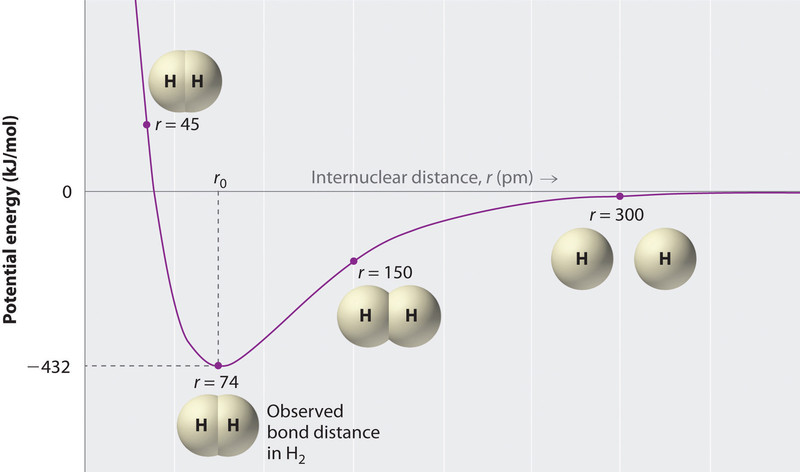
Potential energy vs. internuclear distance for H2
- The minimum point on the curve is the most stable distance between the two atoms, often labeled the equilibrium bond length.
- The depth of the well represents the bond energy, the energy required to separate the atoms completely.
- The deeper the well, the stronger the bond.
Overall reaction enthalpy
Whether a reaction is exothermic or endothermic depends on the balance:
- If energy released forming product bonds > energy absorbed breaking reactant bonds
→ (exothermic) - If energy absorbed breaking bonds > energy released forming bonds
→ (endothermic)
This idea shows up constantly in FRQs where you must justify the sign of ΔH in terms of bond energies.
2. Bond Dissociation Energy and What Affects It
What bond dissociation energy means
Bond dissociation energy (BDE) is the energy required to break one mole of a specific bond in the gas phase.
- Units: usually kJ/mol
- It’s an average value across many compounds.
- Higher BDE → stronger bond.
- Lower BDE → weaker bond.
“Gas phase” matters because intermolecular forces would otherwise affect the measurement.
Factors that affect bond strength
Bond order
- Triple > double > single (in strength and BDE)
- More shared electrons = stronger attraction.
Example: has a much higher BDE than .
Bond length
- Shorter bond → stronger → higher BDE
- Longer bond → weaker → lower BDE
Atoms held closer together experience stronger electrostatic attraction.
Students often mix this up. If a bond is strong, it is short and has a large BDE.
3. Calculating ΔH Using Bond Energies
Every reaction can be treated as:
- Break all bonds in reactants.
- Form all bonds in products.
The formula is:
Think broken − formed.
Step-by-step example
Consider:
1. Identify bonds broken
- 1 H-H
- 1 Cl-Cl
2. Identify bonds formed
- 2 H-Cl
3. Insert BDE values (example values)
- H-H = 436 kJ/mol
- Cl-Cl = 243 kJ/mol
- H-Cl = 431 kJ/mol
Negative → exothermic. More energy was released forming H-Cl bonds than was absorbed breaking H-H and Cl-Cl.
Common traps
- Forgetting to multiply by the number of bonds.
- Missing double or triple bonds because you didn’t draw the structure.
- Reversing the formula. It is broken − formed, which is different from the enthalpy of formation method.
On multiple choice, they love giving structural formulas so you must count bonds carefully.
4. Why Bond Enthalpy Calculations Are Estimates
Bond energies are averages taken from many different molecules.
The strength of a C-H bond in methane is slightly different from a C-H bond in ethanol. When you use tabulated BDE values, you’re using an average.
So:
- Calculated ΔH from BDEs = approximation
- Experimental ΔH (from calorimetry or formation data) = more accurate
If your calculated value is close but not exact, that’s expected.
Key Takeaways
Bond Order and Bond Strength
Triple bonds are strongest, double bonds intermediate, and single bonds weakest, with increasing bond enthalpy.
Bond Length and Bond Strength
Shorter bonds are generally stronger and have higher bond enthalpies than longer, weaker bonds.
Counting Bonds in a Reaction
Draw reactant and product structures, count each bond type, then apply the bond enthalpy equation.
Average Bond Enthalpy
The average energy needed to break one mole of a specific gas-phase bond.
Bond Energy and Potential Energy
Breaking bonds absorbs energy, while forming bonds releases energy as potential energy decreases.
Reaction Enthalpy from Bond Energies
Subtract bond energies of bonds formed from bonds broken to estimate reaction enthalpy.
Notes
Bond Order and Bond Strength
Triple bonds are strongest, double bonds intermediate, and single bonds weakest, with increasing bond enthalpy.
Bond Length and Bond Strength
Shorter bonds are generally stronger and have higher bond enthalpies than longer, weaker bonds.
Counting Bonds in a Reaction
Draw reactant and product structures, count each bond type, then apply the bond enthalpy equation.
Average Bond Enthalpy
The average energy needed to break one mole of a specific gas-phase bond.
Bond Energy and Potential Energy
Breaking bonds absorbs energy, while forming bonds releases energy as potential energy decreases.
Reaction Enthalpy from Bond Energies
Subtract bond energies of bonds formed from bonds broken to estimate reaction enthalpy.
