Topic 4.7 Notes – Types of Chemical Reactions
1. The Three Reaction Types You Must Be Able to Identify
All reactions in this topic come down to one question: What is actually moving between species?
Acid-Base Reactions
An acid-base reaction involves the transfer of one or more protons, H⁺, from one species to another.
- One species donates H⁺ (acid).
- One species accepts H⁺ (base).
- Often forms water when reacts with .
Example:
What’s happening at the particle level?
No electrons are transferred. Oxidation numbers stay the same.
What to look for
- explicitly written
- Formation of
- Acid and base reacting in solution
If oxidation numbers don’t change and you see proton movement, it’s acid-base.
Oxidation-Reduction Reactions
A redox reaction involves the transfer of electrons. You detect this by tracking oxidation numbers.
- Oxidation = increase in oxidation number (loss of electrons)
- Reduction = decrease in oxidation number (gain of electrons)
- Electrons flow from the oxidized species to the reduced species
Example:
- Mg: (oxidation)
- H: (reduction)
Oxidation numbers changed, so this is redox.
Combustion Is a Type of Redox
Combustion reactions involve reaction with .
For hydrocarbons:
Carbon’s oxidation number increases, oxygen’s decreases. Always redox.
On tests, if you see as a reactant, your redox radar should go off.
Precipitation Reactions
A precipitation reaction happens when two aqueous ionic solutions mix and form an insoluble solid.
Example:
is the solid precipitate.
At the particle level:
No proton transfer. No electron transfer. Just ions rearranging.
What to look for
- Two aqueous ionic reactants
- A product labeled (s)
- Double replacement pattern
2. Assigning Oxidation Numbers to Identify Redox
Oxidation numbers are your fastest tool for spotting redox.
Rules You Must Know
- Elemental form →
- Monatomic ion → equals its charge
- Oxygen → usually (except peroxides = )
- Hydrogen → usually (except metal hydrides = )
- Sum of oxidation numbers = overall charge
How to Use Them
- Assign oxidation numbers to all atoms in reactants.
- Do the same for products.
- Compare.
If any element changes oxidation number, it’s redox.
If nothing changes, it’s not redox.
Example:
- Al: (oxidized)
- Cu: (reduced)
Electrons moved. That’s the defining feature.
You don’t need to know the terms “oxidizing agent” or “reducing agent” for the AP exam, but you do need to know who gained and lost electrons.
3. How to Recognize a Precipitation Reaction Quickly
You are only responsible for these guaranteed soluble ions:
- , ,
Salts containing these are always soluble in water. They will not form precipitates.
If one product lacks these and is labeled (s), that’s your precipitate.
Writing the Net Ionic Equation
Example:
Step 1: Dissociate soluble compounds
Step 2: Cancel spectator ions
Spectator ions appear unchanged on both sides.
On FRQs, missing phases (aq, s, l) costs points. Always include them.
4. What’s Happening at the Particle Level
Here’s the clean mental model. The diagram below shows a precipitation reaction at the particle level, with , , , and ions before mixing and solid forming after:
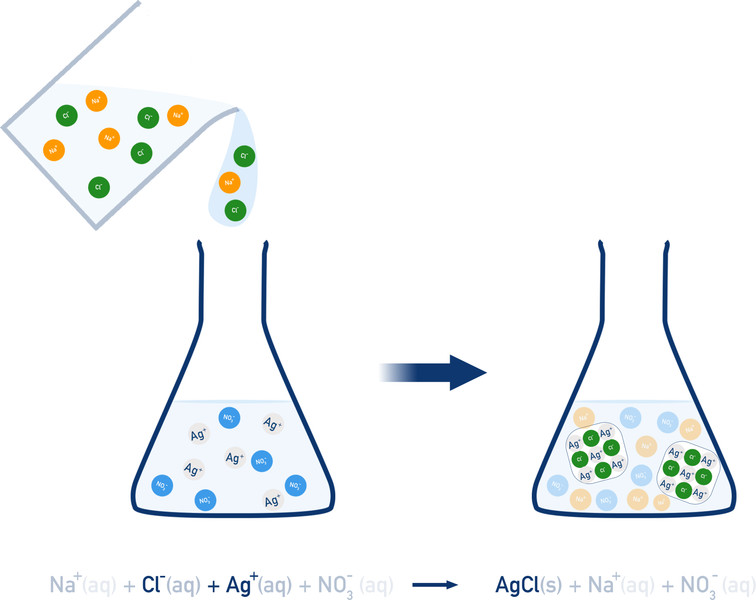
Particle-level view of an AgCl precipitation reaction
- Acid-Base → proton transfer
- Redox → electron transfer
- Precipitation → solid lattice forms from aqueous ions
No reaction in this topic fits more than one of these at the same time in AP-level questions.
5. Fast Identification Strategy
When you see a reaction:
- Check oxidation numbers.
- If they change → redox.
- If not, look for transfer or formation.
- If yes → acid-base.
- If two aqueous ionic solutions form a solid → precipitation.
This order prevents mislabeling acid-base reactions as redox.
Key Takeaways
Acid-Base Reaction
A reaction in which one species transfers one or more protons to another.
Oxidation and Reduction
Oxidation is loss of electrons; reduction is gain of electrons.
Oxidation Numbers
Assigned charges used to track electron transfer and identify oxidation and reduction in reactions.
Common Oxidation Number Rules
Elements alone are 0; O is usually -2, H usually +1; totals equal species charge.
Combustion Reaction
A redox reaction in which a substance reacts with O2; hydrocarbons completely form CO2 and H2O.
Always Soluble Ions and Salts
All sodium, potassium, ammonium, and nitrate salts are soluble in water.
Net Ionic Equation
An equation showing only species that actually change, with spectator ions omitted.
Spectator Ions
Ions present in solution that do not participate in the overall chemical change.
Oxidation-Reduction Reaction / Redox Reaction
A reaction where electrons transfer from one species to another, changing oxidation numbers.
Precipitation Reaction and Precipitate
A reaction in aqueous solution that forms an insoluble ionic solid called a precipitate.
Notes
Acid-Base Reaction
A reaction in which one species transfers one or more protons to another.
Oxidation and Reduction
Oxidation is loss of electrons; reduction is gain of electrons.
Oxidation Numbers
Assigned charges used to track electron transfer and identify oxidation and reduction in reactions.
Common Oxidation Number Rules
Elements alone are 0; O is usually -2, H usually +1; totals equal species charge.
Combustion Reaction
A redox reaction in which a substance reacts with O2; hydrocarbons completely form CO2 and H2O.
Always Soluble Ions and Salts
All sodium, potassium, ammonium, and nitrate salts are soluble in water.
Net Ionic Equation
An equation showing only species that actually change, with spectator ions omitted.
Spectator Ions
Ions present in solution that do not participate in the overall chemical change.
Oxidation-Reduction Reaction / Redox Reaction
A reaction where electrons transfer from one species to another, changing oxidation numbers.
Precipitation Reaction and Precipitate
A reaction in aqueous solution that forms an insoluble ionic solid called a precipitate.
