Topic 9.11 Notes – Electrolysis and Faraday’s Law
1. Electrolytic Cells and Nonspontaneous Redox
An electrolytic cell uses electrical energy to force a nonspontaneous redox reaction.
If a reaction has , it will not run on its own. A battery supplies the energy needed to push electrons in the “uphill” direction.
Two rules never change:
- Oxidation happens at the anode
- Reduction happens at the cathode
That’s true for every electrochemical cell.
What changes in electrolysis is why electrons move. The battery pulls electrons away from the anode and pushes them to the cathode.
What you physically observe:
- Anode
- Oxidation
- Often loses mass (metal → metal ion + e⁻)
- Cathode
- Reduction
- Often gains mass (metal ion + e⁻ → metal)
If copper ions are reduced at the cathode:
Solid copper plates onto the electrode and its mass increases.
That mass change is exactly what Faraday’s Law lets you calculate.
2. Galvanic vs. Electrolytic Cells
Seeing them side-by-side helps lock it in.
| Feature | Galvanic (Voltaic) | Electrolytic |
|---|---|---|
| Spontaneity | Spontaneous | Nonspontaneous |
| Positive | Negative | |
| Energy conversion | Chemical → electrical | Electrical → chemical |
| Power source | None | External battery |
| Anode | Oxidation | Oxidation |
| Cathode | Reduction | Reduction |
Notice what does not change:
AN OX, RED CAT always works.
In free-response questions, they love flipping a familiar galvanic reaction and asking you about the electrolytic version. Make sure you’re analyzing the forced direction, not the spontaneous reverse.
3. Faraday’s Law and the Charge-Mass Relationship
Electricity is just moving electrons. Faraday’s Law connects that electron flow to chemical change.
Start with the definition of current:
- = current (amps)
- = charge (coulombs)
- = time (seconds)
- 1 amp = 1 coulomb/second
Then connect charge to moles of electrons:
That number is Faraday’s constant.
The amount of substance produced at an electrode depends directly on the total charge passed.
More charge → more electrons → more product.
Everything flows through moles of electrons.
4. The Electrolysis Calculation Roadmap
All electrolysis problems follow the same logic chain.
Keep this roadmap in mind as you move through any calculation:
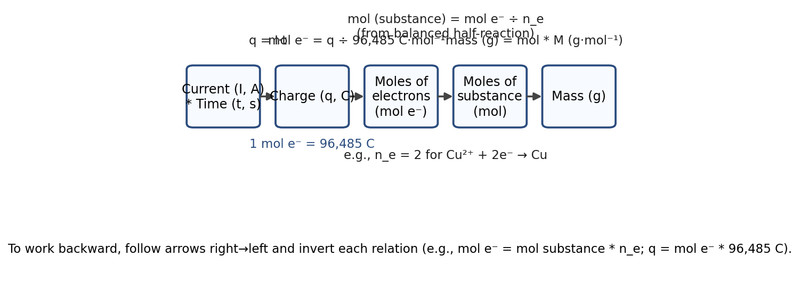
Electrolysis calculation roadmap
Forward direction (given current and time)
- Convert time to seconds.
- Find charge using .
- Convert coulombs → moles of electrons.
- Use the balanced half-reaction to relate mol e⁻ to mol substance.
- Convert moles → grams.
Quick example:
A 3.0 A current runs for 200 s.
If reducing :
- 1 mol e⁻ : 1 mol Ag
- 0.00622 mol Ag formed
- Multiply by 107.9 g/mol to get mass
Working backward
If you’re given mass and asked for time or current:
Mass → mol substance → mol e⁻ → coulombs → use
Just reverse the chain.
5. Electron Stoichiometry Controls Everything
The balanced half-reaction determines the answer.
Example patterns:
The coefficient on electrons tells you how many moles of e⁻ are needed per mole of metal.
If 3 electrons are required instead of 1:
- The same charge produces one-third as many moles of metal.
What increases product?
- Larger current
- Longer time
What decreases product for a fixed charge?
- Larger electron coefficient in the half-reaction
Common mistakes I see every year:
- Forgetting to convert minutes to seconds
- Skipping the electron-to-substance ratio
- Using molar mass before going through moles of electrons
Keep the pathway clean and unit-driven. Units should cancel perfectly at each step.
Key Takeaways
Electrolytic Cell
An electrochemical cell that uses external electrical energy to drive a nonspontaneous redox reaction.
Galvanic Cell vs. Electrolytic Cell
Galvanic cells are spontaneous and produce electricity; electrolytic cells are nonspontaneous and require electricity.
Anode and Cathode in Any Electrochemical Cell
Oxidation always occurs at the anode, and reduction always occurs at the cathode.
Electrode Mass Changes During Electrolysis
The anode loses mass as oxidation occurs, and the cathode gains mass as reduction deposits material.
Minimum External Voltage for Electrolysis
The applied voltage must exceed the magnitude of the negative cell potential to force the reaction.
Faraday's Law
The amount of substance produced or consumed is proportional to the total charge passed.
Current-Charge-Time Relationship
Current equals charge divided by time, with I = q/t.
Ampere
A unit of current equal to one coulomb of charge passing per second.
Electrolysis Stoichiometry
Use balanced half-reactions to relate moles of electrons to moles of substance produced or consumed.
Faraday Constant
One mole of electrons carries 96485 coulombs, linking charge to electron moles.
Electrolysis Calculation Chain
Use unit conversions among amps, seconds, coulombs, electrons, moles, and grams.
Notes
Electrolytic Cell
An electrochemical cell that uses external electrical energy to drive a nonspontaneous redox reaction.
Galvanic Cell vs. Electrolytic Cell
Galvanic cells are spontaneous and produce electricity; electrolytic cells are nonspontaneous and require electricity.
Anode and Cathode in Any Electrochemical Cell
Oxidation always occurs at the anode, and reduction always occurs at the cathode.
Electrode Mass Changes During Electrolysis
The anode loses mass as oxidation occurs, and the cathode gains mass as reduction deposits material.
Minimum External Voltage for Electrolysis
The applied voltage must exceed the magnitude of the negative cell potential to force the reaction.
Faraday's Law
The amount of substance produced or consumed is proportional to the total charge passed.
Current-Charge-Time Relationship
Current equals charge divided by time, with I = q/t.
Ampere
A unit of current equal to one coulomb of charge passing per second.
Electrolysis Stoichiometry
Use balanced half-reactions to relate moles of electrons to moles of substance produced or consumed.
Faraday Constant
One mole of electrons carries 96485 coulombs, linking charge to electron moles.
Electrolysis Calculation Chain
Use unit conversions among amps, seconds, coulombs, electrons, moles, and grams.
