Topic 4.6 Notes – Introduction to Titration
1. What a Titration Is
A titration is a controlled reaction used to determine the amount or concentration of an analyte (unknown solution) by reacting it with a titrant (known concentration).
For this to work, the reaction must:
- Be specific (only reacts with what you care about)
- Go to completion (no partial reaction at equivalence)
Key Terms You Must Know
- Analyte: unknown solution, usually in the flask
- Titrant: known solution, delivered from a burette
- Burette: long, graduated tube that measures volume very precisely
- Molarity (M):
Everything flows through this idea:
Titrations are mole problems disguised as lab procedures.
If you can track moles using the balanced equation, you can solve it.
2. Types of Titrations
AP Chemistry emphasizes acid-base titrations, but you should recognize the broader categories.
Acid-Base Titrations (Most Tested)
Based on Brønsted-Lowry theory:
- Acid = proton donor
- Base = proton acceptor
Typical reaction:
At equivalence, the acid and base have reacted in the correct stoichiometric ratio.
Common scenarios you’ll see later in Unit 4:
- Strong acid + strong base
- Weak acid + strong base
- Weak base + strong acid
Other Types (Know What They Are)
- Redox titrations → based on electron transfer
- Precipitation titrations → form insoluble solid
- Complexation titrations → form complex ions (often metal ions)
You don’t calculate these differently at this level. The same mole logic applies.
3. Equivalence Point vs Endpoint
Students mix these up constantly.
Equivalence Point
This is the stoichiometric completion point.
- Moles of titrant added = moles of analyte reacted
- Determined using the balanced equation
- Reaction is complete
For a 1:1 reaction:
If the equation shows a 1:2 ratio:
The coefficients matter. The AP loves giving reactions that are not 1:1 to see if you’re awake.
Endpoint
This is the observable signal that tells you to stop.
- Usually a color change (indicator)
- Happens experimentally
- Should be very close to equivalence
Here’s the distinction clearly:
| Equivalence Point | Endpoint |
|---|---|
| Defined by stoichiometry | Defined by observation |
| Theoretical value | Experimental signal |
| Exact mole ratio satisfied | Indicator changes color |
Good indicator choice makes them almost coincide.
4. Identifying the Equivalence Point in Calculations
This is what shows up on quizzes and MCQs.
The Process
Write the balanced equation
Example:
Calculate moles of titrant added
Suppose 0.150 M NaOH and 0.0200 L used:
Use mole ratio
2 mol NaOH react with 1 mol H₂SO₄:
Solve for unknown concentration
If analyte volume was 0.0250 L:
Notice: Volumes are not equal at equivalence. Moles are.
5. Titration Curves and What They Show
A titration curve graphs pH vs volume of titrant added. The example below shows a strong acid titrated with a strong base.
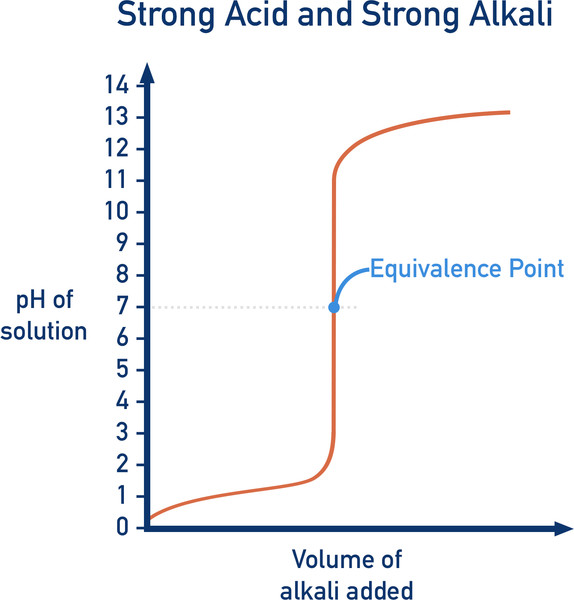
Strong acid-strong base titration curve
Three regions matter:
Initial region
At the start of the curve, the pH is determined only by the analyte in the flask.Steep vertical region
This sharp rise contains the equivalence point. The midpoint of the vertical jump, labeled near pH 7 here, is the equivalence point.After equivalence
Past the vertical jump, the pH is controlled by excess titrant.
Important patterns:
- Strong acid + strong base → equivalence at pH = 7
- Weak acid + strong base → equivalence > 7
- Weak base + strong acid → equivalence < 7
Even if you haven’t mastered weak acid math yet, you should recognize the direction of the shift.
Key Takeaways
Titration
An experimental method that determines an unknown concentration using a reacting solution of known concentration.
Titrant
The solution of known concentration added to react completely with the substance being measured.
Analyte / Titrand
The solution of unknown concentration whose amount or concentration is determined in the procedure.
Indicator
A substance that changes color over a certain pH range to signal the endpoint.
Acid-Base Titration
A titration in which an acid and base react quantitatively to determine an unknown concentration.
Titration Curve
A graph of solution pH versus volume of titrant added during the procedure.
Inflection Point on a Titration Curve
The point of greatest slope change on the curve, corresponding to the equivalence point.
Equivalence Point and Endpoint
One is stoichiometric completion, while the other is the observable change used to detect it.
Titration Stoichiometry
At equivalence, use mole ratios and measured volumes to relate titrant and analyte amounts.
Notes
Titration
An experimental method that determines an unknown concentration using a reacting solution of known concentration.
Titrant
The solution of known concentration added to react completely with the substance being measured.
Analyte / Titrand
The solution of unknown concentration whose amount or concentration is determined in the procedure.
Indicator
A substance that changes color over a certain pH range to signal the endpoint.
Acid-Base Titration
A titration in which an acid and base react quantitatively to determine an unknown concentration.
Titration Curve
A graph of solution pH versus volume of titrant added during the procedure.
Inflection Point on a Titration Curve
The point of greatest slope change on the curve, corresponding to the equivalence point.
Equivalence Point and Endpoint
One is stoichiometric completion, while the other is the observable change used to detect it.
Titration Stoichiometry
At equivalence, use mole ratios and measured volumes to relate titrant and analyte amounts.
