Topic 5.3 Notes – Concentration Changes Over Time
1. Integrated Rate Laws and What They Tell You
A rate law tells you how fast a reaction is happening at a specific moment. An integrated rate law tells you how the concentration of a reactant changes over time.
It connects:
- Initial concentration,
- Concentration at time ,
- Time,
- Rate constant,
On the AP exam, you only deal with zeroth, first, and second order reactions. You don’t derive these equations. You recognize them and use them.
Each order:
- Has a different integrated equation
- Gives a different linear graph
- Has different units for
- Has different half-life behavior
Seeing all three side by side helps the patterns stick.
2. The Three Reaction Orders and Their Equations
a. Zeroth Order
Rate law:
The rate does not depend on concentration.
Integrated rate law:
Rearranged:
That looks like , which tells you the graph is linear.
Linear graph:
Plot [A] vs time
- Straight line
- Slope =
- Intercept =
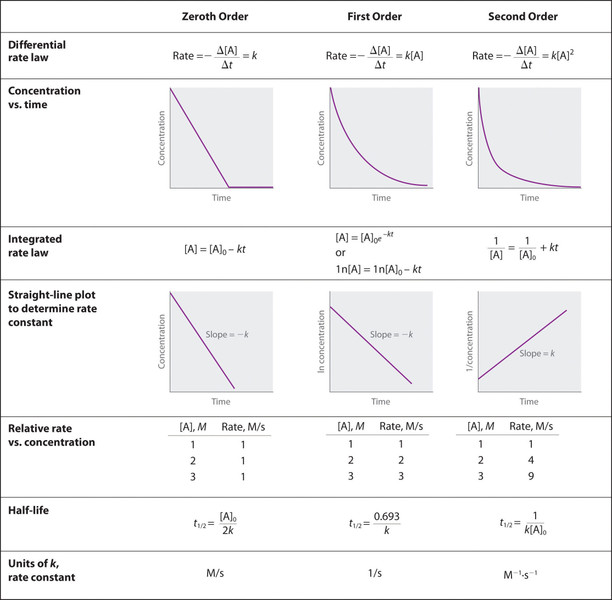
Zeroth-order concentration and rate vs. time
Half-life:
It depends on the starting concentration, so it changes.
Units of : M·s⁻¹
Often seen in surface-catalyzed reactions when the surface is saturated.
b. First Order
Rate law:
Integrated rate law:
Often written:
Linear graph:
Plot ln[A] vs time
- Straight line
- Slope =
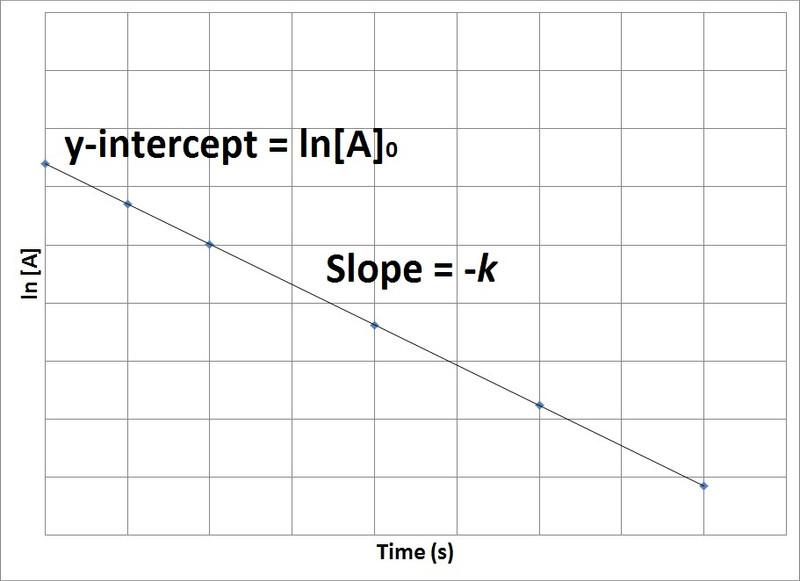
First-order ln[A] vs. time plot
If you instead plot [A] vs time, you get a curved exponential decay.
Half-life:
This is huge. It is:
- Constant
- Independent of initial concentration
- Given on the AP formula sheet
Units of : s⁻¹
When a problem says the half-life stays the same no matter how much you start with, it’s first order.
c. Second Order
Rate law:
Integrated rate law:
Linear graph:
Plot 1/[A] vs time
- Straight line
- Slope = (positive!)
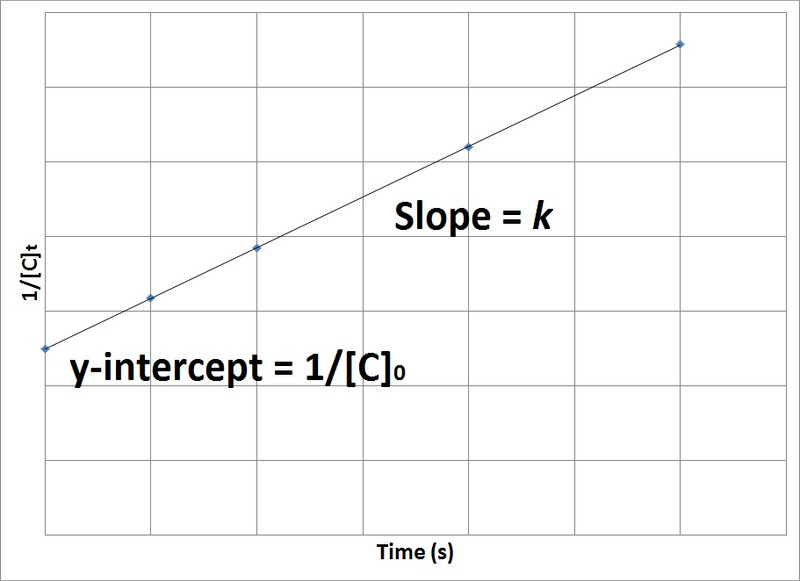
Second-order 1/[A] vs. time plot
If you plot [A] vs time, it curves downward steeply at first and then levels off.
Half-life:
Not constant. It gets longer as concentration decreases.
Units of : M⁻¹·s⁻¹
Reaction Order Summary
| Order | Linear Plot | Slope | Units of k | Half-Life |
|---|---|---|---|---|
| 0 | [A] vs t | -k | M·s⁻¹ | Depends on [A]₀ |
| 1 | ln[A] vs t | -k | s⁻¹ | Constant |
| 2 | 1/[A] vs t | +k | M⁻¹·s⁻¹ | Not constant |
If you memorize the pattern of the linear plots and slopes, most questions become mechanical.
3. Determining Reaction Order from Graphs
On FRQs, you’re often given concentration data and asked to justify the order.
Here’s what you actually do:
- Make three plots:
- vs
- vs
- vs
- See which one is a straight line.
- Match it:
- Linear [A] → zeroth
- Linear ln[A] → first
- Linear 1/[A] → second
- Use slope to get .
If the slope is −0.045 s⁻¹ from a ln[A] vs time graph, then . Don’t forget units.
AP graders look for you to explicitly say that the relationship is linear, not just name the order.
4. Half-Life and Why First Order Is Special
Half-life is the time required for concentration to drop to half its value.
Only first-order reactions have a constant half-life:
If 100% → 50% in 10 s, then:
- 50% → 25% also 10 s
- 25% → 12.5% also 10 s
That repeating halving is a strong clue.
Zeroth and second order reactions do not behave this way.
5. Radioactive Decay as First-Order Kinetics
Radioactive decay follows:
where is number of radioactive nuclei.
Key features:
- Decay rate depends only on amount present
- Each isotope has a fixed half-life
- Half-life never changes
Carbon-14 dating works because the half-life is constant. That’s pure first-order behavior.
If you see constant half-life in a nuclear context, think first order immediately.
Key Takeaways
Zeroth-, First-, and Second-Order Integrated Rate Laws
Zeroth: [A]t - [A]0 = -kt; first: ln[A]t - ln[A]0 = -kt; second: 1/[A]t - 1/[A]0 = kt.
Half-Life in First-Order Reactions
The time for concentration to halve, constant for first-order reactions, with t1/2 = 0.693/k.
Radioactive Decay as First-Order Kinetics
Unstable nuclei decay at a rate proportional to the amount present, giving a constant half-life.
Integrated Rate Law Plots
[A] vs t, ln[A] vs t, and 1/[A] vs t identify order and slope gives k.
Notes
Zeroth-, First-, and Second-Order Integrated Rate Laws
Zeroth: [A]t - [A]0 = -kt; first: ln[A]t - ln[A]0 = -kt; second: 1/[A]t - 1/[A]0 = kt.
Half-Life in First-Order Reactions
The time for concentration to halve, constant for first-order reactions, with t1/2 = 0.693/k.
Radioactive Decay as First-Order Kinetics
Unstable nuclei decay at a rate proportional to the amount present, giving a constant half-life.
Integrated Rate Law Plots
[A] vs t, ln[A] vs t, and 1/[A] vs t identify order and slope gives k.
