Topic 7.2 Notes – Direction of Reversible Reactions
1. Reversible Reactions and Dynamic Equilibrium
A reversible reaction can go forward and backward:
- Forward reaction:
- Reverse reaction:
- Both happen at the same time in a closed system.
At the beginning, only reactant might be present, so the forward rate is high and the reverse rate is low. As product forms, the reverse rate increases.
Dynamic Equilibrium
A system reaches dynamic equilibrium when:
- Concentrations stop changing
- Particles are still reacting in both directions
“Dynamic” means motion is still happening. Molecules keep colliding and reacting. There’s just no net change in concentration.
The graphs below show how concentration, reaction rate, and partial pressure change over time as a system approaches equilibrium.
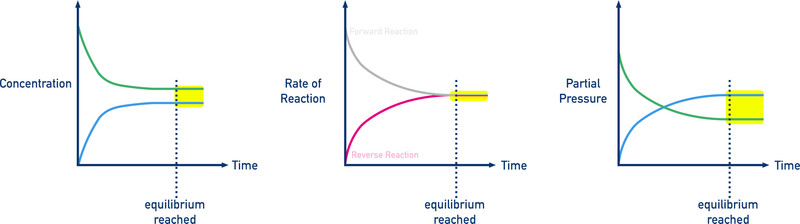
Concentration, rate, and partial pressure vs. time at equilibrium
Notice that in each panel, the curves eventually level off. In the middle graph, the forward and reverse rates become equal. On an AP question, flat concentration lines mean the system is at equilibrium, even though reactions are still occurring.
2. Relative Rates Determine Net Direction
When we talk about the “direction” of a reversible reaction, we mean the net change in concentration at that moment.
Three possible situations exist:
| Relative Rates | What Happens to Concentrations | Net Direction |
|---|---|---|
| Forward rate > Reverse rate | Reactants decrease, products increase | Toward products |
| Reverse rate > Forward rate | Products decrease, reactants increase | Toward reactants |
| Forward rate = Reverse rate | No net change | Equilibrium |
This is the core relationship you’re expected to explain clearly.
If the forward rate is greater, more product is being formed per second than is being converted back. That gives a net conversion of reactants to products.
If the reverse rate is greater, the opposite happens.
FRQs love wording like “justify the direction of net reaction.” The scoring point comes from explicitly comparing the two rates and stating the resulting net change.
3. Product-Favored vs Reactant-Favored
Once equilibrium is reached, one side may have more particles than the other.
Product-favored
- At equilibrium,
- Equilibrium position lies to the right
- The reaction proceeds relatively far forward before rates become equal
Reactant-favored
- At equilibrium,
- Equilibrium position lies to the left
- Reverse rate catches up quickly
Every reversible reaction produces some amount of both sides. “Favored” only refers to relative amounts at equilibrium, not whether a reaction happens at all.
4. The Equilibrium Constant K
The equilibrium constant connects directly to this idea:
This expression uses equilibrium concentrations (with appropriate powers from coefficients, which you’ll practice more in the next topics).
Interpreting K
- → products favored
- → reactants favored
- → comparable amounts of both
For example, if a reaction has , the numerator must be much larger than the denominator at equilibrium. That means a lot more product than reactant.
If , equilibrium heavily favors reactants.
Important connection:
- Rates determine how you get to equilibrium.
- K describes where you end up.
Students often mix this up. A large does not mean a fast reaction. Speed comes from kinetics, not equilibrium position.
You’ll also see this idea in acid-base chemistry. A larger means more formed at equilibrium, so the acid is stronger because equilibrium lies farther toward products.
5. Why This Matters
This rate comparison idea is the foundation for everything else in Unit 7.
When concentration changes, you’ll predict direction by asking which rate becomes temporarily larger. When comparing reactions, you’ll use to decide which side is favored.
If you can clearly state:
- which rate is larger
- what that does to concentrations
- and when equilibrium is reached
you’re thinking exactly the way the AP exam expects.
Key Takeaways
Reversible Reaction
A reaction that can proceed in both forward and reverse directions.
Dynamic Equilibrium
A state where forward and reverse reactions continue at equal rates, so concentrations stay constant.
Product-Favored Vs Reactant-Favored
Product-favored means equilibrium contains more products; reactant-favored means it contains more reactants.
Equilibrium Constant And Favored Direction
K > 1 means product-favored, K < 1 means reactant-favored, and K = 1 means similar amounts.
Relative Size Of K
Larger K values mean reactions proceed farther toward products than smaller K values do.
Rate And Concentration Graphs At Equilibrium
Rates become equal over time, while reactant and product concentrations level off and remain constant.
Relative Reaction Rates And Net Direction
Whichever reaction rate is greater determines the net change toward products or reactants.
Notes
Reversible Reaction
A reaction that can proceed in both forward and reverse directions.
Dynamic Equilibrium
A state where forward and reverse reactions continue at equal rates, so concentrations stay constant.
Product-Favored Vs Reactant-Favored
Product-favored means equilibrium contains more products; reactant-favored means it contains more reactants.
Equilibrium Constant And Favored Direction
K > 1 means product-favored, K < 1 means reactant-favored, and K = 1 means similar amounts.
Relative Size Of K
Larger K values mean reactions proceed farther toward products than smaller K values do.
Rate And Concentration Graphs At Equilibrium
Rates become equal over time, while reactant and product concentrations level off and remain constant.
Relative Reaction Rates And Net Direction
Whichever reaction rate is greater determines the net change toward products or reactants.
