Topic 7.7 Notes – Calculating Equilibrium Concentrations
1. Dynamic Equilibrium and the Role of K
At dynamic equilibrium, the forward and reverse reactions are happening at the same rate. Concentrations stop changing, but particles are still reacting.
The equilibrium constant tells you the ratio of products to reactants at equilibrium.
For a general reaction:
The equilibrium expression is:
Key details you must remember:
- Use for concentrations (M), for partial pressures (atm).
- Only gases and aqueous species go into the expression.
- Skip solids and pure liquids.
- Coefficients become exponents.
Interpreting K
- → mostly products at equilibrium.
- → mostly reactants.
- only changes if temperature changes.
When you calculate equilibrium concentrations, you’re finding the values that satisfy this ratio.
2. Using Q to Predict the Direction of Change
Before doing any algebra, check which way the reaction will shift.
The reaction quotient uses the same expression as , but with current (usually initial) values.
Compare to :
- → shifts right (makes products)
- → shifts left (makes reactants)
- → already at equilibrium
This determines the signs in your ICE table.
A common trap on tests: products are already present initially. If you skip calculating , you might assume the reaction shifts right when it actually shifts left.
3. The ICE Table Setup
ICE stands for Initial, Change, Equilibrium.
Here’s the general structure, shown for the reaction :
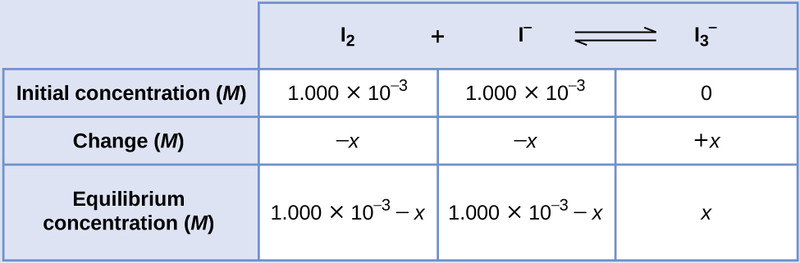
Example ICE table for
Initial row
- Write given concentrations or pressures.
- If a species isn’t present initially, write 0.
Change row
- Use to represent change.
- Reactants decrease.
- Products increase.
- Multiply by coefficients.
Equilibrium row
Add Initial + Change.
These expressions go into the equation.
4. Solving for Equilibrium Concentrations
Let’s walk through the structure using:
Suppose initial , others are 0.
Step-by-step
-
Write K expression
-
Set up ICE
- Initial: 0.80, 0, 0
- Change: −x, +x, +x
- Equilibrium: 0.80 − x, x, x
-
Substitute into K
When K Is Small
Here, is small. That means very little product forms.
So
Now check the 5% rule:
That’s greater than 5%, so technically you’d need the quadratic. On the AP exam, they often choose numbers that pass the 5% rule cleanly.
The 5% Rule
You may approximate only if:
Important:
- You can only eliminate when it’s added to or subtracted from a large number.
- Never drop terms like . That destroys the equation.
5. Special Situations to Watch For
Non-zero Initial Products
If products are present initially:
- Calculate .
- Reaction might shift left.
- That means reactants increase and products decrease in the Change row.
Sign mistakes here are one of the most common quiz errors.
Using Partial Pressures
For gases:
- Use
- ICE table uses atm
- Math is identical.
Checking Your Answer
At equilibrium:
- All concentrations must be positive.
- Values must match the size of .
- Small → mostly reactants.
- Large → mostly products.
If your answer contradicts what suggests, something went wrong in setup.
Key Takeaways
ICE Table / RICE Table
A setup listing initial, change, and equilibrium amounts to solve for unknown equilibrium concentrations.
Initial, Change, Equilibrium Rows
Initial lists starting amounts, change uses stoichiometric x values, and equilibrium combines initial plus change.
Stoichiometric X Relationships In ICE Tables
Species change by coefficient multiples of x, with reactants negative and products positive.
Reaction Quotient Compared With Equilibrium Constant
If Q < K products form, if Q > K reactants form, and if Q = K equilibrium exists.
Dynamic Equilibrium
Forward and reverse reactions occur at equal rates, so concentrations remain constant.
Equilibrium Constant Expression With ICE Values
Substitute equilibrium concentrations or partial pressures from the table into the K expression.
Solving For X In Equilibrium Problems
Use the K equation after substitution, then solve algebraically for the unknown change variable.
Equilibrium Concentrations Vs Partial Pressures
Use molar concentrations for Kc problems and partial pressures for Kp problems.
Given And Zero Initial Values In ICE Tables
Use provided starting amounts, and assign zero to species not initially present unless stated otherwise.
5% Approximation In Equilibrium Problems
Treat a ± x term as constant when x causes less than 5% error.
Notes
ICE Table / RICE Table
A setup listing initial, change, and equilibrium amounts to solve for unknown equilibrium concentrations.
Initial, Change, Equilibrium Rows
Initial lists starting amounts, change uses stoichiometric x values, and equilibrium combines initial plus change.
Stoichiometric X Relationships In ICE Tables
Species change by coefficient multiples of x, with reactants negative and products positive.
Reaction Quotient Compared With Equilibrium Constant
If Q < K products form, if Q > K reactants form, and if Q = K equilibrium exists.
Dynamic Equilibrium
Forward and reverse reactions occur at equal rates, so concentrations remain constant.
Equilibrium Constant Expression With ICE Values
Substitute equilibrium concentrations or partial pressures from the table into the K expression.
Solving For X In Equilibrium Problems
Use the K equation after substitution, then solve algebraically for the unknown change variable.
Equilibrium Concentrations Vs Partial Pressures
Use molar concentrations for Kc problems and partial pressures for Kp problems.
Given And Zero Initial Values In ICE Tables
Use provided starting amounts, and assign zero to species not initially present unless stated otherwise.
5% Approximation In Equilibrium Problems
Treat a ± x term as constant when x causes less than 5% error.
