Topic 4.3 Notes – Representations of Reactions
1. Chemical Equations as Particle Accounting
A balanced chemical equation is a bookkeeping system for atoms. It follows the law of conservation of mass, which says atoms are rearranged in a reaction, not created or destroyed.
Take this reaction:
That equation tells you:
- Ratios of particles (moles): 2 molecules of react with 1 molecule of .
- Atom conservation: 4 H atoms and 2 O atoms on both sides.
- Bond changes: H-H and O=O bonds break; O-H bonds form.
- Physical states: (g), (l), (s), (aq) tell you how particles exist.
Important reminders:
- Coefficients change amounts. Subscripts change identity.
is two nitrogen dioxide molecules.
is a different compound. - Coefficients represent the simplest whole-number ratio.
- If the equation is unbalanced, any diagram based on it will also violate conservation.
That’s why balancing comes first.
2. Types of Reaction Representations
These all describe the same reaction, just at different levels.
Molecular Equation
Shows all compounds intact, including states.
Example:
This gives the full picture of reactants and products.
Complete Ionic Equation
Break strong electrolytes (aq) into ions. Leave solids, liquids, and gases intact.
Now you see every particle in solution.
Net Ionic Equation
Remove spectator ions (unchanged on both sides).
This shows what actually changed.
If every ion stays dissolved and unchanged, you write no reaction. That shows up often in multiple choice.
Particulate Model
A diagram that shows:
- Atoms as spheres
- Molecules as bonded spheres
- Ions separated (with charges if shown)
- Correct particle counts
Here’s what the precipitation reaction above would look like before and after at the particle level:
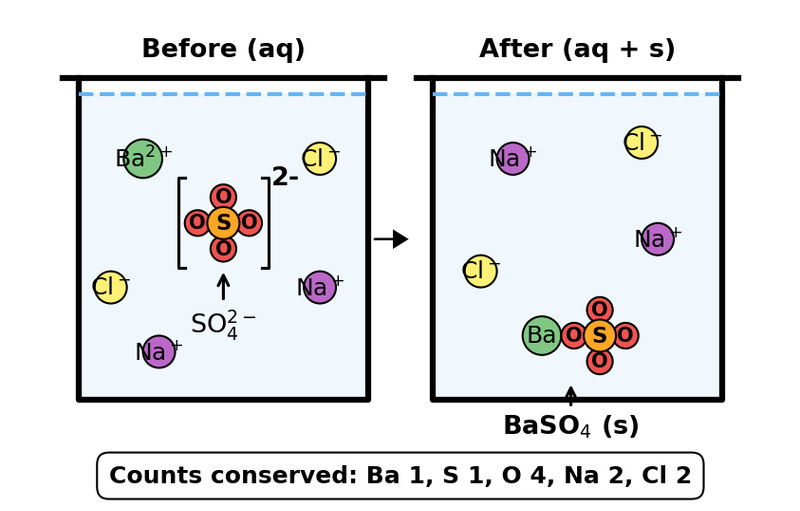
Particulate view of a precipitation reaction forming BaSO4(s)
Notice that and come together to form the solid at the bottom, while and remain dispersed in solution. Those are the spectator ions.
3. How to Balance Chemical Equations
Balancing is systematic, not guessing.
- Check if already balanced.
- Balance elements in only one compound per side.
- Balance elements appearing in multiple compounds.
- Leave H and O for last (usually).
- Recount everything.
- Reduce to lowest whole-number ratio.
Example:
Balance C → 3
Balance H → 4
Now count O: O atoms → 5
Final:
Common patterns:
- Diatomic elements:
- Combustion: hydrocarbon + → +
For AP free response, always double-check atom counts before moving on.
4. Translating Between Equations and Particles
This is the heart of 4.3.
From Equation to Diagram
If you have:
Your drawing must show:
- 2 separate NO molecules
- 1 O₂ molecule
- After reaction: 2 NO₂ molecules
- Same total N and O atoms before and after
That is exactly what the particulate diagram below represents: two NO molecules and one O₂ molecule before collision, rearranging into two NO₂ molecules with atom counts conserved.

Particulate representation of 2NO(g) + O₂(g) → 2NO₂(g)
For aqueous ionic reactions, separate strong electrolytes into ions in the drawing.
From Diagram to Equation
- Count each type of particle.
- Identify what bonds changed.
- Write correct formulas.
- Add states.
- Reduce coefficients.
AP trick: diagrams often show multiple “sets.” If you see 4 identical reaction events, divide to lowest whole-number ratio before writing the equation.
5. Physical vs Chemical Changes
Not every diagram shows a reaction.
Chemical Change
- Bonds break/form
- New substances appear
- Atom rearrangement
Example: gas bubbles forming or a solid precipitating.
Physical Process
Particle identity stays the same.
Dissolving :
- Crystal lattice breaks apart
- and separate
- Charges stay the same
- Ions disperse in water
No new substance formed. Just separated particles.
On exams, students often call dissolving a “reaction.” It isn’t unless a new substance forms.
6. Common AP Mistakes
- Changing subscripts instead of coefficients
- Forgetting diatomic elements
- Drawing intact ionic compounds in aqueous solution
- Not conserving atoms in diagrams
- Forgetting to reduce coefficients
If the particle count in your diagram doesn’t match the equation exactly, something is wrong.
Key Takeaways
Coefficients Vs. Subscripts
Coefficients change particle amounts; subscripts change a substance's identity and composition.
States Of Matter In Equations
Symbols like s, l, g, and aq show each substance's physical state in a reaction.
Representing Atoms, Molecules, And Ions
Atoms are single spheres, molecules are bonded groups, and ions carry charges.
Formula Units In Ionic Compounds
The lowest whole-number ratio of ions in an ionic compound, not a discrete molecule.
Proper Bonding And Separation In Particle Diagrams
Bonded atoms should be connected, while separate ions or unbonded particles should be drawn apart.
Balanced Chemical Equation
A reaction written with whole-number coefficients so each element has equal atoms on both sides.
Particulate Model
A particle-level drawing made from a balanced equation showing the correct particles before and after.
Law Of Conservation Of Mass
Matter is conserved, so each element must have the same number of atoms before and after.
Physical Processes And Chemical Reactions
Physical changes keep particle identity the same, while chemical changes rearrange atoms into new substances.
Spectator Ion
An ion present in solution that does not change during the reaction.
Notes
Coefficients Vs. Subscripts
Coefficients change particle amounts; subscripts change a substance's identity and composition.
States Of Matter In Equations
Symbols like s, l, g, and aq show each substance's physical state in a reaction.
Representing Atoms, Molecules, And Ions
Atoms are single spheres, molecules are bonded groups, and ions carry charges.
Formula Units In Ionic Compounds
The lowest whole-number ratio of ions in an ionic compound, not a discrete molecule.
Proper Bonding And Separation In Particle Diagrams
Bonded atoms should be connected, while separate ions or unbonded particles should be drawn apart.
Balanced Chemical Equation
A reaction written with whole-number coefficients so each element has equal atoms on both sides.
Particulate Model
A particle-level drawing made from a balanced equation showing the correct particles before and after.
Law Of Conservation Of Mass
Matter is conserved, so each element must have the same number of atoms before and after.
Physical Processes And Chemical Reactions
Physical changes keep particle identity the same, while chemical changes rearrange atoms into new substances.
Spectator Ion
An ion present in solution that does not change during the reaction.
